

Unlock Premium Content – For just $0.39/day ($12/month) or $0.27/day ($100/year)!
🔗 Portfolio Corner - 🗓️ Monthly Updates (Last Update: 28-Jul-2026)

The debate around this VMS holdings ecosystem has shifted quickly and furiously recently. A year ago, most of the conversation started to fly around AI disruption, Software disintermediation and whether LLMs would eat into the moat of niche, mission-critical vertical market software. I’ve written about this extensively in my Software Darwinism series, and I don’t think the disruption thesis holds up well under scrutiny. So I won’t revisit it here.
What I do think deserves more attention (and curiously isn’t getting it) is a different question altogether: where does each entity in the CSU ecosystem sit within its own lifecycle, and what should incremental capital realistically expect to earn from here? This matters far more to long-term IRR and it’s what I want to work through today.
For those new here, the three names I’m referring to are Constellation Software (CSU), Topicus (TOI), and Lumine (LMN). The three heads of the empire that Mark Leonard 🧙🏻♂️ has spent 30 years building through an elegant and endlessly repeatable playbook: acquire niche, mission-critical software businesses at disciplined multiples, operate them for cash flow, and redeploy that cash flow into more acquisitions.
The model works and that part is already settled as long as the system and culture remain intact after the heartbreaking Mark Leonard’s departure (sigh). The more interesting question now is which of the three vehicles gives you the best return on incremental capital from today’s entry point and why the pecking order matters.
Before I rank them, I want to ground the conversation in the structural forces that make this complex worth owning in the first place:
The digitalization of public sector and SME operators is still early in many geographies. The UN reported that the share of the global population lagging in digital government adoption dropped from 45% in 2022 to 22.4% in 2024, a two-year move, and not one that reverses. For Topicus specifically, this is directly relevant. European healthcare, education, and local government software customers are still in relatively early innings of their digitalization cycle, which goes a long way toward explaining why Topicus’ organic growth is running 200–300 basis points above the parent.
The founder succession pipeline is expanding, not shrinking. The global VMS landscape is populated by tens of thousands of founder-led niche software businesses generating between $1M and $50M in revenue. The baby boomer generation of software entrepreneurs is retiring, and that pipeline of acquisition targets is opening up, particularly in geographies that CSU and Topicus have only recently begun to penetrate. CSU has already acquired over 1500 businesses serving 250 000 customers across more than 100 countries, and the sourcing machine shows no signs of running dry.
AI-driven margin enhancement within portfolio companies has potential. I want to be careful here because this one gets hand-waved a lot. AI tooling embedded into VMS products will not suddenly push organic growth to 15%. My realistic version of this thesis is that AI supports modest price increases and improves retention in segments where the software is already sticky. For a business running at 2–5% organic growth, even a 100 basis point improvement compounds meaningfully over a decade. That is worth acknowledging, but it shouldn’t be the load-bearing pillar of any investment thesis.
📚 Articles
🔎 Deep Dive Briefs
⛅ Cloudflare | 👷♂️ Parsons | 𓇲 MPS | 🥼 Medpace #1, Medpace #2 | 🔌 Arista | 🛒☁️ Amazon | 🤖 ASML | 🦎 Topicus | 💡 Lumine | ✈ HEICO | 🧙♂️ CSU Part #1, Part #2, Part #3 | 🤖 Intuitive | 🛒 💳 MELI Part #1, Part #2, Part #3 | 💻 Cadence | 🌊 Norbit | ✈ HONA
💸 General Investing
💎 Hidden Gems Series
✨ Annual Specials – Annual Letters, Investing Philosophy, Industry Write-ups & Top Picks of the Year
📚 Resources for Investors
📢 Latest Stock News → Earnings Digests & other related news
💬 Join My Chat → [🔗 Learn more]
🔐 Paid Subscriber Exclusives
💼 Portfolio Corner – Holdings, valuation models, trades, performance & more!
🤫 Exclusive Sections – From select articles, Deep Dive Briefs & Hidden Gems
👀 Recent Releases!
💸 Software Darwinism, Software Darwinism 2.0 & Software Darwinism 3.0 → We talk AI, SaaS, VMS and Where the CSU family stands
💎 Hidden Gems: Special Edition IV → A Robotics play in the defense space.
👀 Coming Soon
🔎 Two-parts Primer: Palantir
💎 Hidden Gems: Seventh Edition —> 2 Nordics Niches, early stage.
New Article Format Coming: Short analysis briefs on the watchlist stocks I currently find most interesting (or am digging into more deeply):
where I see the opportunity,
what I like,
and what keeps me from pulling the trigger.
(Will be partially open to read, the rest will be kept available for paid subsdribers).
Topicus: The Most Interesting Risk/Reward
I don’t think the organic growth differential between Topicus and CSU gets nearly enough attention. Topicus is posting roughly 5-6% organic growth versus the parent’s approximately 2-3%.
That gap does not sound as much until you think about it more carefully: Topicus’s existing portfolio companies are operating in markets where the digitalization cycle is earlier, horizontal SaaS competition is lower, and pricing power has more room to run. That seems to me like a structural difference, but the market does not seem to be giving it much credit though; which is, in my view, one of the better mispricing opportunities in the ecosystem right now.
The geographic runway is, to my mind, the most visible and least-priced-in optionality in the entire CSU complex. CSU’s North American VMS market is mature. Bid competition for targets is real, multiples have crept up (although SaaS-mageddon is reverting that trend), and the law of large numbers is obvious at this point (more on this later).
And Topicus’ geographic expansion has become one of the most compelling parts of the investment case.
For years, the company steadily expanded beyond its Dutch roots into the rest of Europe, with a particular focus on Southern and Eastern Europe, while also strengthening its presence in France, the Benelux, and Germany. Last year alone, we saw landmark transactions such as the Asseco stake in Poland and the acquisition of Cipal Schaubroeck in Belgium. During 2026, however, the pace and breadth of expansion have been keeping up. A quick look at 🔗 TSS Insights gives you a good sense of just how active the company has become, specially after a slow start in Q1 2026 as the company used it to deleverage the balance sheet post-2025 acquisitions/investments spree.
This creates what I believe is a highly visible and repeatable multi-year runway. Topicus is operating in markets where the “boomer founder” succession wave is only beginning, acquisition competition remains significantly lower than in North America, and software assets are still available at attractive valuations.
Perhaps even more interesting is that Topicus is no longer thinking solely about Europe.
The company has quietly started laying the foundations for international expansion:
Asia (Indonesia more precisely), where it has already deployed dedicated M&A professionals to build local sourcing capabilities. One example is 🔗 Alwyn Rusli’s LinkedIn, who recently joined to lead M&A efforts across the region.
Australia, where it attempted the acquisition of 🐘 🔗 ReadyTech , demonstrating a willingness to pursue larger strategic targets outside Europe.
North America, where earlier this year TSS acquired another sizeable 🐟, 🔗 Keypoint Intelligence, a New Jersey-based software business rumored to generate roughly €50 million in annual revenue. To me, this was one of the most interesting acquisitions of the year, extending the Topicus playbook back into the original home turf of the CSU ecosystem.
Returning to Europe, though, I think it’s worth revisiting what makes the region so attractive.
European regulatory complexity, fragmented languages, and localized software markets are often viewed as obstacles. I see them as competitive advantages for an operator like Topicus, ready to deploy the CSU’s permanent-owner philosophy and M&A playbook in this complexity. A traditional private equity buyer, operating on a 5-year exit horizon, in such a complex environment simply cannot replicate that model.
So, the very friction that discourages competitors is the same friction that creates Topicus’ opportunity. Or, as an owner-operator shark like ol’ good Bezos would put it: “Your regulatory nightmare, is my opportunity.”
It’s one of the reasons I believe the company’s acquisition runway remains significantly longer than the market currently appreciates.
Size is also still working in Topicus’s favour. At approximately €1.55 billion in revenue (in 2025) and around 10 000 employees, Topicus can still move the needle with smaller, lower-priced acquisitions, which is where the CSU playbook has historically generated its best returns. CSU at $11.6 billion in revenue needs increasingly larger deals to register at the portfolio level. Larger deals mean more contested auctions, more execution risk, and more often than not, higher multiples. Topicus is still at the sweet spot of the original playbook, where the best returns were made.
There is also an architectural detail here that gets overlooked: Operating Unit (OU) proliferation. The real bottleneck to scaling the CSU playbook has never been capital (at least so far); it has been finding and nurturing autonomous Business Unit (BU) managers capable of sourcing and running acquisitions locally. Each time Topicus buys a software company in Southern and Eastern Europe, it’s effectively building decentralized operating pods on the ground. When TSS/Topicus establishes a local M&A hub in Poland, Spain, or Indonesia, it drops the effective deal size threshold down to €1M–€5M natively, completely bypasses corporate overhead, and operates under the radar of European PE. Size isn't just a hurdle rate advantage; at Topicus's current scale, it’s the culture and agility advantage that the mothership has displayed for many years.
On the other hand, Topicus has consistently been the early testing ground for CSU’s most interesting experiments. Organic growth ran stronger at Topicus first. And PEMS, the most important capital deployment development in the complex right now, also ran its earliest proof of concept through Topicus, not CSU. If you believe that Topicus has historically been the advanced child of this ecosystem, that’s one more reason to pay close attention to what it does next.
Now let’s move from the narrative to the cold, hard numbers.
I spent some time digging into Topicus’ financials using what I call Cash-on-Cash (CoC) Returns, a simple framework I use to assess management’s capital allocation skills (if you’re unfamiliar with it, you can read my full piece here: 🔗 Understanding CoC Returns).
I also combined those CoC returns with the company’s reinvestment rate to estimate its expected intrinsic value growth using a straightforward relationship:
Intrinsic Value Growth ≈ CoC Returns × Reinvestment Rate
The full model (including the Excel spreadsheet) is available for download in the 🔗 Portfolio Corner. The key results are summarized below.
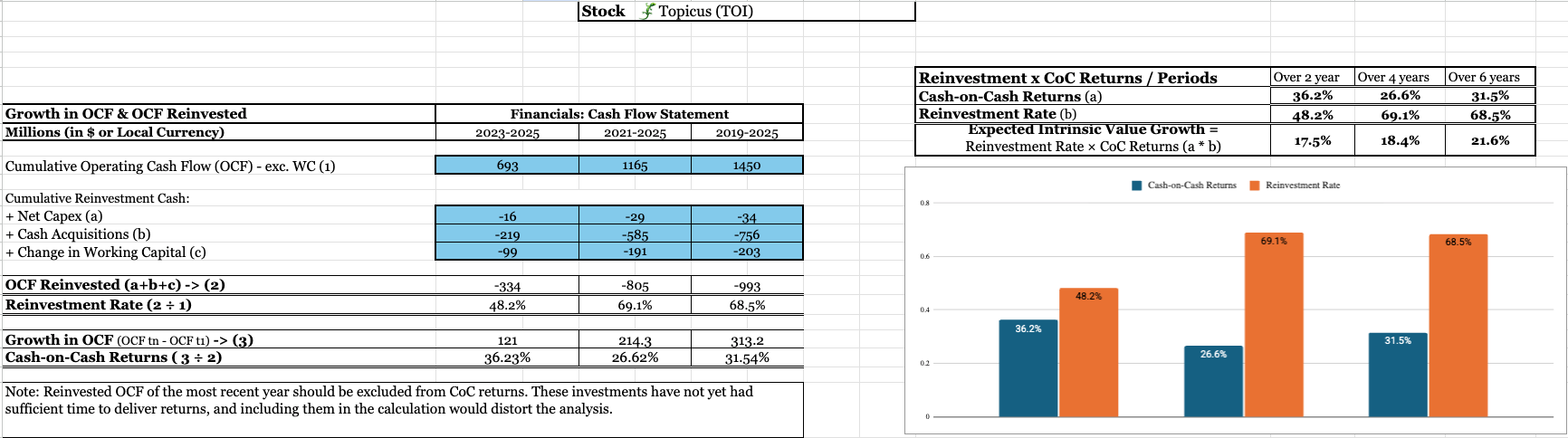
As you’ll notice, Topicus generates exceptionally high CoC returns, currently the highest within the CSU family, ahead of both Constellation Software and Lumine.
Historically, however, one criticism of Topicus has been its relatively modest reinvestment rate. Strong capital allocators only create value if they have enough opportunities to redeploy capital at attractive returns.
That’s begun to change in the most recent years though.
Following the surge in M&A activity throughout 2025 (what a year 🙌🏼), Topicus’ reinvestment rate has now climbed above the 100% threshold, reflecting management’s willingness to supplement internally generated cash with external capital when sufficiently attractive opportunities arise. That shift has only recently begun (2025), so its full impact on the financials and capital allocation metrics, like my CoC Returns and Reinvestment rate ratio, won’t be apparent until we move further into 2026.
Lastly, I wanted to share my DCF model for Topicus, specifically built and adjusted for serial acquirers like the CSU family. If you’re unfamiliar with the process for building it, you can read my full piece here: 🔗 How to Build a DCF for Serial Acquirers Like Constellation Software
And, just like the CoC Returns model, it’s available for download inside the 🔗 Portfolio Corner, where you’ll find the full extent of my assumptions and all the calculations done over a 40 years period to get to the Implied Share price.
Here’s the valuation summary extracted from my DCF model:
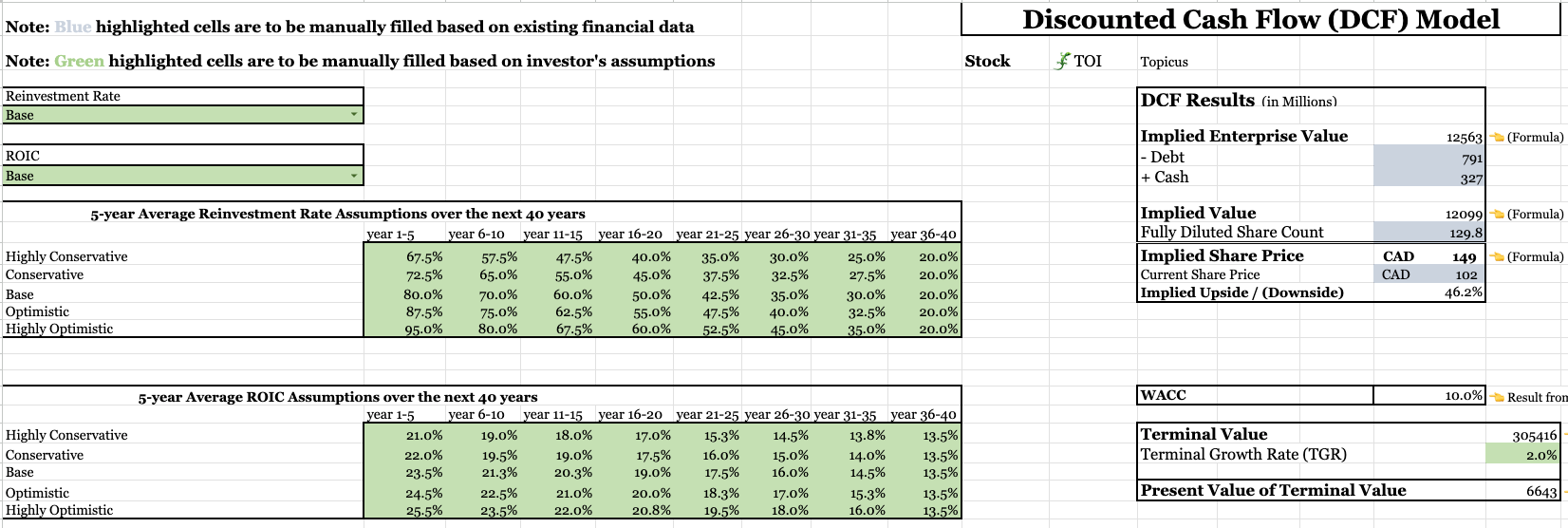
At the time of my analysis, using a CAD 102 share price and my base-case assumptions, the model implied +46% upside to intrinsic value.
Quite undervalued, don’t you think? That said, take the output with a dose of skepticism.
Valuing serial acquirers is inherently difficult. The biggest challenge isn’t forecasting next year’s earnings, but estimating how long management can continue reinvesting capital at high incremental returns. That depends on the availability of attractive acquisition opportunities, competitive intensity in European VMS markets, execution quality (keeping hurdle rates intact), and the unknown long-term implications of AI for software businesses.
Even so, under what I believe are reasonable assumptions, my model suggests the market is undervaluing Topicus today, particularly over the next several years given its superior organic growth profile (you can see how it makes a difference on the FCF over the years vs CSU/LMN once you get to compare them on the Serial acquirers DCF model spreadsheet). Whether that valuation gap ultimately closes will depend less on multiple expansion and more on management continuing to execute the playbook that has served the CSU family so well for decades.
If you want to use it as a framework to input your own assumptions, you can do so by downloading the model from the Portfolio Corner.
Constellation Software: The Ultimate Compounder You Don’t Sell
CSU is the one you don’t sell.
Capital allocation track record over 30 years on this spectacular systems-driven, culturally-entrenched M&A machine is as close to a secular compounding guarantee as public markets offer, and I don’t mean to use that language lightly.
But the other (less rosy) assessment is that new $$ deployed through CSU today are competing for targets in a more crowded environment than at any point in the company’s history, and the returns on incremental acquisitions is slowly and gradually starting to reflect that.
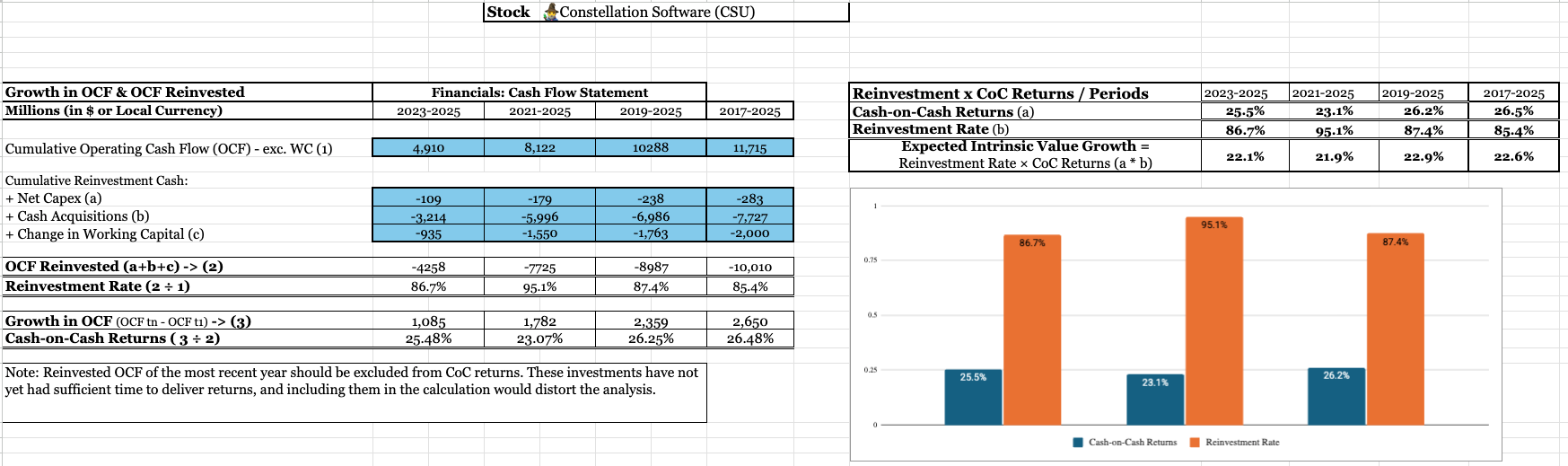
Low-to-mid-20% Cash-on-Cash returns hardly make for a bad investment, don’t you think?
Even more so when they’re paired with reinvestment rates that have consistently remained above 85%, occasionally approaching 100%. That’s a great combination, and it’s what has made Constellation such a compounder beast over the past two decades.
That said, one trend has become more apparent in recent years.
(And as always, don’t take the outputs of my model as absolute truth. CoC returns and reinvestment rates fluctuate over time, so longer measurement periods tend to paint a more representative picture of the returns earned on incremental acquisitions.)
As Constellation has grown, the law of large numbers has inevitably started to assert itself. Deploying billions of dollars every year requires pursuing increasingly larger acquisition targets, and larger deals rarely generate the same exceptional returns that were achievable when the company was much smaller and buying tiny vertical software businesses.
That’s simply the arithmetic of scale.
The key question is whether management can continue deploying capital (close to 75-100%) at returns comfortably above the cost of capital for many years to come. If the answer remains yes, even at somewhat lower incremental returns than in the past, the compounding story is still very compelling.
While I am not here to deny that CSU’s decentralised model still works (it does as you can see on its CoC Returns and Reinvestment rates over the years), I do think investors sometimes conflate the quality of the track record with the prospective returns on capital deployed today. Those are two different things.
Going forward, I see two key growth drivers that could push the "gravity of large numbers" a little further into the future.
The emerging market optionality is still underappreciated for being ‘too difficult’ and carrying more uncertainty. Asia-Pacific should be expected to be the fastest-growing VMS region going forward, and CSU has explicitly begun studying and piloting acquisitions there. The playbook successfully travelled from North America to Europe via Topicus but also to South America, specially in Brazil. The intellectual capital to travel further exists. That said, execution risk in less institutionally developed markets with more pronounced cultural differences is higher, and I think this optionality deserves a discount until CSU demonstrates it at scale.
(By the way, successfully applying its playbook in Japan, once and for all, would be a dream 👀. So far, they’ve had a hard time doing so).
The PEMS strategy has drawn a lot of attention and for good reason.
It’s probably the most important thing happening in the CSU ecosystem right now, and I don’t think the market has fully processed what it means.
Earlier this year, Constellation formally introduced what it calls the Permanent Engaged Minority Shareholder strategy (PEMS) as an additional capital deployment mechanism, with the investments in Asseco Poland and Sabre as the first meaningful expressions of it at the parent level.
The rationale is straightforward. CSU now generates so much FCF that the traditional acquisition model cannot readily absorb it all, particularly given that private software acquisition multiples have not meaningfully declined (yet) despite the AI-driven pressure on public SaaS valuations. When Buffett’s insurance float began exceeding what private acquisitions could absorb, he started taking large public equity positions. CSU is at an analogous inflection point. The thing is, this comparison is not hyperbole. This is how Berkshire’s capital deployment architecture evolved, and I think it’s a reasonable framework for thinking about where CSU goes next.
Now, here’s where Topicus deserves way more credit that I rarely see people give it: the precursor to PEMS at CSU was Topicus’s stake in Asseco Poland. Topicus acquired its initial position at approximately 85 PLN per share and ultimately built to roughly 24.8% ownership at a total cost of around $500 million USD. By mid-2025, Asseco was trading near 200 PLN, implying an entry at roughly a 60% discount to where the market subsequently valued it. That is not luck. That is sourcing and conviction operating at a different level than the market gives Topicus credit for.
More importantly, Asseco operates in 62 countries and is itself an active VMS acquirer in Central and Eastern Europe, essentially a Topicus twin for markets that Topicus had not yet penetrated directly. The investment didn’t just generate a return, it also opened a new geographic corridor.
The Sabre investment follows a similar logic at the parent level. CSU accumulated a combined 9.7% stake across common stock and derivatives, then negotiated a board seat for a Constellation executive on Sabre’s Technology Committee. The PEMS structure allows CSU to deploy hundreds of millions in a single investment, install operational influence, and benefit from a platform company’s FCF without paying a control premium. A board seat also functions as a window into future carve-out or full acquisition opportunities, which is precisely how we should think about Topicus’s Asseco position.
The key risk is the obvious one: minority status means influence without control. If target management resists the CSU operating philosophy, the capital sits in a suboptimal structure. The Sabre situation illustrated this briefly before the standstill agreement was reached. That’s a real risk, and it’s worth sizing for. I think the market is still figuring out how to price PEMS as a capital deployment channel, which means the optionality is not fully in the stock yet.
Speaking of the culture post-Mark Leonard: the reason CSU’s decentralized engine will outlive its creator comes down to where decision-making actually lives. CSU’s hurdle rates (traditionally ~20-25% IRR) aren’t enforced from a corporate boardroom in Toronto; they are embedded into the compensation formulas of dozens of Operating Group presidents and hundreds of BU managers. Capital allocation at CSU is essentially an algorithmic incentive structure. Mark Leonard built an intellectual franchise model. That organizational design is precisely why the mothership can handle multi-billion dollar capital deployment stress while the underlying operating units continue compounding unimpeded.
Before moving on to CSU’s DCF valuation, there’s another source of optionality that I think deserves attention: spin-offs.
Arguably, spin-offs have become Constellation Software’s most effective tool for fighting the law of large numbers, and I wouldn’t be surprised to see more of them over the coming years.
That said, spin-offs solve the scale problem more effectively for the newly created entity than for the parent company itself. By separating a collection of businesses into a smaller, more focused organization, management can preserve the entrepreneurial culture and capital allocation discipline that become increasingly difficult to maintain as organizations grow.
For CSU shareholders, however, the beauty lies elsewhere.
Constellation typically retains significant ownership stakes in its spin-offs, roughly 30% of Topicus and 60% of Lumine Group, for example. That means shareholders continue participating in the value creation of these businesses while also benefiting if the market assigns them higher standalone valuations.
And if another spin-off were announced tomorrow, existing CSU shareholders would immediately participate in that optionality through their ownership of the parent.
It’s a very shareholder-friendly mechanism: management creates another independent capital allocator without forcing investors to choose between the parent and the spin-off. In many ways, you get exposure to both. Thank you, Leonard, Sir. 🧙🏻♂️
Now, let’s move into the DCF model I’ve crafted for CSU. Like the Topicus DCF model, it is available for download inside the 🔗 Portfolio Corner; and, the resulting valuation summary below:
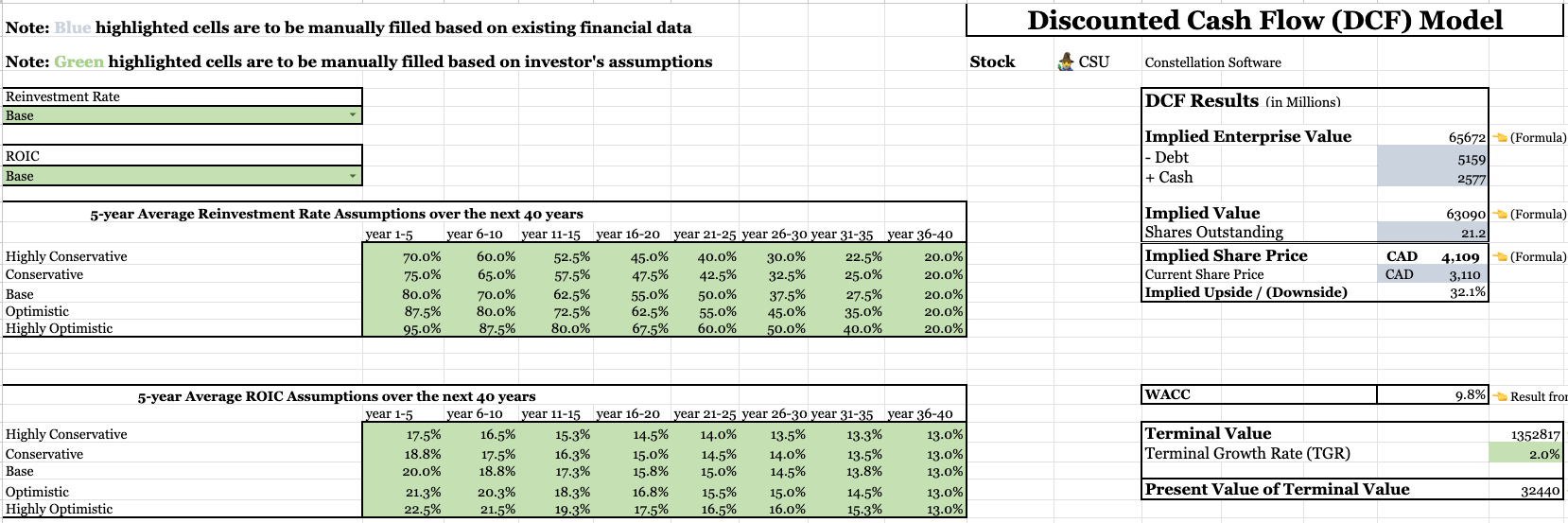
At the time of my analysis, using a CAD 3000 share price and my base-case assumptions, the model implied +32% upside to intrinsic value.
Still undervalued, just like Topicus at these prices.
Again, take my output with a dose of skepticism. If you want to use it as a framework to input your own assumptions, you can do so by downloading the model from the Portfolio Corner.
Lumine Group: Great Management, Asymmetric Upside
In my view, Lumine is the highest-ceiling, highest-risk name of the three, and I think the appropriate framing is that it’s a high-conviction bet on a differentiated strategy, not a core compounder in the CSU or Topicus sense.
Their carve-out playbook is what makes this business so special.
Lumine is, as far as I can tell, the only permanent-owner acquirer specifically positioned in the telecom and media VMS vertical. Telco software customers demand continuity. The “buy and hold forever” model is a meaningful competitive advantage in seller conversations, particularly when the alternative is a PE fund that will flip the business in five years. As large vendors like Nokia, Ericsson, and Cisco continue to rationalise their software portfolios through 5G infrastructure transformation and Open RAN adoption, the pipeline of carve-out assets is likely to grow rather than shrink.
Now, what I like the most about this company is their management. The team is executing the playbook to a T this year, and it’s beating my own high bar expectations. Do a little bit of DD and take a good look at their recent acquisitions: 🔗 Lumine | Press Release.
Music to my ears.
The funny part is I suspect the market won’t appreciate the next few quarters. Large acquisitions tend to weigh on margins, create operating noise, and muddy both the income statement and cash flow before the benefits show up.
That’s the price of playing the long game…
Anyways, onwards.
So, they are running their playbook flawlessly, and I’ve been genuinely impressed by CEO David Nyland’s leadership after listening to him on the recent CSU AGM. Nyland is the closest thing I’ve seen to Constellation’s Mark Leonard, i.e. exceptionally pragmatic, deeply thoughtful, and entirely systems-driven.
Out of our three CSU family holdings, Lumine is simply executing the best so far this year. And after some hesitation last few months, it feels way better than I feared to have my capital anchored back here.
What makes Lumine's carve-out playbook so lethal when executed correctly is the sheer magnitude of margin expansion post-acquisition. When legacy tech giants like Nokia or Ericsson divest software divisions, these assets are often saddled with bloated corporate overhead, inefficient sales structures, and (sometimes) sub-10% operating margins. Lumine doesn't buy these businesses for their organic growth. but to strip out corporate cost, re-orient management toward net revenue retention, and apply CSU’s rigorous benchmarking metrics. Within 18 to 24 months, Lumine regularly converts 5-10% margin telecom corporate orphans into 25%+ EBIT margin cash cows. That operational turnaround lever gives Lumine a margin of safety on valuation that other pure buy-and-build serial acquirers don't have.
Lumine's greatest asset may well be its management team. (What a blessing for Lumine’s investors). This is an exceptionally complex playbook to execute, and without the right people at the helm, it would be almost impossible to replicate consistently.
That said, there are a few things I want to highlight that makes this name riskier:
Large carve-outs are inherently messy to integrate, and some of the underlying telecom software businesses face structural volume declines that have nothing to do with Lumine’s operating skill.
Each deal at Lumine’s scale is more binary than at CSU or Topicus. One poorly executed $200 million acquisition has outsized portfolio impact in a way that would be noise inside CSU’s 1 500-business portfolio.
What continues to hold me back is the underlying end market, which David Nyland himself described as “fatigued and bruised.” The persistent low/zero (potentially negative) organic growth profile of telecom software (especially as Tier 1 operators consolidate) keeps me cautious.
Ironically, I fully understand that this is precisely where Lumine’s strengths lie: buying dysfunctional carve-outs and operationally improving them. But this strategy feels more execution-dependent and management-sensitive than CSU’s or Topicus’, which benefit from broader and structurally healthier end markets.
Last, the full CoC returns and DCF models (including the Excel spreadsheet), are available for download in the 🔗 Portfolio Corner. The results are summarized below:
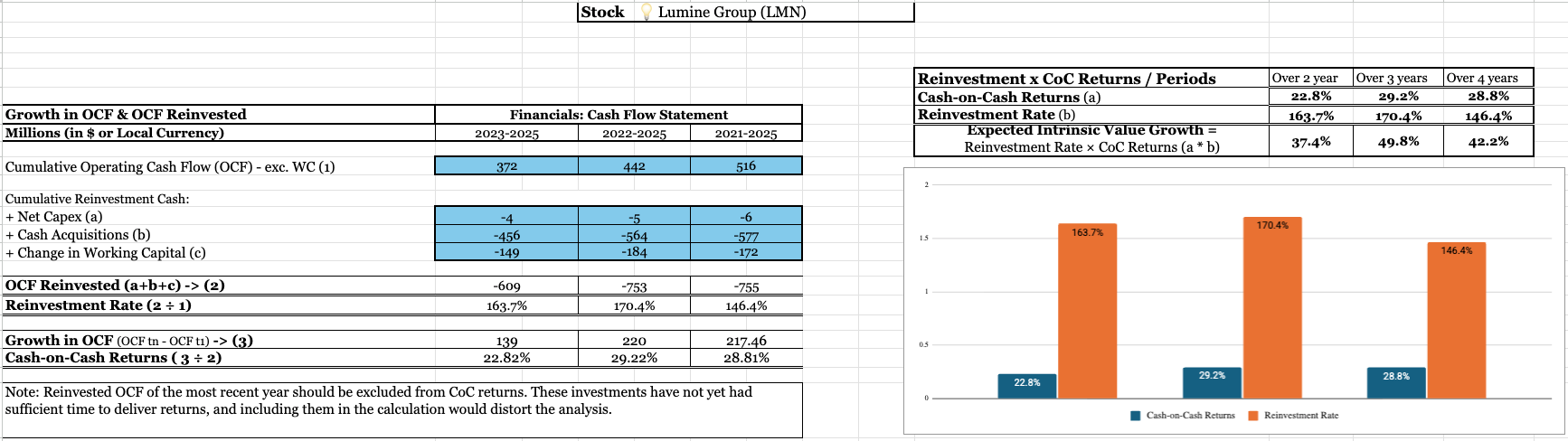
Lumine’s Cash-on-Cash returns have consistently remained in the high-20% range, while reinvestment rates have exceeded 100% throughout the four years since the company went public.
That’s not entirely surprising given Lumine’s strategy. Its focus on large carve-outs naturally creates a deeper pipeline of opportunities to redeploy capital. That doesn’t mean execution is easy (far from it), but it does make deploying operating cash flow at attractive returns somewhat easier than for businesses pursuing smaller acquisitions.
The combination of high CoC returns and aggressive reinvestment is exactly what you want to see in a serial acquirer.
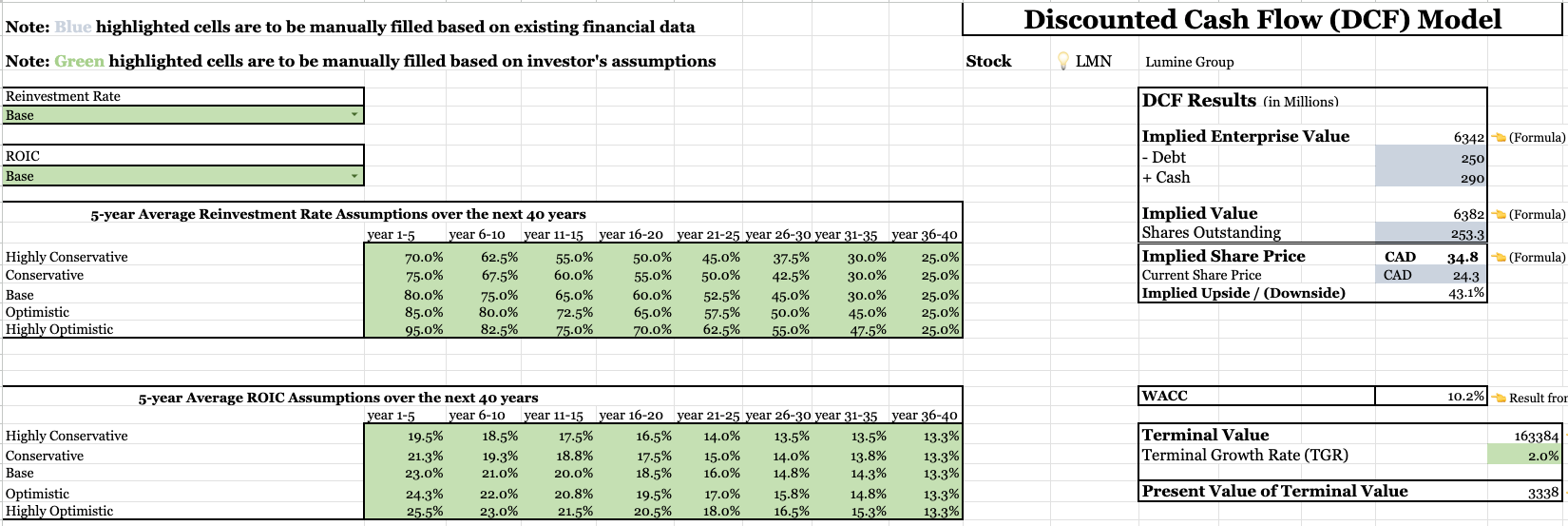
The DCF tells a similar story. Under my base-case assumptions, the smallest member of the CSU family still appears meaningfully undervalued, with roughly 43% upside to my intrinsic value calculations.
Sometimes I catch myself wondering why I don’t just put all my eggs in the CSU basket. 😅
Then I remember that risk management exists and that diversification is one of the few free lunches in investing. Even the best capital allocators deserve position sizing that acknowledges uncertainty.
Again, take my assumptions with a grain of salt and make your own opinions.
👀 Important Note on DCF Models Assumptions
You may have noticed, after digging through the full DCF models inside the spreadsheet, that I’m using a tad more conservative assumptions for the spin-offs than for the mothership.
What can I say? Constellation Software has a 30-year track record, exceptional bench depth, and the market’s confidence. That deserves a premium reflected in some of my numerical assumptions.
There’s also a more practical consideration. While it shouldn’t matter over the long run (nor has any impact on their business fundamentals), Constellation trades on the Toronto Stock Exchange, benefiting from greater liquidity, broader institutional ownership, and higher visibility. The spin-offs, meanwhile, remain listed on the TSX Venture Exchange, where liquidity is thinner and many institutions simply don’t participate.
Perhaps one day they’ll graduate to the TSX alongside their parent. Until then, I think a slightly more conservative underwriting is justified.
My Pecking Order & A Word on AI
The secular tailwinds that the VMS complex is riding (i.e. public sector digitalization, founder succession, and AI-enhanced margins, etc.) remain promising. But the entity-level differences within the ecosystem matter more than they did 5 years ago, and I think many investors are still underweighting them.
Topicus offers the most legible organic growth profile, the most visible geographic runway at a size where the original CSU playbook still generates its best returns, and has already served as the proving ground for what may be CSU’s most important strategic evolution. I would say that Topicus is the most structurally interesting name in the complex today.
CSU is the legendary compounder you hold through any environment. While incremental returns on new capital are inevitably starting to reflect the law of large numbers, the PEMS strategy, the extreme decentralisation and ability to expand the playbook into emerging markets are some variables that could shift that calculus, and it’s a key thing to track over the next 12-24 months. The market hasn’t fully priced this optionality in yet.
Lumine is the asymmetric bet with a great management team at the helm, a special differentiated playbook carrying higher execution risks. I’m sizing it accordingly.
My pecking order for new incremental capital:
Topicus first, CSU second, Lumine third, with PEMS and successful expansion in key emerging markets being the development that could move CSU up that ranking faster than anything else.
Before wrapping up, a word on AI. Some of you may be wondering why I’ve barely mentioned the hot topic as part of the investment case.
It’s not because I’m skeptical about AI’s contribution to the CSU family. Quite the opposite. Constellation, Topicus, and Lumine are already rolling out AI-enabled products and workflows that are delivering measurable ROI to customers.
The reason is simpler: I’ve covered that topic extensively in previous deep dives, earnings digests, and other articles. More importantly, I find it incredibly difficult to incorporate AI into a comparative valuation framework when analyzing businesses with broadly similar models, customers, and industry dynamics.
At this stage, AI feels more like a rising tide than a differentiator.
If I had to bet on which company within the CSU family ultimately extracts the most value from AI, I’d still lean toward Constellation Software. Mainly, because it has by far the deepest installed base, the broadest collection of operating groups, and the greatest ability to identify successful use cases and systematically disseminate them across hundreds of business units.
With that said, Thank you all for following along,
— Nikotes
Unlock Premium Content – For just $0.39/day ($12/month) or $0.27/day ($100/year)!
🔗 Portfolio Corner - 🗓️ Monthly Updates (Last Update: 28-Jul-2026)
Hey, so I have trouble getting to your $4,100 IV estimate. This feels far too conservative?
I get the returns and reinvestment rate falling over time but that's been the bear argument for 25 years+, the spinoffs/PEMS as you mention are a fantastic way of ensuring the company can still grow while the parent sizes up. But really when you put a 10% WACC on this when the S&P is at 29x PE. It seems like a crazy penalty. CSU has had V/MA/Costco like up and to the right growth. It seems like the risk of the underlying FCF growth would warrant something far lower? Something like Costco is trading at 3x the FCF multiple with half the growth. Great work though man!
How do you justify a 40 year DCF? Do you have such high confidence in the industry and these companies for the next 10+30 years?