

Software Darwinism
Does All SaaS Die in the Age of AI? And Where Does Constellation Software Fit?


The market is pricing in a software apocalypse. Many SaaS stocks have been hammered since October 2025, other sectors (data services, financial services, cybersecurity) have followed, with the narrative being that AI will unbundle, displace, and destroy the incumbents. Companies will vibe-code their own solutions, agents will replace seats, and decades of software moats will evaporate overnight. 2026 starting strong 🙌🏼
The thing is this narrative is both right and catastrophically wrong, depending on which type of companies you’re talking about.
Not all software are created equal. Some software must be correct. Other software just needs to be useful. Understanding that distinction is key to building conviction if you want to keep holding these companies today.
Another question that keeps coming up among fellow Constellation investors is where Constellation Software stands in all of this. So let’s walk through the “apocalypse” scenario together and try to bring a bit of light to it.

📰 What’s New?
📚 Articles
🔎 Deep Dive Briefs
⛅ Cloudflare | 👷♂️ Parsons | 𓇲 MPS | 🥼 Medpace #1, Medpace #2 | 🔌 Arista | 🛒☁️ Amazon | 🤖 ASML | 🦎 Topicus | 💡 Lumine | ✈ HEICO | 🧙♂️ CSU Part #1, Part #2, Part #3 | 🤖 Intuitive | 🛒 💳 MELI Part #1, Part #2, Part #3 | 💻 Cadence | 🌊 Norbit
💸 General Investing
💎 Hidden Gems Series
✨ Annual Specials – Annual Letters, Investing Philosophy, Industry Write-ups & Top Picks of the Year
📚 Resources for Investors
📢 Latest Stock News → Earnings Digests & other related news
💬 Join My Chat → [🔗 Learn more]
🔐 Paid Subscriber Exclusives
💼 Portfolio Corner – Holdings, valuation models, trades, performance & more!
🤫 Exclusive Sections – From select articles, Deep Dive Briefs & Hidden Gems
👀 Recent Releases!
💸 Software Darwinism, Software Darwinism 2.0 & Software Darwinism 3.0 → We talk AI, SaaS, VMS and Where the CSU family stands
💎 Hidden Gems: Sixth Edition → A Primer on TerraVest Industries
👀 Coming Soon
🔎 Two-parts Deep Dive Brief: Palantir
💎 Hidden Gems: Special Edition IV —> A Robotics play in the defense space.
💎 Hidden Gems: Seventh Edition —> 2 Nordics Niches, early stage.
New Article Format Coming: Short analysis briefs on the watchlist stocks I currently find most interesting (or am digging into more deeply):
where I see the opportunity,
what I like,
and what keeps me from pulling the trigger.
(Will be partially open to read, the rest will be kept available for paid subsribers).
Types of Software
There’s been a lot of chatter on FinTwit and among software investors about what separates software that’s vulnerable to AI disruption from software that isn’t.
I won’t rehash the whole debate, but it’s useful to frame the divide.
On one side, you have deterministic systems where precision is key. On the other, you have probabilistic systems where “good enough” is acceptable.
Deterministic Systems: Selling Correctness
Deterministic software follows a simple rule: same input → same output, every single time. These are systems where errors are catastrophic.
Think about payroll software. If the system is off by 2%, that’s not “close enough”. That probably ends up in a lawsuit and potential regulatory violation. The same goes for accounting systems, banking ledgers, hospital billing, inventory management, tax software, and airline reservations. These systems must be correct.
Some characteristics of deterministic software are:
Mission-critical to operations
High switching costs
Long contract cycles (3-5 years is common)
Moderate but steady growth
Retention rates approaching 100%
Pricing based on value delivered, not usage
Often focused on specific verticals
This is where most VMS thrives. This is where companies like Constellation Software live. And this is where the AI disruption narrative starts to break down.
Probabilistic Systems: Selling Improvement
Probabilistic software operates in likelihoods rather than certainties. The outputs are statistically good but not guaranteed. Errors are expected and tolerated as long as the overall system performs adequately.
Netflix recommending a mediocre movie? No big deal. Google showing you a slightly less relevant search result? Minor inconvenience. Marketing attribution being directionally correct but not precisely accurate? Acceptable. These systems work with pattern recognition, optimization, prediction, and generation.
Of course, many probabilistic systems are built on top of, or tightly integrated with, deterministic layers. So drawing a clean line between the two isn’t as straightforward as it might seem.
The business model for these looks entirely different:
Usage-based or consumption pricing
Rapid iteration cycles
Data network effects as the primary moat
Horizontal platforms serving broad markets
Lower switching costs
Commoditization
The examples are everywhere: search engines, recommendation systems, fraud detection, marketing tools, LLMs like ChatGPT, image recognition, demand forecasting. All valuable, all useful, but none require perfection.
So, the main take here is that: deterministic software sells correctness. Probabilistic software sells improvement.
Why This Distinction Matters
AI is fundamentally a probabilistic technology. It excels at pattern matching, generation, and “good enough” solutions across different problem spaces. This means that AI is a direct substitute for probabilistic systems in ways it simply cannot be for deterministic systems. Or at least on the current state of the art.
If an LLM can replicate your probabilistic product with 90% of the quality at 10% of the cost, you may end up not having a good business anymore. Even a great UI or UX won’t save you.
But try getting an LLM to run payroll for a 10 000 person company. Try having it manage municipal billing where errors create regulatory violations. Try using it for public safety dispatch where lives depend on precision. The answer isn’t “the AI isn’t quite there yet”, it’s that these problems don’t suit probabilistic solutions.
Anthropic uses Workday for HR. OpenAI uses Slack for communication. It’s incredibly clear to anyone with half a brain that nobody is vibe-coding critical infrastructure. The liability alone would be absurd. When the cost of failure is asymmetric: lawsuit, business shutdown, regulatory violation, people dying, … You don’t experiment with “good enough.” You pay for proven, deterministic systems that simply work.
A Bear Case Stack
Let me lay out some bear cases I came up with for incumbent SaaS. In no particular order, except one of them.
1. Platform differentiation trends toward zero. We were already trending toward every platform offering every app. AI just made it easier to copy features.
2. Value will accrue to the agentic layer sitting on top of systems of record. The AI layer that orchestrates across systems (siloed systems of record) might capture more value than the underlying systems themselves.
3. Investor sentiment becomes a structural headwind as the business model gets de-rated. If the market believes software quality is declining and with it, the durability of terminal value, then multiples compress, regardless of underlying fundamentals. Sentiment matters and for a software investor, this is arguably the most dangerous risk of all IMO.
4. AI-native startups deliver tremendous value at better prices, eating incremental LTV. A startup without technical debt, built AI-first, might offer 80% of the functionality at 20% of the price for certain use cases. I don’t really believe in this though.
5. As agents do more work, seat-based revenue declines. If one employee with AI agents can do the work of three, you need fewer seats. This breaks the traditional SaaS pricing model.
6. Legacy SaaS struggles to transition from seats to outcomes. The companies built on seat-based pricing don’t have the infrastructure, go-to-market motion, or pricing expertise to shift.
7. Diminished pricing power due to decreased differentiation. As features commoditize and lock-in weakens, pricing power goes away.
8. Gross margins deteriorate because AI revenue is structurally more expensive. Running inference costs money. If your AI features have 60% gross margins versus 85% for traditional software. Margins compress as AI adoption grows.
9. Competition for scarce AI talent increases SBC/opex faster than revenue. Incumbents fight to keep A-players from jumping to AI-native startups, bidding up compensation while growth slows. I can see a world where this happens, particularly with the US software darlings.
These are all real risks. Some could play out for certain companies.
A Bull Case Stack: Why Incumbents Win
The counter-narrative is that the AI disruption will be highly selective, and incumbents in the right categories have more structural advantages than headwinds.
1. AI expands TAM by enabling outcome-based pricing. The opportunity isn’t selling seats anymore, it’s displacing labor by charging for outcomes. This could become a new larger market.
2. Customers are willing to pay for an AI add-on if it actually works and solve their problems. If a business currently spends $20-50 to close a support ticket with human labor, they’ll be happy to pay $0.50 for AI to solve it. Similar dynamics exist with lead qualification, business development, and other workflows.
3. No company wants to use another vendor or build in-house. The idea that enterprises will eagerly rip out proven systems to cobble together AI point solutions is fantasy. It is infinitely easier to just use your existing relationship and infrastructure.
4. Customers are rooting for incumbents to figure this out. Customers don’t want to re-evaluate competitors, migrate data, retrain employees, and manage additional vendor relationships as long as the existing ones offer them “AI augmented” value.
5. Even if they’re testing other solutions, they’ll switch back if the incumbent becomes good enough. The bar isn’t “the incumbent must be better.” The bar is “the incumbent must be acceptable.” That lowers the hurdle.
6. Incumbents still have time to become acceptable. If they execute reasonably well, the switching costs and relationship inertia will continue to protect them. If they fumble for 3-4 years, the window may close though.
I believe that many incumbents will figure it out. If their AI talent gap is closing, if their playbook becomes clearer, and their incentives are properly aligned, betting against them is as foolish as betting on all of them.
Where Does Constellation Software Fit in All This?
Constellation Software and the broader VMS universe sit mainly in the deterministic camp.
I’ve gone over what CSU does many times on previous articles but let’s do it again: CSU specializes in acquiring and operating mission-critical systems for niche industries: municipal billing, public safety systems, healthcare administration, utility management, education administration, transportation logistics, real estate management. These are boring, essential systems where correctness is a must have.
The characteristics are textbook deterministic:
Must be accurate (billing errors create lawsuits)
Must be compliant (regulatory violations shut you down)
Must not fail (when the system goes down, operations stop)
Rarely replaced (switching costs are big)
Deeply embedded in customer workflows (often the system of record)
CSU explicitly avoids the things getting easily disrupted. They don’t chase:
Speculative tech bets
Platform plays with network effects
Consumer software
AI-first businesses
“Growth at all costs” narratives
Their model is: buy boring, critical, deterministic software → improve margins → hold forever. The result is high ROIC, high free cash flow generation, customer retention rates close to 100%, and steady compounding.
They sell reliability. And reliability doesn’t get disrupted by tools that are probabilistic by nature.
The AI Impact on VMS
AI both threatens and helps software businesses, depending on how you look at it.
Why VMS moat is different from horizontal SaaS
There’s been a bunch of articles on Fintwit and X explaining how horizontal systems of record - Salesforce, Workday, HubSpot, are at risk of disruption. Not in 5 years but in the next 12 to 18 moths.
But VMS companies such as the ones sitting in Constellation’s portfolio made hundreds of them are different: marina management systems, ski resort software, construction bidding tools, library systems, etc.
The moat here isn’t just “we have your data.” It’s “we encoded 30 years of domain expertise into workflows that actually work for marina operators.” That’s harder for an agent to replicate than a generic CRM.
The customers are different (especially for Constellation)
Enterprise buyers with AI teams might say “let’s have an agent interact with our systems.” But the owner of a small marina in Wisconsin? They’re not spinning up AI agents. They’re not even thinking about AI. And even if they are, they still just want software that works, doesn’t break, and doesn’t require them to overthink it.
Constellation’s sweet spot is small businesses and mid-market companies that are risk-averse and technically unsophisticated. These are the last people who will experiment with replacing their mission-critical software with AI agents.
Switching costs in VMS
In horizontal SaaS, you might have 5 credible alternatives. In VMS, there’s often 1-2 players. If you run a cemetery and you’re using cemetery management software, switching means:
Migrating decades of burial records
Retraining staff on completely different workflows
Risking compliance issues
Dealing with integrations to other niche systems (plot mapping, funeral home integrations, etc.)
The “just copy the data to an agent” argument assumes the data is the whole product. But in VMS, the product is often the workflow, the integrations, and the fact that everyone in your industry uses it.
The computer use assumption is weakest here
Many of these articles I’ve come around in Fintwit assume computer use agents “just work” with existing systems. But VMS systems are often messy software with legacy codebases, weird UI patterns, industry-specific quirks. The idea that a general-purpose agent navigates this reliably feels less plausible than it does for clean, modern SaaS.
A Plausible Threat: Domain Expertise Commoditization
The traditional VMS moat rested partly on domain expertise. Building software for municipal utilities required understanding regulations, workflows, and compliance requirements that took years to accumulate. This created a knowledge barrier that protected incumbents.
AI, eventually, can potentially compress this learning curve. Big players (like hyperscalers or the AI labs - OpenAI and Anthropic ) could start seeing value in going after smaller vertical markets. By engaging industry domain experts, feeding their knowledge into models, and develop a “good enough” product delivering 80-90% of the value at 10-20% of the cost. For smaller VMS companies, especially those optimized for extraction rather than innovation, this is a threat.
Many PE-backed or serial acquirer-owned VMS businesses run on a simple playbook: acquire the software, reduce Operating costs to bare minimum, raise prices annually, harvest cash flows, repeat. Customers stay because switching is painful, not because the product is great. The software is often old, clunky, and under-invested.
If an AI first company can deliver a modern, intuitive product that solves the core workflow problem adequately, the incumbent’s switching cost moat starts eroding. It won’t happen overnight. These are still deterministic systems where errors matter, but the risk is real over a 5-10 year horizon.
There are other legit scenarios, where Constellation might be vulnerable:
The high-end VMS customers might defect first. Larger, more sophisticated customers in each vertical could be the ones who experiment with agents. If agents can handle 80% of use cases, the high-value customers might accept that trade-off.
The services revenue dries up. Many VMS companies have sticky services/implementation revenue. If agents make implementation easier, that revenue stream compresses (exactly the KPMG dynamic).
Pricing pressure becomes universal. Even if customers don’t switch, they’ll use the “AI should make this cheaper” argument. To some extent, Constellation’s model relies on maintaining pricing power in these niches.
The Opportunity: Productivity Enhancement and TAM Expansion
There’s also another side to this. AI can make VMS businesses more efficient and expand their addressable markets in ways that weren’t economically viable before.
VMS companies can use AI to:
Automate tier-1 support, reducing cost-to-serve by 70-80%
Build features faster, shortening development cycles from years to months
Offer outcome-based pricing that captures more value from AI-enhanced productivity
Expand into adjacent workflows that previously required too much custom development
For well-managed VMS businesses that reinvest adequately and maintain product quality, AI is a tool that could strengthen the moat rather than erode it. They can serve customers better, faster, and cheaper while maintaining the accuracy that customers require.
Constellation Software, with its decentralized structure and track record of acquiring underinvested VMS assets and improving them, seems well-positioned to leverage AI for operational enhancement while avoiding disruption risks.
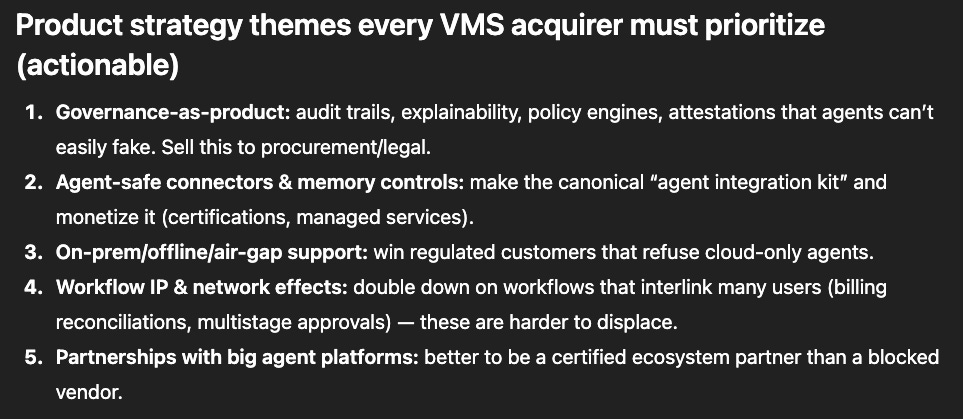
I was playing around the other day with my AI chatbot, asking how software incumbents, particularly VMS players, could reinforce their products and services with AI. It actually came up with some pretty interesting ideas.
Software Darwinism: The Fittest Will Survive
The market sees an apocalypse. I see Darwinism.
Some software will get displaced by AI. Other software will thrive, using AI as a tool while maintaining the characteristics that made it valuable in the first place.
The way I see it, the winners will share some common traits:
Deterministic over probabilistic. Systems where precision matters will outlast systems where “good enough” is acceptable.
Must-have over nice-to-have. Mission-critical software where failure means business shutdown will survive. “Vitamin” software that provides marginal improvements will struggle.
Consolidators over point solutions. Customers want to reduce vendor count, not increase it. Platforms that solve multiple problems with one vendor relationship win.
Long contracts over short contracts. Multi-year agreements create switching cost moats and allow companies to be strategic about product development rather than chasing quarterly metrics.
High-value over low-value. Software that prevents $10 million problems can charge $100,000. Software that saves two hours per week can only charge $50/month. Guess which survives pricing pressure.
Change over static. Companies that continuously improve their products and embrace AI to enhance their offerings will win. Those staying put will disappear.
Vertical over horizontal in certain cases. Deep vertical expertise creates switching costs that horizontal platforms can’t replicate. But, only, if you’re actually reinvesting and innovating, not just extracting.
Their portfolio is deterministic, mission-critical, focused on consolidation within verticals, contract-heavy, high-value, and increasingly dynamic as they push operating groups to adopt AI for internal productivity.
The VMS businesses that are at risk? PE-backed extraction plays with minimal R&D, weak products, and customers staying only because switching is too painful. An AI startup offering 80% of the functionality at 30% of the price with a modern UI could absolutely disrupt those over the next decade.
But the well-managed VMS businesses, the ones actually serving customers, reinvesting in the product, and using AI to get better, have decades of runway ahead.
Time for Constellation Software and its teams to prove the doom sayers wrong. Again.
Thanks for following along,
—Nikotes
Unlock Premium Content – For just $0.39/day ($12/month) or $0.27/day ($100/year)!
🔗 Portfolio Corner - 🗓️ Monthly Updates (Last Update: 25-Jun-2026)

Horizontal software is most at risk, particularly the more niche ones. But VMS is the last to go from AI!