


Although I had the company on my watchlist for several months, I thought it was worth writing about this rather unique business following my recent 🔗 Deep Dive Brief on Norbit ASA.
Before we get started, let’s take a moment to appreciate what might be one of the best corporate logos I’ve come across in a while. 🐙
Credit where it's due, the marketing / management team absolutely nailed it.
Enough with the hype. Onwards.
Before diving into the company itself, it’s worth taking a step back and framing the market it operates in.
For years, the subsea defense market flew under the radar. That changed following the outbreak of the Russia–Ukraine war. What was once a niche corner of the defense industry has become one of its most strategically important segments.
The sabotage of the Nord Stream pipelines changed how NATO governments think about protecting critical underwater infrastructure. Pipelines, telecommunications cables, offshore energy assets, and naval chokepoints have all become strategic priorities, triggering a structural increase in subsea defense spending.
Norbit has clearly benefited from this trend through its Oceans division, but it's far from a pure-play. In fact, finding a pure-play to this niche is surprisingly difficult. That asymmetry is precisely what, I believe, makes the opportunity so interesting.
Enter Kraken Robotics.
Kraken is one of the few publicly listed companies sitting at the intersection of subsea defense, underwater autonomy, and critical infrastructure monitoring. Better still, it remains small enough that continued execution in this niche can still meaningfully move the needle. It's no longer a micro-cap, but it's still a small-cap operating in what could become a very attractive defense niche of the coming decade.
Before discussing the investment case, however, one point deserves your attention: following its biggest acquisition ever expected to close on July 2, 2026 of Covelya Group : 2.5x Kraken’s revenues at 10x EBITDA, with 25 EBITDA margins and a top line 24% CAGR since 2023. We’ll talk later about what Covelya brings to Kraken’s portfolio and how Kraken closed this deal and what it implies for shareholders but what’s for sure is that investors are no longer evaluating the same company they were looking at just a few months ago.
What was previously a highly specialized sonar and subsea battery business is evolving into something far more compelling and diversified: arguably the only independent, pure-play provider of a fully integrated underwater autonomy stack.
That changes the investment thesis materially. Not only does it expand the upside, but it also introduces new layers of complexity. Both deserve a closer analysis.
This Hidden Gems special kicks off the first part of a two-part series:
Part I (this article): A primer on Kraken Robotics: the business, its technology, end markets, a first glance at the Covelya acquisition and why Kraken caught my attention.
Part II: A detailed breakdown of Q1 2026 results, June's AGM, the latest investor presentation, and what they reveal about the investment thesis.
Topics I’ll Cover On this Primer
🔹 What is Kraken ?
🔹 The Covelya Inflection
🔹 The Structural Tailwind
🔹 Is There A Moat ?
🔹 Management with “Skin in the Game” & The Balance Sheet
🔹 The Part That Deserves the Most Attention (🔐 available for subsribers)
🔹 The DCF Model & How I think about Kraken (🔐 available for subsribers)
Let’s dig in.
What’s New ? 📚 Articles
🔎 Deep Dive Briefs
⛅ Cloudflare | 👷♂️ Parsons | 𓇲 MPS | 🥼 Medpace #1, Medpace #2 | 🔌 Arista | 🛒☁️ Amazon | 🤖 ASML | 🦎 Topicus | 💡 Lumine | ✈ HEICO | 🧙♂️ CSU Part #1, Part #2, Part #3 | 🤖 Intuitive | 🛒 💳 MELI Part #1, Part #2, Part #3 | 💻 Cadence | 🌊 Norbit | ✈ HONA
💸 General Investing
💎 Hidden Gems Series
✨ Annual Specials – Annual Letters, Investing Philosophy, Industry Write-ups & Top Picks of the Year
📚 Resources for Investors
📢 Latest Stock News → Earnings Digests & other related news
💬 Join My Chat → [🔗 Learn more]
🔐 Paid Subscriber Exclusives
💼 Portfolio Corner – Holdings, valuation models, trades, performance & more!
🤫 Exclusive Sections – From select articles, Deep Dive Briefs & Hidden Gems
👀 Recent Releases!
💸 Software Darwinism, Software Darwinism 2.0 & Software Darwinism 3.0 → We talk AI, SaaS, VMS and Where the CSU family stands
💎 Hidden Gems: Sixth Edition → A Primer on TerraVest Industries
👀 Coming Soon
🔎 Two-parts Primer: Palantir
💎 Hidden Gems: Seventh Edition —> 2 Nordics Niches, early stage.
New Article Format Coming: Short analysis briefs on the watchlist stocks I currently find most interesting (or am digging into more deeply):
where I see the opportunity,
what I like,
and what keeps me from pulling the trigger.
(Will be partially open to read, the rest will be kept available for paid subsribers).
What is Kraken ?
Before the Covelya deal, Kraken operated as three distinct businesses that most people seem to discuss independently but which actually reinforced each other quite elegantly.
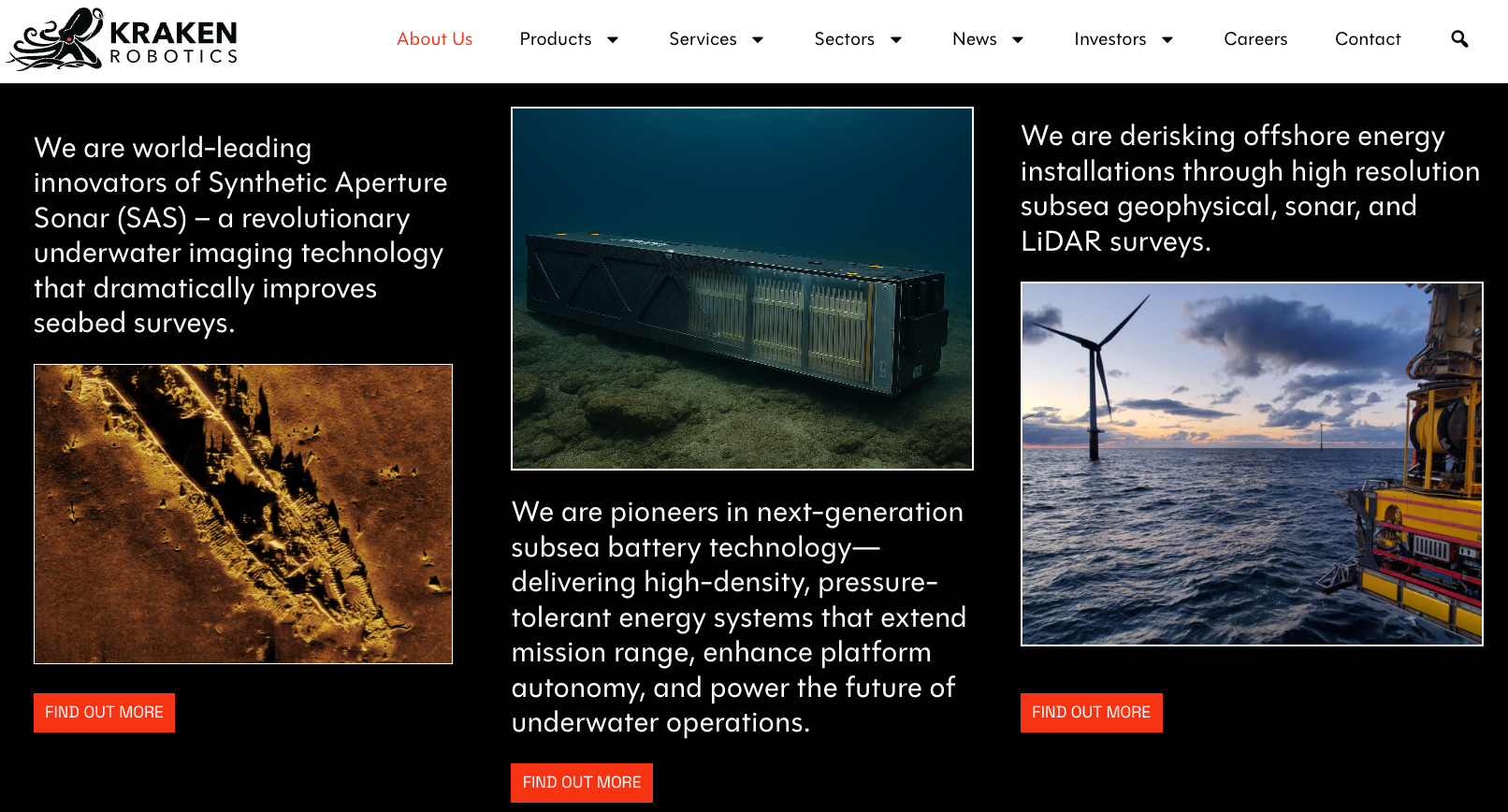
The first is its 🔗 Synthetic Aperture Sonar (SAS) business, anchored by the KATFISH system.
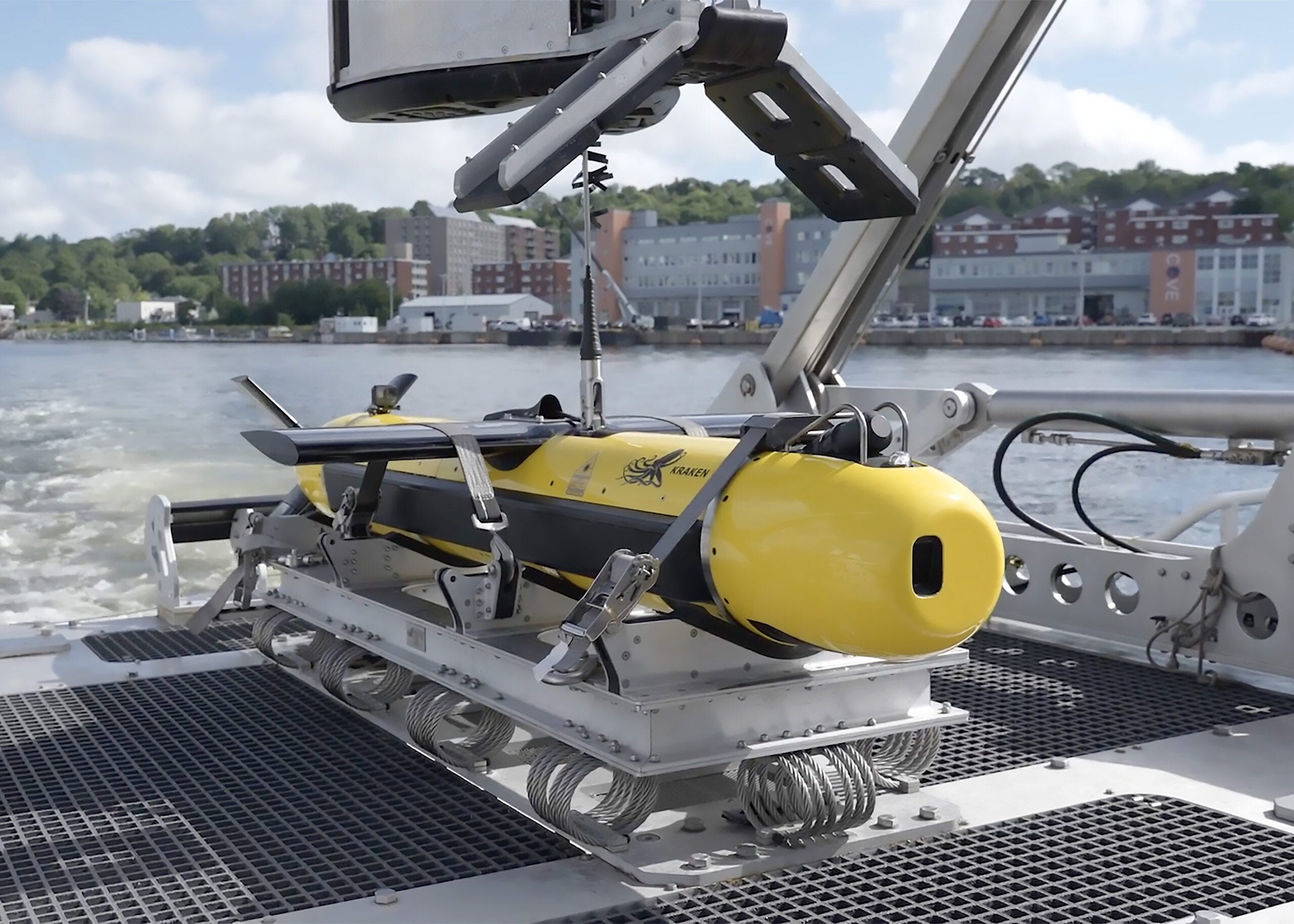
SAS is Kraken's headline technology and the one that tends to get the most attention. For good reason: it delivers up to 10x the image resolution and area coverage rate of legacy side scan sonars (used to create detailed, 2D images of the seafloor), which means naval customers can map the seabed faster and with far greater fidelity. This matters a lot for mine countermeasure (MCM) operations, where identifying a target correctly is the difference between a mission and a catastrophe.
At REPMUS exercises (NATO’s annual undersea robotics trials), Kraken’s adoption expanded from a single team in 2022 to 10 international naval teams and UUV manufacturers across multiple underwater drone classes. That’s proof of concept at scale, in front of the exact customers that the company is going after. To date, KATFISH is already deployed across a diversified cohort of NATO navies and offshore wind developers.
The second business, subsea batteries through its 🔗 SeaPower division.
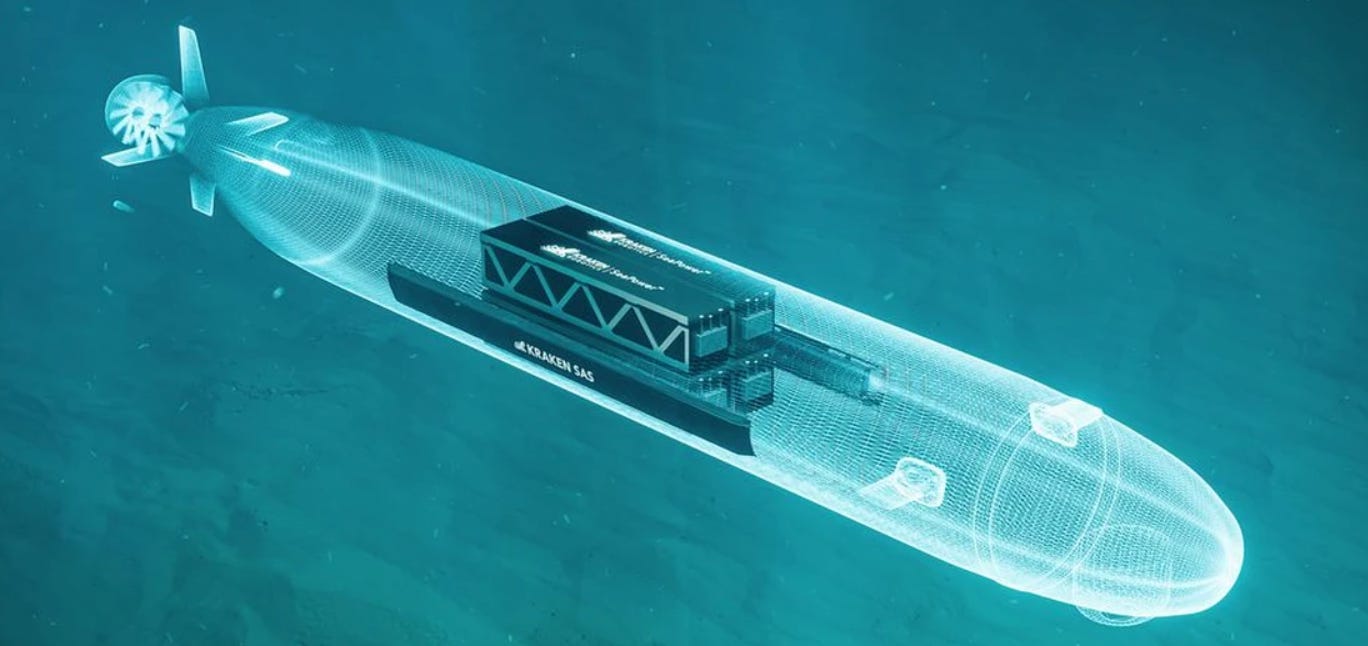
This is the one that often goes under-the-radar and, in my view, potentially the most important for the next leg of long-term growth. Every autonomous underwater vehicle (UUV) needs power, and power for underwater applications is a difficult engineering problem. As the UUV market scales (and the evidence suggests it's scaling aggressively) the constraint on deployment isn't always the sensor or the navigation system but endurance. Kraken's pressure-tolerant, high energy density batteries address this bottleneck directly. The business is also interesting because batteries carry an inherent replacement schedule, which gives it characteristics closer to a recurring consumable than a lumpy hardware product. I'll come back to this later.
The third business is subsea services. Survey operations conducted with their own equipment, covering seabed imaging, sub-bottom profiling, and 3D LiDAR. This is the recurring-like revenue engine of the company and the primary reason gross margins expanded to 62% in 2025. Service revenue reached $40.5 million in 2025, up 63% YoY That number tends to get lost in the noise around defense hardware orders, which is a mistake.
The Covelya Inflection
Now, add Covelya.
On June 18, 2026, Kraken received all final regulatory and stock exchange approvals for the $615 million acquisition of UK-based 🔗 Covelya Group, with closing set for July 2. The acquisition was done with $480 million in cash and $135 million in stock (i.e. around 20% dilution). More on this later.
Covelya brings Sonardyne (underwater positioning and acoustic communications), EIVA (navigation software), Voyis (optical imaging), and several other specialized businesses (Wavefront, Forcys, and Chelsea Technologies) into the fold.
The combined entity owns a complete underwater maritime defense stack across sonar, imaging, navigation, positioning, communications, power, software, and autonomous systems. Think about it this way: an UUV needs three fundamental things: sensors, power, and navigation. Kraken + Covelya provides all three. No independent company at this quality level does.
The only alternatives are defense primes like Lockheed or Thales, who are an order of magnitude more expensive and are not in the business of selling components to third parties.
For additional context, the combined entity brings together roughly 1200 employees, more than 450K square feet of production capacity across 25 facilities, and over 110 IP patents. Management expects approximately $10 million in cost efficiencies within 24 months (does not sound like much tbh), but they have flagged meaningful revenue synergy opportunities through cross-selling into what is now a combined customer base of over 700 accounts. Whether those synergies materialize is THE key variable to monitor that I'll address in the risk section.
The combined sales pipeline currently stands at approximately $2 billion, more than double YoY. For a company that recently set a standalone FY 2026 guidance (exc. Covelya) of $170 million in revenue (at the mid-point) up from $102 million in FY25 with an elite 26% Adj. EBITDA margin (exc. restructuring costs), these numbers are enticing to say the least. I generally treat pipeline figures with some skepticism though, but the underlying demand drivers here seems real enough that the directional signal matters even if the conversion rate is uncertain.
The Structural Tailwind
I’m generally skeptical when “structural tailwinds” are invoked as an investment thesis, because the phrase is often used to justify buying overpriced businesses with deteriorating fundamentals. But I think the underwater defense investment cycle is very real, durable, and still underappreciated by most generalist investors (I’ve been overlooking it myself the last few years).
NATO defense spending on subsea critical infrastructure protection (i.e. mines, UUVs, submarine detection) represents an $8-12 billion serviceable market (🔗 Source) and every NATO country is behind on modernization. Most NATO MCM fleets entered service in the 1980s and early 1990s, which means the average vessel is approaching or past its intended service life. The replacement cycle has begun, and the replacement technology is UUVs. Every one of those programs represents addressable demand for Kraken's sensor, power, and navigation stack. This is shaping up to be a decade-long catch-up driven by a permanent shift in threat perception following Nord Stream, the conflicts in Ukraine and the Middle East, and the demonstrated effectiveness of uncrewed systems in asymmetric warfare contexts.
Beyond defense, offshore wind adds another $4-6 billion in addressable demand. Five times growth in offshore wind by 2030 means every new farm requires seabed surveys. Nord Stream proved that underwater cables and pipelines are strategic targets, and governments are now requiring continuous monitoring, a spending category that effectively didn’t exist at scale three years ago.
The UUV market itself is expected to grow at roughly a 24% CAGR through 2035 according to 🔗 Astute Analytica. I have no particular insight into the precision of that forecast, but the directional logic (that autonomous systems will continue to displace crewed platforms as they do in every other military domain) seems defensible.
As of mid-2026, Kraken had CAD 97 million in new battery orders in 2026, representing around 37% of the total order backlog of CAD 262. And the cherry on top is that these UUV customers are treating this as a strategic supply relationship, not a commodity.
In a stable world, Kraken could benefit from steady infrastructure and defense modernization demand. In dangerous world, Kraken benefits from accelerated procurement cycles and higher demand for proven underwater surveillance capabilities. There are very few niche businesses I can point to where that kind of asymmetry exists.
Is There A Moat ?
Underwater defense technology is embedded into mission-critical systems through a qualification and procurement process that is deliberately conservative and slow. Once Kraken’s SAS is accepted into a program, it doesn’t leave. Naval procurement cycles are measured in years. Switching costs are operational and bureaucratic, because any change in sensor architecture requires re-validation of the entire system.
The battery business adds a dimension to this that I think is quite interesting to reinforce the Kraken’s advantage. Because underwater batteries directly affect vehicle weight, buoyancy, mission endurance, and performance, the moment a vehicle designer specifies Kraken’s battery, it becomes embedded in the structural architecture. You can’t swap it out without redesigning the vehicle around it. That’s a strong lock-in for a component that most investors would look past when trying to assess a company’s competitive position.
Post-Covelya, the vertical integration deepens considerably.
Sonardyne’s underwater positioning and EIVA’s navigation software are sticky because they feed into mission planning and data fusion workflows that take years to develop. The integration creates a platform effect where each component becomes more valuable in the context of the full stack. I would even go as far as to say that what Kraken is building here is the underwater equivalent of what Axon Enterprise has built for law enforcement: a deeply integrated platform that customers find increasingly difficult to exit, not because of contractual lock-in, but because the switching cost grows with every additional layer of adoption.
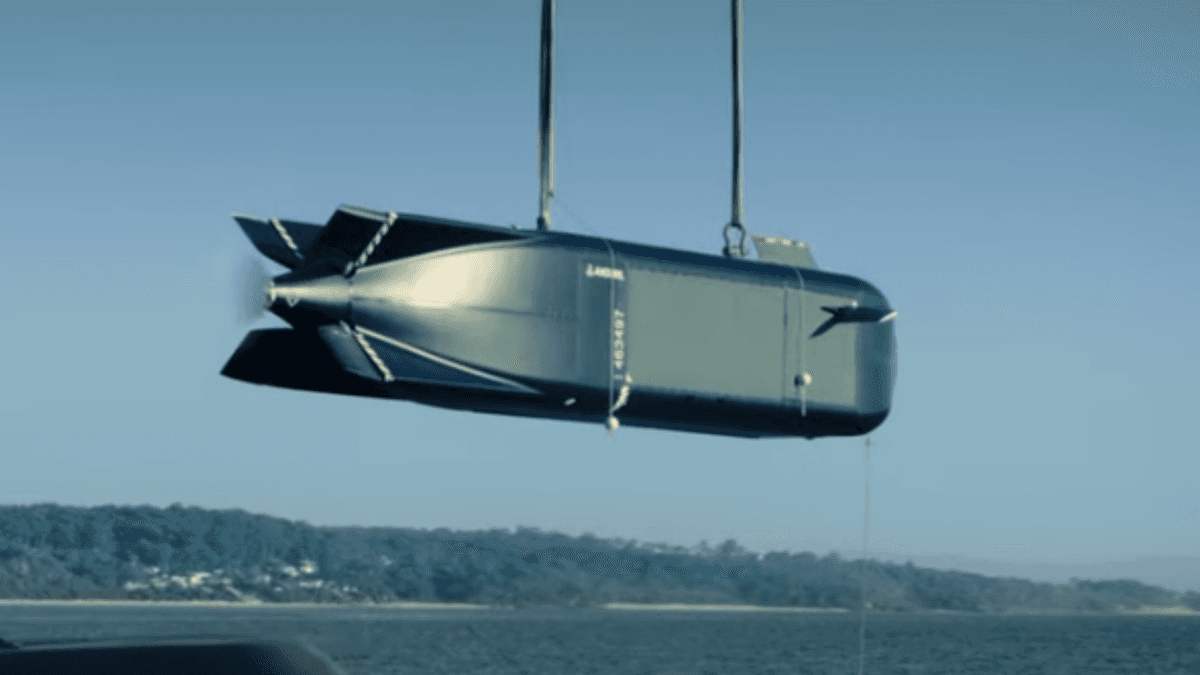
Kraken's engineering lock-in is already evident at the platform level. In their recent 🔗 2026 AGM in June, they presented how the 🔗 REMUS 620 (an UUV), built by Huntington Ingalls Industries (HII), uses Kraken MINSAS as an OEM standard sonar payload. Meaning Kraken is baked into the program at the design level.
Similarly, Kraken has integrated its SAS technology across Teledyne's AUV lineup and supplies SeaPower batteries into Teledyne's SeaRaptor vehicle. Anduril's underwater platforms (including the Dive-LD / 🔗 Dive-XL and GhostShark) also use mission-critical systems from both Kraken and Covelya.
The customer roster already reflects this. Lockheed Martin, Anduril, BAE Systems, Northrop Grumman, Teledyne, HII, Boeing, Saab, the US Navy, the Royal Navy. Despite that reach, the top 10 customers represent roughly 50% of combined revenue in 2025, which means the business isn't concentrated in any single relationship. That's a healthy customer structure for a defense technology company. Next leg of growth seems to point to a more concentrated one though, with Anduril as the key driver as we'll see in the second part of my Kraken's research.
Management with “Skin in the Game” & The Balance Sheet
🔗 Greg Reid has been President and CEO since January 1, 2023. Started his journey in Kraken, as CFO from 2015-2019 with some key M&A strategy know-how and was named COO right after that before taking over the executive position. When he took over, Kraken traded at roughly CAD 0.58. By June 2026, the stock was around CAD 7.60 after touching a 52-week high of CAD 10.72, more than 1200% under his leadership.
Reid directly owns 7 million+ shares, approximately 2.4% of the company. At CAD 7 per share, that stake is worth roughly CAD 53 million, or about 124x his base salary of CAD 450 000. A 10% move in Kraken’s share price changes his personal equity value by more than CAD 5.5 million. I don’t need a complex governance analysis when the numbers are this clear: when a CEO’s equity stake is 124x their annual salary, their incentives and yours are aligned in a very straightforward way.
This seems to be the type of management that behaves like an owner-operator, not a hired executive optimizing for short-term bonus metrics.
The balance sheet heading into the post-Covelya integration is also worth noting. As of Q1 2026, Kraken had CAD 108.7 million in cash against CAD 24.4 million in total debt. How is this possible?
Kraken pre-funded the acquisition by raising CAD 402.5 million through subscription receipts, which mean they sold temporary investment vouchers to fund the acquisition. This cash is held safely in a secure account and will only be used if the deal officially closes, otherwise, the investors get all their money back. This also means the company enters integration with some operational flexibility and without the kind of leverage that can make the typical complex integration hard to swallow.
Now, the Part That Deserves the Most Attention
The narrative is excellent. But I want to spend some time on what I think is the only thing that matters right now (at least, to the market), because it’s the thing that could derail everything else.