


Unlock Premium Content – For just $0.39/day ($12/month) or $0.27/day ($100/year)!
🔗 Portfolio Corner - 🗓️ Monthly Updates (Last Update: 29-Mar-2026)

I’ve increasingly been discussing the bifurcation in the current market, and frankly, the setup we are seeing entering 2026 is unlike anything I’ve encountered recently.
The AI narrative has effectively broken the market into two distinct camps: the “AI takes-it-all believers” who are bidding up semicaps and infrastructure plays to the moon, and the “AI skeptics” who are indiscriminately selling anything software-related. We are seeing quality names like ServiceNow down 40% and Constellation Software cut in half. The prevailing narrative of the crowd is that AI kills SaaS margins and turns software into a commodity.
I believe this view is fundamentally flawed. The market is pricing in structural decline for companies that are actually going through a period of adaptation within a broader secular growth trend.
That said, I’m not suggesting all software companies are created equal. Quite the opposite. Tech is an extremely competitive sector, and many SaaS companies, especially in North America, have traded for years at nosebleed valuations, coupled to excessive stock-based compensation and, in some cases, mediocre management teams more focused on personal incentives than long-term value creation. The market’s willingness to reward the sector masked a lot of weak fundamentals.
But there are also truly exceptional companies in this space. Businesses with real moats, durable customer relationships, and, most importantly, top management teams that have proven their ability to adapt and compound value over time. When the market starts behaving irrationally, as we’re seeing today, the risk–reward equation flips in favor of the patient investor.
The goal of this article is to unpack three companies where I believe the market has lost the plot: MercadoLibre, Amazon, and Constellation Software + spin-offs.
Constellation Software (CSU) and Spin-Offs — Buying the Panic
This is probably the most controversial pick, so I’ll start with it.
Constellation Software is down ~45% from its highs, now trading around CAD $2,850. The market is effectively pricing in an “AI apocalypse” for Vertical Market Software (VMS).
The debate on FinTwit went to extremes almost immediately this year.
For some, this is a once-in-a-decade opportunity.
For others, it’s proof that AI will break the entire model.
Let’s reset and remind ourselves what CSU actually does.
Constellation acquires and operates vertical market software: mission-critical systems of record for industries like utilities, the public sector, healthcare, education, and justice systems.
These aren’t flashy products, they never have been. Some still run on 30-year-old, ugly-ass user interfaces.
So what are these “ugly-ass” businesses, really?
They’re infrastructure.
Billing systems for utilities
Permitting workflows for municipalities
Employee and payroll systems for school districts
Case management software for courts
This is the software that cannot go down. But, why are they so sticky?
Because they’re deeply embedded in processes, regulation, and decades of accumulated data. The cost of the software itself is tiny relative to the customer’s total operating cost. Migration risk is high. Failure tolerance is close to zero.
Customers don’t rip these systems out. They layer on top of them and rely on their “IT trusted advisors”, i.e. Constellation.
One X user made me laugh the other day with this take:
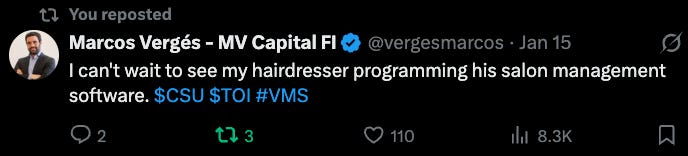
He’s not wrong.
The “Death of Software” Narrative
The bear case is that AI makes software a commodity, allowing cheap competitors to displace CSU’s systems of record.
However, we must differentiate between “vibe coding” and “enterprise software.”
Software development is just one part of the business.
The Business involves sales, complex integrations, compliance, security, and customer success.
The skeptics don’t understand that B2B software stickiness comes from regulatory integration and process reliance, not just the code itself.
In verticals like public sector, utilities, and healthcare (CSU’s core), the risk of displacement is low because failure tolerance is zero. In my opinion, AI is more likely to be a productivity layer than a replacement.
The Key Questions for Investors
Forget abstract debates about whether AI is powerful or not. We already know it is. Focus on observable signals:
Are contract cancellations increasing?
Is recurring revenue growth slowing in core verticals?
Is R&D spending spiking to stay competitive without margin payoff?
Or is AI integrating into products and operations without eroding stability or margins?
Right now, none of the alarm bells are ringing. The fear is narrative-driven, not data-driven.
The Valuation Reset
We rarely get to buy a compounder of this quality at a discount.
Current Valuation: ~22x Free Cash Flow available to shareholders (FCFA2S).
Historical Returns: CSU has compounded capital at 20%+ annually for two decades.
My conservative case assumption at this valuation is 15%+ IRR.
If we run a reverse DCF at current levels, the market is clearly pricing in a sharp and sustained slowdown in growth.
That assumption deserves scrutiny. CSU’s management has proven to be intellectually honest, adaptive, and pragmatic for nearly three decades across multiple shifts in the software landscape. AI is simply the latest frontier. They’ve openly said they are “monitoring it closely” and are “obsessed” with understanding its impact. That doesn’t sound like a team sitting still, waiting to be disrupted.
The current narrative-driven distress is uncomfortable, no doubt. But it may also create opportunity.
At roughly 22x FCFAS, you’re buying CSU with a management team that has repeatedly proven its ability to allocate capital well during chaotic periods. That combination, compressed expectations, optionality on M&A, and elite capital allocation, offers a meaningful margin of safety.
The Long-Term Bet Among a Painful Narrative
Constellation’s model has never been tested like this. That’s fair. The AI era is uncharted territory.
But there’s another side to the story. CSU has adapted before. What investors are really struggling with today is narrative discomfort: the loss of a familiar, predictable playbook that felt safe for years.
And yet, distress narratives often creates opportunity.
In this “SaaS-mageddon” environment, you could picture how over-leveraged PE firms struggle to refinance. Or, how some founders may prefer to sell rather than compete in an AI-native world.
The result? A larger pool of potential acquisition targets and, potentially, better entry valuations. If you’re a disciplined capital allocator, like CSU, that’s exactly the setup you want.
I could be wrong. Major technological shifts can do more than break narratives, they can permanently damage even great businesses. I don’t dismiss that risk.
But my conviction rests on CSU’s structure: decades of aligning returns-focused operators with pragmatic, high-quality capital allocation. If any organization is built to navigate uncertainty like this, it’s Constellation.
If you want to go deeper on this name, my views are largely reflected on this Deep Dive Brief trilogy:
🔗 Part III: How to Build a DCF for Serial Acquirers Like Constellation Software (includes DCF for CSU)
As for the spin-offs, Topicus and Lumine, I also wrote two pieces last year:
Mercado Libre (MELI) — The LATAM Digital Economy Builder Disguised as E-commerce
Many investors look at Mercado Libre (Meli) and see “the Amazon of Latin America.” If you view it through that lens, you are missing the real story.
Meli is not only another e-commerce company in LATAM. It has been building, for over two decades, the digital economy of a continent with 600+ million people.
I’ve been writing extensively on this name since I started Expanse Stocks and my readers know the high conviction I have been building on this name. This is reflected on my latest Deep Dive Brief trilogy I’ve published recently in the second half of 2025:
🔗 Part II: Mercado Libre’s Flywheel (includes DCF model)
The Valuation Disconnect
Let’s look at what’s currently priced in. We’re talking about a company with a ~$120 billion market cap trading at roughly 24x forward EBIT, an all-time low valuation.
A compression of this magnitude typically signals a business that’s hitting saturation or facing structural decline. But the underlying data tells a very different story:
E-commerce penetration in LatAm: ~14% (vs. ~26% in the US and ~30% in China)
TAM penetration: Meli has captured only ~2% of its ~$1.3 trillion serviceable market
So here’s the disconnect. You have a business growing revenue north of 30% annually (and recently, reaccelerating in key regions), the only company in history to compound at 20%+ YoY for 24 consecutive years, still sitting at 2% market penetration, yet trading at what looks like a terminal-decline multiple.
When fundamentals and valuation diverge this much, the market is offering a gift.
The Moat: Chaos is the Advantage
The bear case usually revolves around macro volatility or competition from Amazon and Shopee. However, I believe the specific challenges of Latin America act as a barrier to entry that protects Meli’s returns.
As I explained in the first part of my deep dive brief trilogy, Meli didn’t just copy the ebay or Amazon model like many still claim, they took the high risk to built what didn’t exist from the ground up.
Mercado Pago (Fintech) - 23 years old: Created to solve the lack of trust in a cash-dominated economy, now processing $200+ billion annually.
Mercado Envíos (Logistics) - 13 years old: A network spanning 18 countries with 22 fulfillment centers and 70,000 employees.
Even if a competitor arrived with unlimited capital today, they could not replicate the “muscle memory” Meli has developed by navigating two decades of regional instability. Operating in chaos is not a risk factor for MELI; it is their competitive advantage.
With gross margins trending toward 40% and a leadership transition that ensures continuity (Ariel Szarfsztejn taking the helm), the drivers for earnings growth are robust. The “flywheel” effect is real here: the marketplace drives payment volume, which provides data for lending (multi-billion $ credit portfolio), which reinforces marketplace usage.
Amazon (AMZN) — The Re-Rating Candidate
Amazon has arguably been “dead money” for five years, underperforming its big tech peers. Investors are fatigued. But as I have discussed in previous articles, investor fatigue often creates the best entry points.
The Sum-of-the-Parts Opportunity
The thesis here is simple: the market is mispricing the components and the optionality.
AWS: Projected to hit $170B in ARR with reaccelerated top line growth.
The Valuation: If you apply a 15x P/S multiple to AWS (consistent with peers like Microsoft in recent years), the math implies you’re almost getting the rest of Amazon for free.
Read that again. The entire e-commerce empire, the advertising business, the logistics network, Prime, MGM, Whole Foods, Kuiper, the Trainium chip unit… all of it priced at zero if AWS trades at peer multiples.
The Margin Story
The narrative that retail is a “low-margin” business is outdated in my opinion. Amazon is undergoing a margin revolution:
Robotics and automation driving fulfillment efficiency
Last-mile logistics optimization reducing delivery costs per package
Advertising revenue (high-margin) scaling inside the e-commerce flywheel
We are seeing a setup where retail margins expand due to automation, while the high-margin advertising business scales inside the flywheel.
There is a consensus building that 2026 will be the year of acceleration for both AWS revenue and retail margins. Although I don’t really like the “consensus” in investing, I’ve got to agree with this take.
Fears of AI disrupting Amazon’s search dominance are valid but likely overblown in the medium term. Even if discovery shifts to AI agents away from Amazon’s interface (a real risk, by the way), the logistics moat remains untouchable. Nobody else can deliver at this speed and cost structure. Discovery might fragment, but fulfillment doesn’t. The physical last-mile delivery, which Amazon dominates, cannot be digitized.
Trainium: The Chip Asset
AWS’s custom silicon unit is a massive long-term margin lever that almost nobody talks about. As AI infrastructure scales, hyperscalers with proprietary chips maintain pricing power and avoid full dependency on NVIDIA.
Trainium is a strategic asset that keeps AWS competitive in the AI buildout without getting crushed on component costs and margins.
The Optionality Stack
Kuiper: Satellite internet constellation. Direct Starlink competitor. Massive TAM if execution lands (and early signs suggest it will).
Advertising: Already a top-3 digital ad platform. High-intent commerce data. Growing faster than the core retail business. Analyst estimates suggest advertising revenue grows from $68 billion in 2025 to $142 billion by 2030, a 16% CAGR that keeps compounding on top of everything else.
The overlooked Prime ecosystem: 200 million+ subscribers and counting. Sticky, recurring, high lifetime value. The switching cost for a Prime member isn’t not only about losing free shipping, it’s losing the entire integrated experience.
It seems like the market is tired of hearing about “Amazon's potential”. That exhaustion is my opportunity.
Conclusion
My 2026 playbook won’t be about chasing the hot AI infrastructure trades. I’m already well positioned there and have been for years. Instead, it’s about spotting where the market has swung the pendulum too far the other way.
Mercado Libre. Constellation Software. Amazon.
Growth, quality, and optionality. All trading at mispriced valuations.
Thanks for following along,
— Nikotes