



Lumine Group reported Q2 2026 earlier last week, and if you only looked at the headline net income figure (if you’ve been here long enough I hope you don’t at this point, for f**k sake), you’d probably walk away thinking something went wrong. Net income fell 35% YoY.
For a serial acquirer whose entire pitch rests on compounding capital at high returns, that’s the kind of number that tends to spook people who don’t look past the first line of the income statement.
The net income decline is almost entirely a function of non-cash amortization, which grew 39% YoY as Lumine layered the Synchronoss Technologies purchase price allocation onto the balance sheet. Amortizing intangible assets is an accounting construct (not a real cash outflow), and conflating the two is how you end up missing what’s actually a cleaner quarter underneath the surface, specially when you look at the M&A activity YTD 👀.
Let’s get into it.
Financials
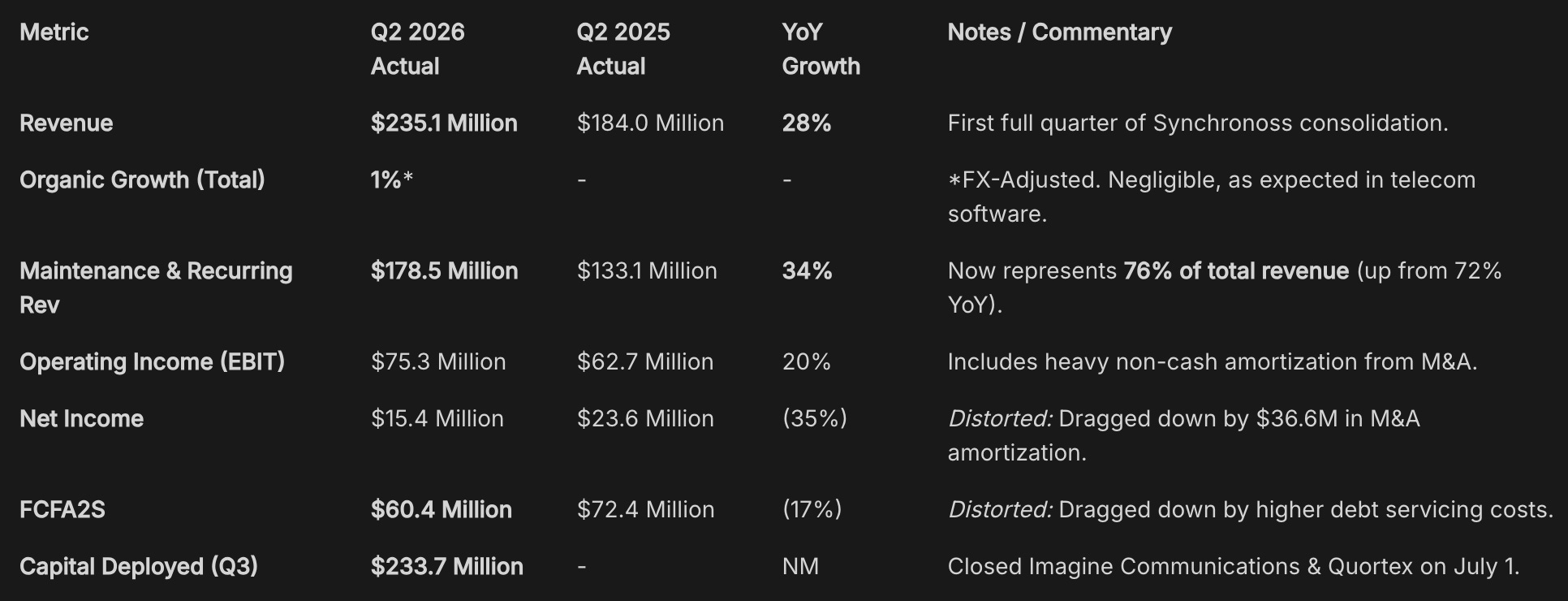
Headline Numbers Undersell the Story
Revenue grew 28% YoY to $235.1 million, and almost all of that growth is attributable to the first full quarter of ownership of Synchronoss, the $309 million acquisition that closed back in February. Organic growth, FX-adjusted, came in at a muted +1%.
I know some investors will look at that +1% and get uneasy, but this is by design, not a sign of a deteriorating business, I’ve explained this in my latest piece on the CSU complex (here: 🔗 Ranking Constellation, Topicus & Lumine) and I’ll explain why in the next section.
Operating income grew 20% YoY to $75.3 million, which on its own is a solid quarter. But the number I actually care about here is what I’d call the cash EBITA proxy: if you add back the $36.6 million of non-cash intangible amortization to operating income, you get to roughly $111.9 million of pre-amortization operating income, a 47.6% margin.
That’s the number that tells you how profitable the underlying cash-generating engine actually is, stripped of the accounting noise created by an aggressive acquisition pace. A business generating that kind of margin while simultaneously integrating a formerly public company’s cost structure is not exactly a business in trouble.
The +1% Organic Growth
This is where I think serial acquirers generalist investors get the Constellation/Lumine model wrong most often. The muted organic growth isn’t a sign that the underlying assets are stagnating but the result of a deliberate mix shift that’s happening underneath the headline number:
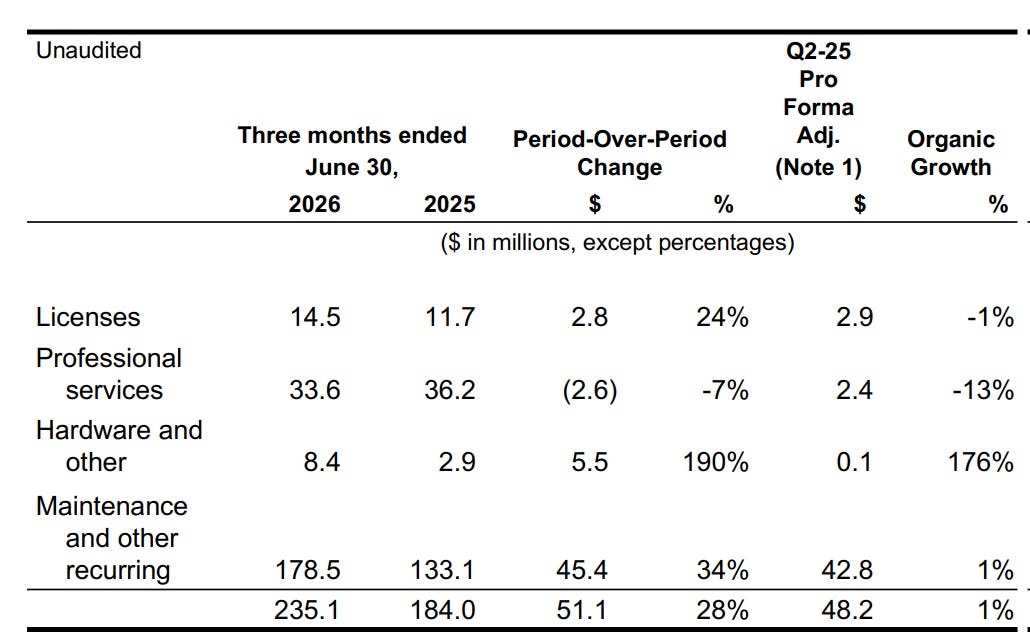
Recurring revenue is doing the heavy lifting. Maintenance and other recurring revenue grew 34% YoY, outpacing total revenue growth of 28%. Recurring revenue now makes up 76% of the total business. This is the kind of sticky, high-visibility revenue base that deserves a premium multiple, and it’s growing faster than the headline number suggests.
Professional services is shrinking on purpose. Professional services revenue declined 7% YoY (13% on an organic basis), and this is precisely what you want to see post-acquisition. Consulting work is low-margin and doesn’t scale, so running it off in favor of recurring maintenance contracts is straight out of the Constellation playbook. The “shrinkage” here is additive to quality, not a sign of lost business.
Put together, you get a business where the top-line growth rate understates how much better the earnings quality has gotten. A dollar of maintenance revenue is worth meaningfully more than a dollar of professional services revenue, and Lumine is actively reallocating its revenue mix toward the former.
A word on the persistent low/zero (potentially negative) organic growth profile of telecom software where Lumine operates in.
The underlying end market, which CEO David Nyland himself described as “fatigued and bruised” is precisely where Lumine’s strengths lie: buying dysfunctional carve-outs and operationally improving them.
I wouldn’t expect Lumine to replicate Topicus’ organic growth profile, and I don’t think investors should underwrite it that way. Lumine operates in less attractive end markets. What it gets in return is a different source of value creation: steep margin expansion post-acquisition.
A typical corporate orphan might come with 5–10% margins, bloated corporate overhead, inefficient sales structures, and limited strategic attention. Lumine can strip out those inefficiencies and turn them into 25%+ EBIT margin cash cows.
So the thesis isn’t really organic growth × multiple expansion. It’s acquisition + operational improvement + margin expansion + reinvestment.
The Synchronoss Digestion
In Q1, margins compressed as Lumine absorbed the bloated cost structure that comes with buying a formerly public company (redundant executive layers, public company compliance costs, the works). That compression was expected, and I wouldn’t have read much into it. What matters is what happens next, and by Q2, the first full quarter of ownership, the “Luminization” playbook is already visibly working.
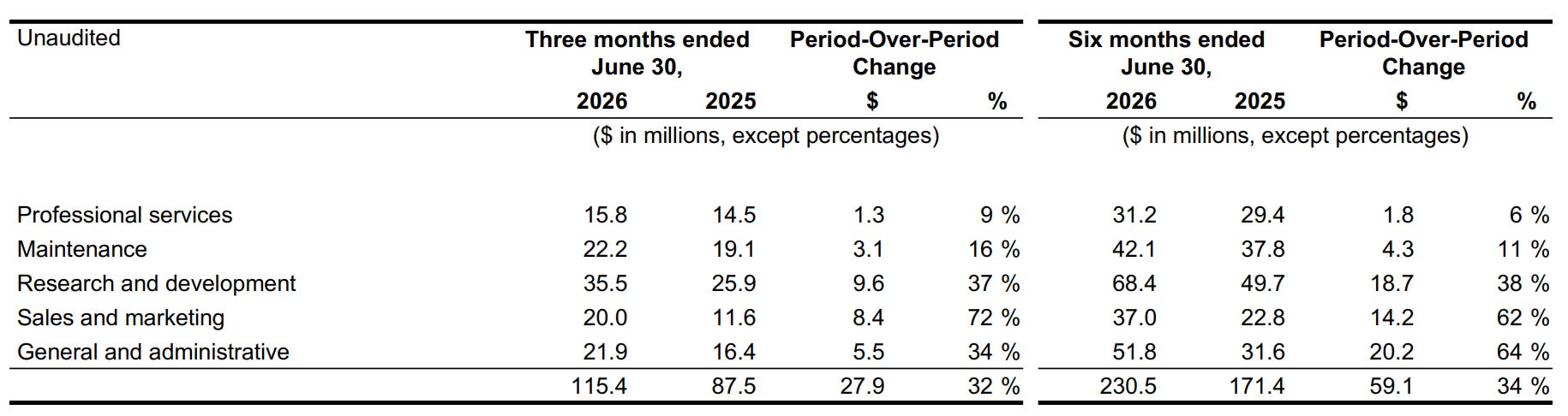
G&A expenses grew 34% YoY to $21.9 million, which on its own sounds like it’s outpacing revenue growth. But context matters here: in Q1, G&A had surged 95% YoY. Going from a 95% growth rate to 34% in a single quarter is a massive deceleration, and it tells me Lumine is stripping out redundant overhead and public-company costs faster than most operators out there would be able to accomplished in a such a short time.
I’d rather see a business demonstrate this kind of rapid cost rationalization in real time than simply take management’s word for it on a call.
Capital Allocation: Over $500 million Deployed in Six Months
If there’s one section of this report that should command the most attention, it’s the subsequent events note.
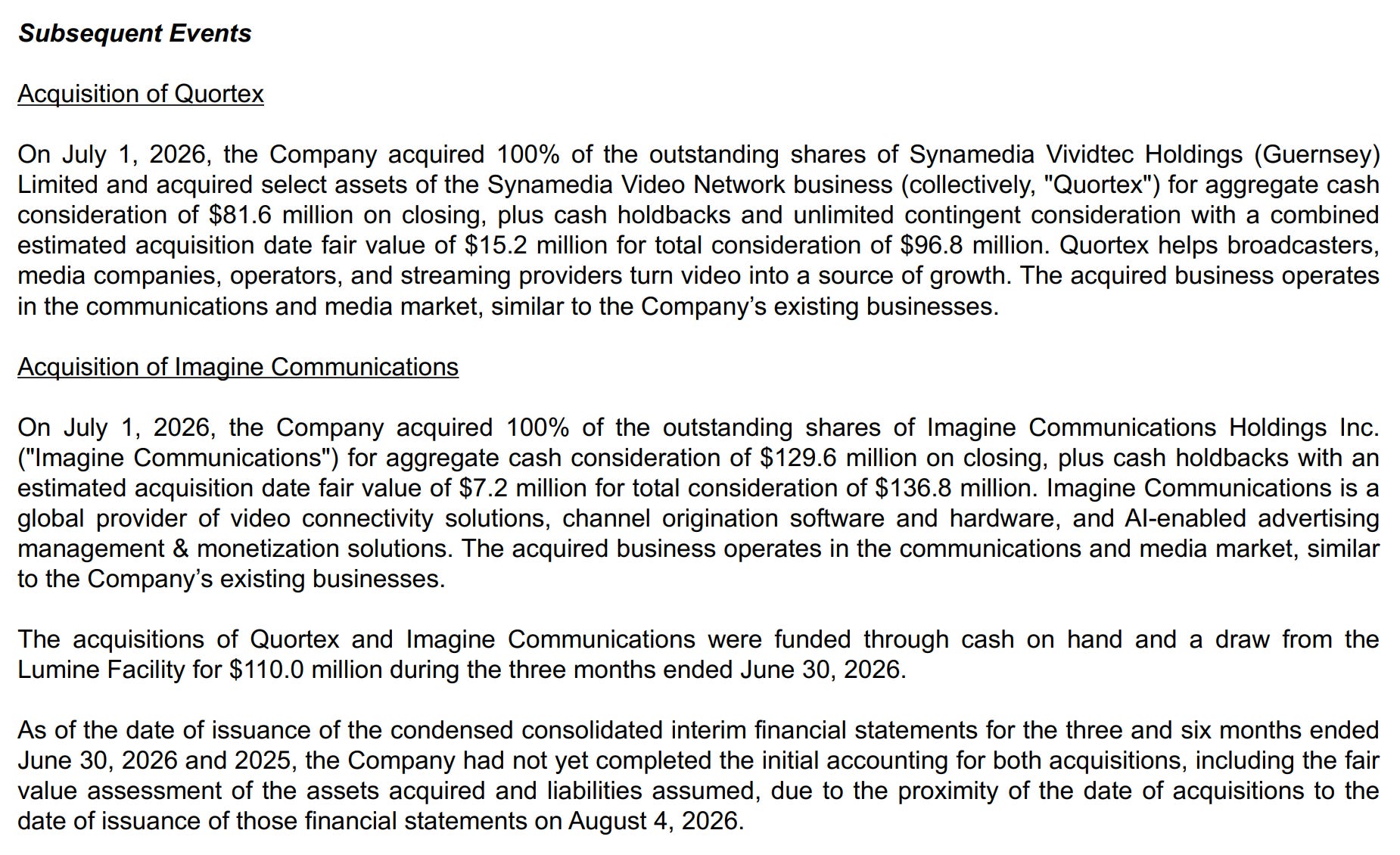
On July 1, literally day one of Q3, Lumine closed two acquisitions simultaneously:
Imagine Communications ($136.8 million), a global provider of video connectivity, channel origination, and AI-enabled ad monetization software.
Quortex ($96.8 million), a video streaming network software business acquired from Synamedia.
Combine those two with the $309 million Synchronoss deal from February, and Lumine has deployed roughly $543 million of capital in 2026 alone.
For a company generating $846M in TTM revenue, that’s a pretty serious amount of capital being put to work.
Now look at Lumine’s current $4.6B market cap and let that sink in. 👀
For more context, this is a highly specialised VMS business that was spun out of Constellation only 3-4 years ago. Deploying over half a billion dollars in six months, across three separate transactions, is not a pace you see from a business that’s struggling to find attractive uses of capital. If anything, it tells you the opposite: management is executing the playbook to the T and finding more high-return opportunities than they know what to do with, and they’re not waiting around to deploy capital.
To fund the July deals, Lumine drew down $110 million on its corporate credit facility, leaving $220 million drawn against a $360 million total capacity. That still leaves meaningful dry powder for further M&A in the back half of the year, which, given the pace we’ve just seen, I wouldn’t bet against.
Where I’d Want to Keep an Eye on Things
I don’t think any of this is a reason to sour on the thesis, but there is one item worth flagging so we’re not caught off guard down the road.
Free cash flow available to shareholders contracted 17% YoY to $60.4 million. Two things are driving this:
First, debt servicing costs are rising as the company leverages up to fund the acquisition spree: interest paid on bank indebtedness increased to $4.2 million from $3.9 million, and transaction costs on debt (essentially zero in the prior year) hit $1.9 million this quarter.
Second, working capital absorbed $20.3 million, driven primarily by an $8.4 million decrease in payables.
Neither of these strikes me as structural. They’re the direct cost of financing $500+ million of acquisitions in six months, and I’d expect both to normalize as the newly acquired businesses get integrated and payables timing settles.
Putting it together
Here’s what I take away from this quarter:
The GAAP net income decline is, yet again, a distraction. It’s almost entirely explained by non-cash amortization tied to an aggressive, value-accretive acquisition pace, not by any deterioration in the underlying business.
The revenue mix is improving even though the headline growth rate looks muted. Recurring revenue growing 34% while low-margin professional services shrinks is the trade-off for higher revenue and margin quality.
Cost integration is happening fast. G&A growth decelerating from 95% to 34% YoY in a single quarter is proof that Lumine’s management team is executing on the “Luminization” playbook.
Capital allocation remains the core of the thesis. Deploying $543 million across three deals in six months 🤑, for a $4.6$ market cap company three years removed from its spinoff, generating $846 million in TTM revenue, this is the kind of pace that should keep long-term compounding intact so long as returns on that capital hold up, which is what I’ll be watching most closely in the quarters ahead.
As I predicted in my 🔗 Lumine’s Q1 earnings digest, Q2 was going to look messy and the Q3 print is setting up to look even messier as Lumine absorbs both Imagine Communications and Quortex simultaneously. Expect another spike in G&A and deal-related costs, similar to what we saw with Synchronoss in Q1.
I wouldn’t read too much into that when it happens. This incoming digestion phase is not the risk here, it’s where the long-term value is actually being created.
Thank you, David Nyland, for executing the CSU playbook so perfectly year to date.

And thank you, to all my readers, for following along.
— Nikotes
Unlock Premium Content – For just $0.39/day ($12/month) or $0.27/day ($100/year)!
🔗 Portfolio Corner - 🗓️ Monthly Updates (Last Update: 28-Jul-2026)

Thanks 💚 🥃
thank you for such a thoughtful write-up