

Topicus Q2 2026
❤️ Serial Acquirers? Then You Better Get Comfortable With Lumpy M&A


Topicus reported Q2 2026 earnings last week, and if you only glanced at the headline numbers, you’d probably come away thinking it was a “not exceptional, not ‘meh’ either” kind of quarter.
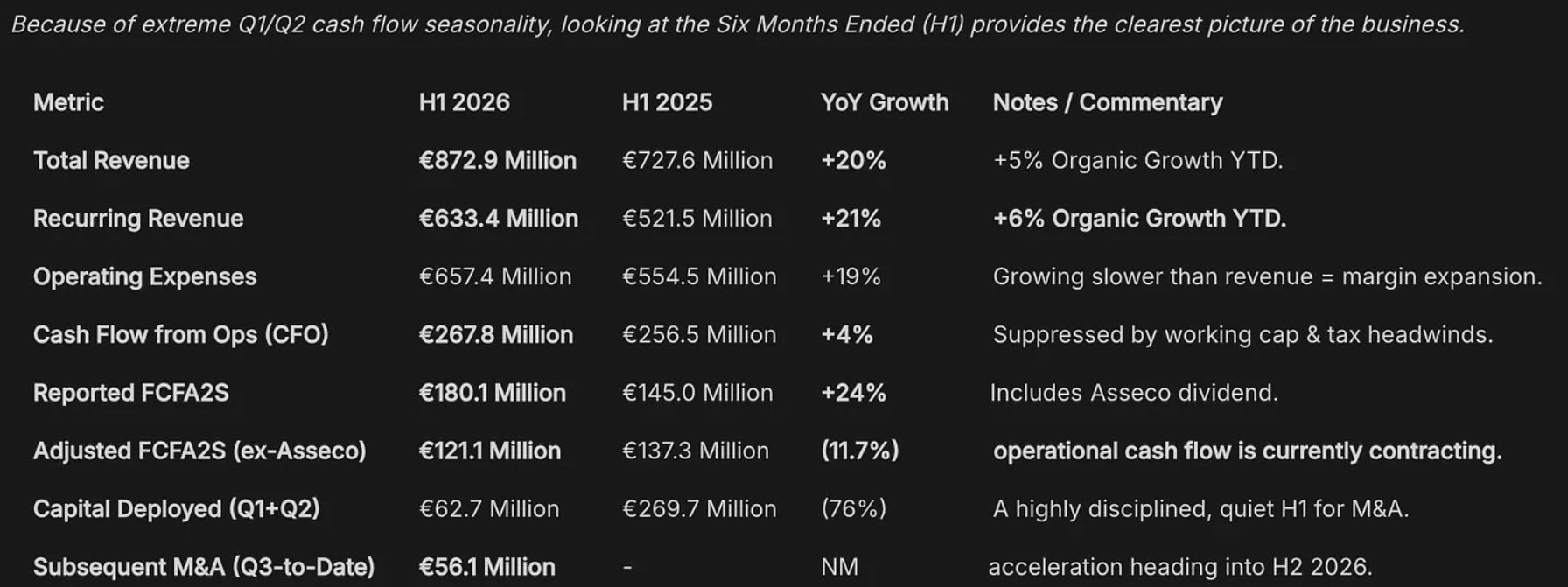
FCFA2S was up 24% YTD to €180.1 million, which is, on the surface, a very good print.
The catch is almost all of that growth came from a single source: the €59.0 million cash dividend received from Topicus’ 23.14% stake in Asseco Poland. Strip that out, and underlying operational cash flow actually went backwards YoY.
But, wait, do we need to strip it out? Not really. We’ll get into this later.
Underneath this noisy cash-flow accounting (trust me, it won’t get any simpler), there’s an attractive cash-generating business.
Although this complexity may be a reason for concern for some; for me, it’s more an invitation to dig a little deeper into what happened this quarter, and, more importantly, what comes next.
Because if you love serial acquirers, there’s one thing you’d better get comfortable with: complexity and M&A lumpiness (specially in the CSU family).
Let’s unpack the quarter.
Financials
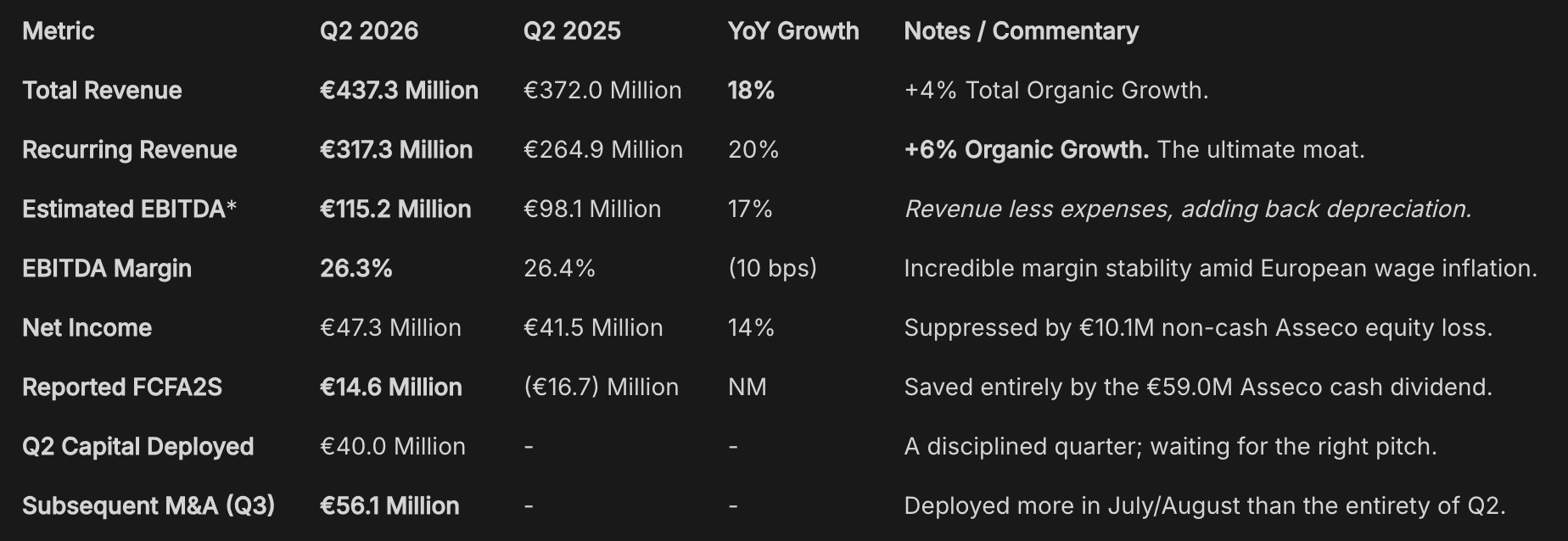
Q2 2026 Focus
H1 2026 Focus
A Solid, If Unspectacular, Quarter
Topicus delivered €437.3 million in Q2 revenue, up 18% YoY. Solid, not spectacular, and I wouldn’t read too much into the cash flow optics on their own, because Q2 is structurally the least relevant quarter of the year for Topicus from a cash generation standpoint.
The vast majority of recurring maintenance contracts are billed and collected upfront in Q1, which means Q2 through Q4 are, by design, a slow bleed of that working capital as it gets consumed by operations. More on that below.
The organic growth is steady and healthy. No signs of AI-driven acceleration though.
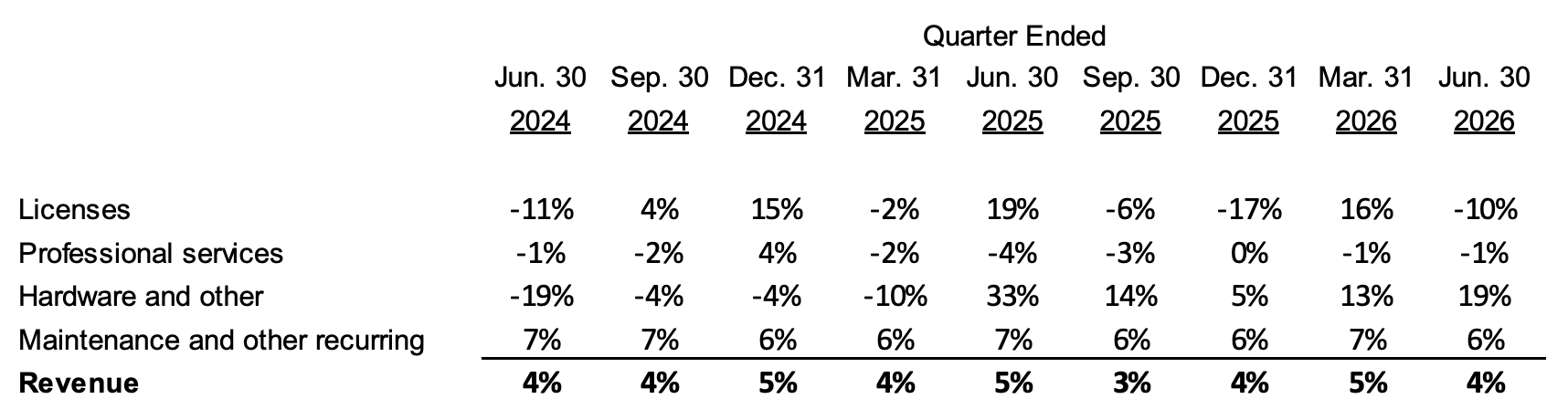
One of the highlights of the quarter, in my view, is the underlying organic growth of the software business. It continues to do exactly what you want a VMS compounder to do.
That said, if you were expecting AI to show up already in the form of customers paying up for new modules and accelerating organic growth, you might be disappointed. I won’t lie, I had the same dream too.
Overall organic growth came in at 4%, but the number that matters more is organic maintenance and recurring revenue growth, which came in at a defensive 6%.
Recurring revenue now represents 73% of total revenue, up from 71% in Q2 2025, and that 6% growth in the segment is, to me, one of the most important data points.
It tells us that, despite a sluggish European zero-growth macro environment, specially in the Nordics, Germany, the Netherlands, Belgium, France... the list goes on; the underlying software remains mission-critical.
We’re not seeing AI-driven acceleration in the reported numbers (not yet at least). But we’re seeing something important for a VMS compounder: high retention, recurring revenue growth, and pricing power holding up in a difficult macro environment.
The operating leverage story also seems to back this up.
Total expenses this quarter grew 18% YoY, matching revenue growth exactly, but staff expenses (the largest cost line) grew only 15%.
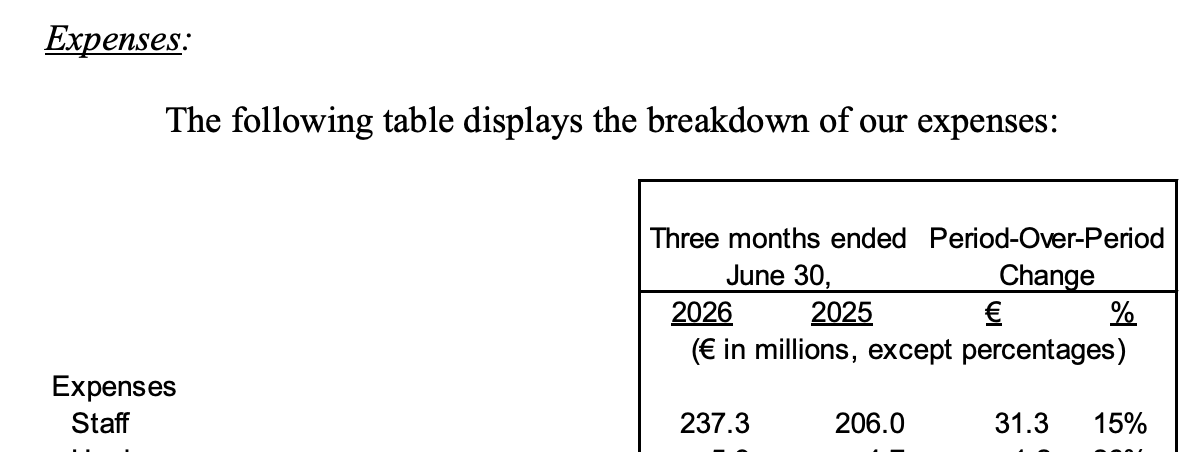
That 300-basis-point spread between revenue growth and staff cost growth is yet another evidence that Topicus’ management team knows exactly how to successfully digest its 2024/2025 acquisition cohorts, stripping out redundant headcount, and letting pricing increases flow to the bottom line.
The same pattern holds for H1 2026 as a whole: total revenue grew 20% YTD while staff expenses grew only 18%.
We can also back into an EBITDA figure, since Topicus doesn’t report the line explicitly. Taking revenue (€437.3 million) less operating expenses (€333.8 million) and adding back the depreciation embedded in those expenses (€11.7 million) gets us to €115.2 million of Q2 EBITDA, a 26.3% margin. That’s virtually identical to the 26.4% margin in Q2 2025.
n an environment of persistent European wage inflation (cooling from the 2023 peak, but still stubbornly elevated), combined with essentially zero GDP growth across some of Topicus' key markets, holding margins flat while growing recurring revenue 6% organically is, in my view, a quiet victory. It provides evidence that Topicus’ value proposition (and the pricing power that comes with it) is not simply a function of inflation or GDP growth.
Customers continue to pay for these products because they need them.
The Cash Flow
Here’s where the quarter gets more interesting, and where I think the headline FCFA2S number does investors a disservice if taken at face value.
Operating cash flow (CFO) was negative €12.7 million for the quarter. I wouldn’t panic about this in isolation, as it seems to be mainly driven by standard seasonality. Topicus invoices the bulk of its annual maintenance fees in Q1, so Q1 sees a bigger cash influx and Q2 through Q4 see that cash slowly consumed by operations. YTD CFO is actually up 4% to €267.8 million, which is more relevant number to anchor on. We’ll see how this evolves going into H2.
Let’s dig into the FCFA2S trend inside the MD&A:

What’s more concerning is what happens once you strip out the Asseco dividend and look at the underlying operational trend. Core FCFA2S (excluding the Asseco dividend in both periods) declined from €137.3 million in H1 2025 to €121.1 million in H1 2026. The MD&A isolates two culprits:
Working capital absorption. Topicus experienced a €23.4 million negative swing in non-cash working capital in H1 2026, driven by a €37.2 million decrease in accounts payable (they simply paid their bills faster) and some inventory build.
Higher cash taxes. The company paid €27.6 million in cash taxes in H1 2026, up from €21.9 million in H1 2025.
The business itself is highly profitable. Cash is just temporarily trapped in working capital cycles and tax payments, and the Asseco dividend arrived at a convenient moment to paper over what would otherwise have been a fairly ugly operational cash flow trough.
Now, this raises an interesting question:
Should we treat the Asseco dividend as a one-off, or as a structural benefit of the PEMS strategy that can increasingly flow through to Topicus’ cash flows?
PEMS: Optical GAAP pain, Real Cash Gain
To value Topicus properly, you have to decouple the income statement from the cash flow statement when it comes to the Asseco stake, because the two seems to tell us almost opposite stories.
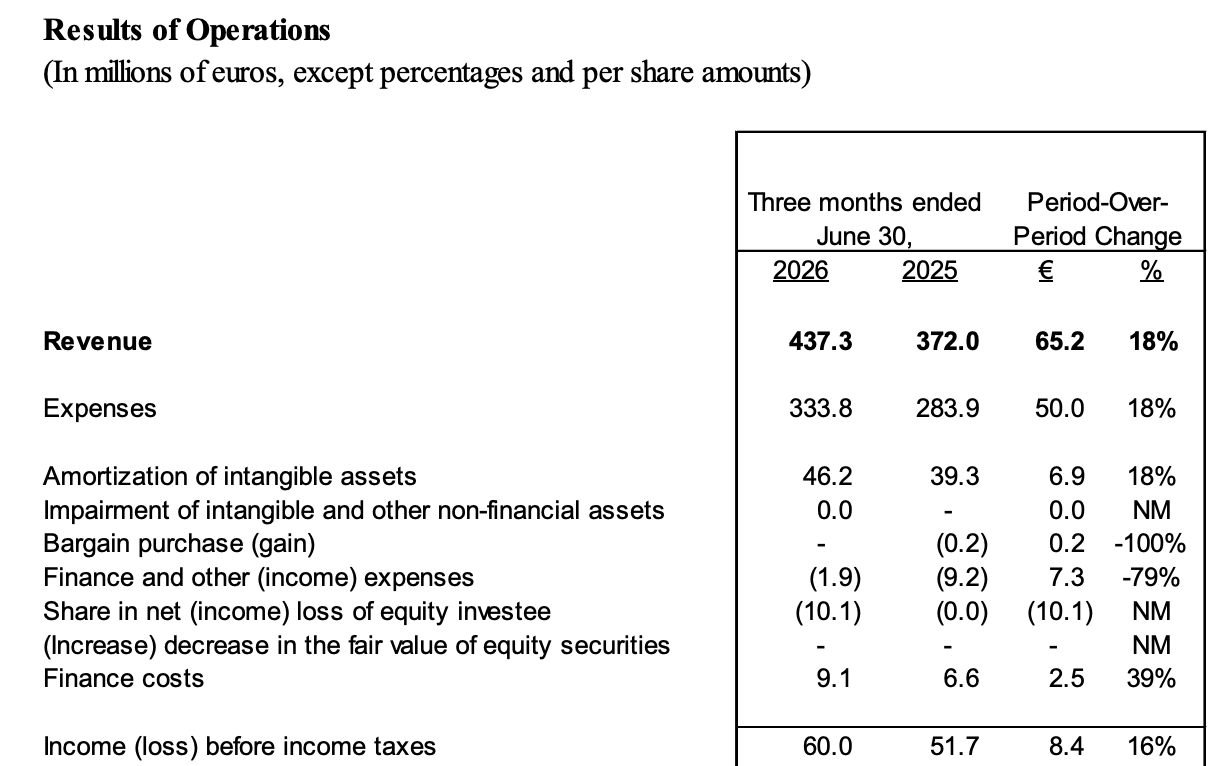
On the income statement, Topicus recorded a €10.1 million non-cash loss on the “share in net (income) loss of equity investee” line.
Why? Because Topicus uses the equity method with a three-month reporting lag for Asseco, so Q2 2026 actually reflects Asseco’s Q1 2026 performance. On top of that, when Topicus originally acquired its stake, it had to perform a purchase price allocation, assigning value to Asseco’s intangible assets. Those intangibles now have to be amortized against Topicus’s share of Asseco’s net income, and that non-cash amortization crushes the GAAP earnings line, making the investment look like a paper failure (it isn’t).
The cash flow statement tells us something different. The actual economic value of Asseco to Topicus is recurring cash extraction, full stop. As the MD&A puts it:
“The increase in FCFA2S is primarily due to a dividend in the amount of €59.0 million that was received from Asseco in Q2 2026 as compared to €7.7 million in Q2 2025.”
The PEMS strategy was born, in part, as a second-leg of optionality to extend the CSU complex M&A runway; and, in my view, partly out of frustration with elevated private-market multiples when the time simply isn't right to buy.
Put differently: rather than compete for expensive private VMS assets, Topicus took a large minority stake in a public VMS conglomerate, Asseco, at a low single-digit free cash flow multiple.
The trade-off is that Topicus absorbs some ugly, non-cash GAAP noise every quarter. What it gets in return is a real, growing cash yield that it can immediately recycle into private VMS acquisitions at its own strict hurdle rates.
It’s a capital recycling loop, and this quarter is a good demonstration of exactly how it’s supposed to work: optical GAAP pain, real cash gain.
Just wait until (if) the PEMS strategy at the mothership level gets big enough to matter at CSU scale. The accounting noise (and the bears feeding on it) will be something to reckon with.
CSU management mentioned on the Q1 2026 call that they’re actively discussing introducing a new internal metric, likely “Economic Net Income.” Please make it happen sooner rather than later. 🙏
The M&A Activity is Lumpy & You Should Get Used to It
To understand Topicus’s M&A pacing in 2026, you have to abandon any expectation of linear, QoQ capital deployment. Deployment ebbs and flows by design, and Topicus is currently giving a masterclass in cycle management.
Topicus deployed just €23 million in Q1 and €40 million in Q2, for €63 million total in H1 2026. Compare that to H1 2025, when total deployment reached €413 million (though that figure includes the one-off Asseco stake purchase itself). Stripping that out, “organic” acquisition deployment in H1 2025 was closer to €285 million, still way higher than what we saw in H1 2026.
Now, I wouldn’t rush to call the H1 2026 slowdown to a lack of targets. I’d rather see it as the result of strict adherence to hurdle rates. Anyone who knows the CSU playbook knows how unwavering they are on this point. If private sellers won’t come down to Topicus’s required return threshold, Topicus simply waits.
Because they refused to overpay, management redirected operating cash flow and the Asseco windfall toward the balance sheet instead, paying down €228.8 million on the revolving credit facility YTD.
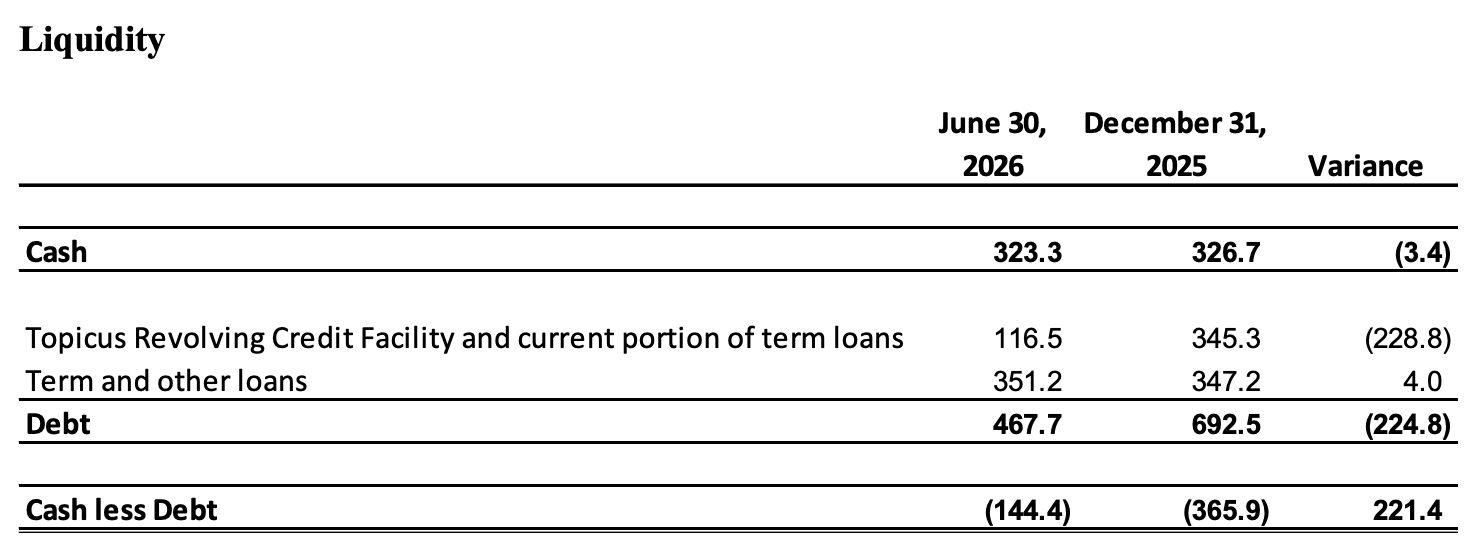
Topicus ended Q2 with €323.3 million in cash against €467.7 million in debt, for net debt of just €144.4 million. The result is a Net debt / EBITDA at just 0.4x, about as clean a balance sheet as you’ll find in this space, and it’s effectively a coiled spring: hundreds of millions in dry powder sitting idle, waiting for valuations to move.
And it looks like they might be moving. In the subsequent events note, Topicus disclosed that it has already committed €56.1 million to new acquisitions in just the first 35 days of Q3, nearly as much as it deployed in the entirety of H1. Combined with H1 spend, that puts YTD deployment (including subsequent events) at roughly €120 million. Still light versus 2025, but the M&A trajectory seems to be improving.
Before going into next section, I’d like to bring in some gossip/hype in the VMS and M&A activity story going into H2 2026 with something Roper Technologies said on their call a few weeks ago: management flagged early signs that private software valuations are starting to mirror, or come down toward, public market multiples. Some private equity checks I’ve seen point in the same direction.
Gotta admit, I kind of like myself in full speculative mode 😎, but if private market software valuations in the US (and potentially Europe) are beginning to capitulate, that’s the environment in which Topicus re-engages its dry powder at its own strict hurdle rates.
Risks & Interesting Things To Watch Going into H2
The operational cash flow drag. Working capital swings are normal, but Q3 and Q4 CFO deserve closer monitoring. If core FCFA2S (ex-Asseco) keeps declining YoY, it could raise a more interesting question: Are Topicus’ recent acquisition cohorts structurally more capital-intensive (or simply less cash-cows) than CSU' historical portfolio? It’s probably way too early to draw that conclusion, and I wouldn’t read too much into a couple of quarters given the inherent lumpiness of M&A and working capital. But it’s something I’ll be watching closely.
Asseco equity accounting volatility. The three-month lag and the equity method mean Topicus’s GAAP net income will keep carrying un-hedgeable, non-cash volatility tied to Asseco’s reported results. Investors need to be comfortable looking past messy P&L prints to focus on cash generation and dividends, but it’s worth being honest that this volatility is a real feature of the PEMS strategy.
Q2 Takeaways
Look through the Q2 seasonality. Q2 is structurally the least relevant quarter for Topicus, and negative CFO here is mainly driven by standard seasonality tied to how the company invoices its customers, not a warning sign on its own (yet).
The core is unbroken. Underneath the cash flow and net income noise, the software business is steady. 6% organic growth in recurring revenue and flat-to-expanding EBITDA margins in an inflationary European labor market are proof that the underlying VMS model is durable.
The balance sheet is a coiled spring. By paying down €228.8 million in debt during H1 rather than chasing overpriced deals, Topicus brought net debt down to €144.4 million. That’s a lot of unused capacity sitting on the sidelines.
The M&A engine may be reloading 👀. The €56.1 million deployed in the first 35 days of Q3 is a good start. Paired with early, still-unconfirmed signs of softening private market valuations, and a nearly unlevered balance sheet, Topicus looks well positioned for a much heavier back half of capital deployment in 2026.
See through the Asseco (PEMS) distortion: optical GAAP pain, real cash gain.
The 24% YTD growth in FCFA2S is almost entirely the product of recurring dividend payments. While underlying cash conversion is facing headwinds from working capital and cash taxes, and that deserves to be tracked. Another trade-off of PEMS is that Topicus absorbs some ugly, non-cash GAAP noise every quarter. What it gets in return is a real, growing cash yield that it can immediately recycle into private VMS acquisitions at its own strict hurdle rates.

Thanks for following along,
—Nikotes
Unlock Premium Content – For just $0.39/day ($12/month) or $0.27/day ($100/year)!
🔗 Portfolio Corner - 🗓️ Monthly Updates (Last Update: 28-Jul-2026)

Great write up!
One correction though…
You say “On the income statement, Topicus recorded a €10.1 million non-cash loss on the “‘share in net (income) loss of equity investee’”.
This is not a loss. It’s income. It’s simply presented as negative in that table because it’s a reduction of expenses