



Meta reported Q2 2026 earnings, and it was messy. The market has chosen blood and it’s doing what it usually does after a complex quarter, to fixate on:
The 31% operating margin (down from 43% a year ago),
or the $784 million in Free Cash Flow on $60.8 billion in revenue,
or the $31.1 billion CapEx quarter
At first glance, this looks uninspiring, another “Zuck betting da house” moment.
The market has seen this movie before (2022) and doesn’t seem eager for a sequel, especially when Microsoft reported on the same day, and Satya and Amy show you what AI investment looks like without blowing up the income statement or cash flow.
You’ve got to love Zuck, though. He never does things by halves.
Now, you coud paint a very different (and rosier) picture from these results, by choosing to fixate on:
the 28% revenue growth at this scale,
the 8.3% uplift in ad clicks + the 15.7% conversion improvement,
or the $75 billion Meta Advantage+ run rate,
Suddenly, the story looks very different. I suppose that’s what makes a market.
Let me be clear upfront, these results seem more positive than they look on what matters for the long-term thesis envisioned by Zuck.
The noise obscures a core advertising business that is, in my view, the most powerful digital ad engine ever built. What Meta is doing with AI looks more like a structural overhaul of how advertising works (I go deeper on this later). And the billions in CapEx? And the billions in operating costs ?! That’s another debate worth having.
Financials
The Ad Business: There is Nothing Quite Like It
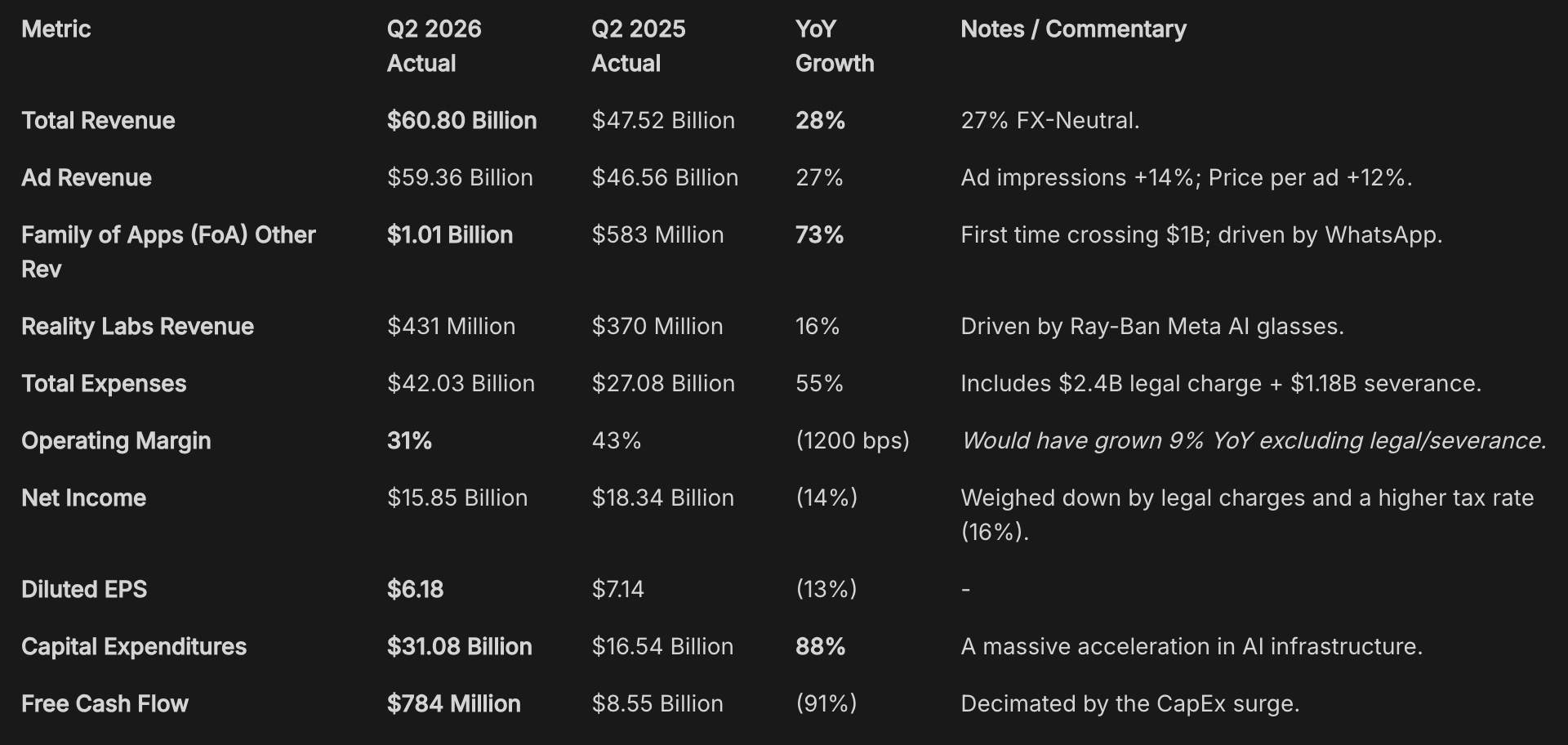
Revenue grew 28% YoY to $60.8B. Before you contextualize that away, consider that Meta generated $13B in incremental revenue in a single Q on a base of $47.5B. I wouldn’t simply call this is a macro tailwind (specially in this environment), but more like an AI-driven tailwind driving improvements in ad targeting, engagement, and monetization with structural legs.
The centerpiece of the ad story this quarter is what Meta calls the Meta Generative Recommender:
“We introduced Meta Generative Recommender, a paradigm shift in how our ad system works. Rather than scoring every possible ad individually, we are now using LLMs to reason about ad content and user preferences together... This makes our ad matching more intelligent and more precise, which compounds performance gains for advertisers.” — CFO Susan Li
This is a paradigm shift in how their ad ranking system works. Rather than scoring every possible ad individually and then matching, they are now using LLMs to reason about ad content and user preferences simultaneously.
The results seem to validate this new approach:
Ad clicks on Facebook rose 8.3%,
conversions improved 15.7%,
and the average price per ad grew 12% year-over-year.
The advertiser reaction to this is rational, they’re willing to pay more because the return on ad spend (ROAS) are better. This is how you get sustained pricing power in digital advertising, not from scarcity of inventory, but from superior ROI for the buyer.
There is one number that I don’t think got enough attention: Advantage+. This is Meta’s automated creative and targeting suite, which is now running at a $75B annualized revenue rate, representing 33% of total revenue.
That’s a meaningful chunk of total revenue coming from a product line that essentially automates media buying for SMBs. Small and medium businesses are price-sensitive and quick to cut spending when returns disappoint. The fact that Advantage+ is scaling at this rate tells you the product is working and generating ROI.
On the engagement side, Meta is equally impressive. Instagram global time spent grew double digits. Over half of all recommended content in the IG feed is now less than one day old, double the rate from last year. Facebook video time spent grew 9%. The AI-driven content discovery engine is extending session times, which means more ad inventory, which means more revenue. The flywheel is spinning fast.
WhatsApp monetization
Another overlooked datapoint in an earnings release full of big numbers is what happened to “Other Revenue” within the Family of Apps segment.

This line (essentially WhatsApp monetization) crossed $1 billion for the first time, growing 73% YoY. For a product that’s been really hard to monetize for years after the acquisition, this seems like a big step forward.
But it’s not just the revenue number. Zuckerberg explained in the call a specific B2B use case: Movida, a rental car company in Brazil, deployed Meta’s AI business agent on WhatsApp. The result was that 85% of customer conversations were handled entirely by the AI, with a 44% increase in daily bookings. I would be the first to say that a single case study does not make a thesis. But the potential of what Meta is building here is hard to dismiss. If AI agents can handle the majority of customer service interactions at scale, at a fraction of the cost, while improving conversion rates, then the addressable market for WhatsApp’s B2B offering is very large and largely untapped in the Western economy.
The CapEx
Here’s where I’ll spend most of my energy. (Do you see what I did here? 😆 😎… 🙄).
Onwards.
Meta spent $31.1 billion on CapEx in a single Q. That is nearly double what they spent in Q2 2025. FCF consequently crashed to $784 million, down from $8.5 billion a year ago. If you are in the business of valuing companies on trailing free cash flow, this quarter looks catastrophic. If you’re trying to understand what Meta is building (and believe in it), it looks different.
CFO Susan Li provided some good framing:
“The industry has underbuilt historically for the wave of AI adoption, making existing capacity, including our own, extremely valuable... we believe near-term capacity is more valuable than long-term capacity, and it remains a very dynamic planning process.”
There are two legitimate ways to read this.
The bull interpretation: compute is a constraint on AI product rollout, and a company willing to build ahead of demand can achieve structural advantages in latency, cost, and product capability that capacity-constrained competitors cannot match.
The bear interpretation: this is a late-cycle capacity build that will be stranded if demand proves smaller than anticipated.
What I found more interesting than either clean interpretation is Zuckerberg’s disclosure that Meta is already receiving inbound offers to purchase its excess compute capacity from external buyers:
“There’s just nowhere near enough compute for all the demand. So that is why we see that... we are getting a large number of offers for the compute that we have... we believe that there will continue to be a significantly higher margin on selling intelligence rather than selling compute directly. But we think that there’s a big opportunity, obviously, to sell compute as well.”
This changes the risk calculus somewhat. If the internal AI products disappoint, Meta has a potential fallback in selling raw compute capacity at a time when supply is deeply constrained globally. The recent announced venture with BlackRock to develop a 1-gigawatt data center in Texas is another signal that Meta is evolving its capital structure to handle “long-duration” AI infrastructure projects without fully draining the balance sheet.
(Laughs). “Zuck is all in, he doesn’t care about the balance sheet”. Maybe, but give the man a break, he plays hard.
My view is I don’t really think the CapEx level is unreasonable given what Meta is trying to achieve. What I do think is that the market will interpret it as unreasonable in the short term, and that the resulting multiple compression is where either the opportunity or the risk lies, depending entirely on your conviction in the long-term thesis.
The full-year CapEx guidance of $130–$145 billion confirms the long-term plan. So, the real question to ask yourself is: Do you believe?
The Costs
Total expenses grew 55% YoY to $42 billion, and operating margin compressed from 43% to 31%. These are large scary numbers, and they require context.
Embedded in this quarter’s expense base are two items I would not expect to recur: a $2.4 billion legal charge and $1.18 billion in severance tied to an 8 000-person headcount reduction. Strip those out, and operating income growth would have been approximately +9% despite the CapEx backdrop. Not spectacular, but not the collapse the headline number suggests.
The more serious medium-term cost concern is the ongoing legal exposure. Susan Li warned that Meta faces several “youth-related trials” in the U.S. later this year that could “ultimately result in a material loss.”
I am not in a position to predict legal outcomes, but the regulatory and legal environment for social media companies (particularly around minors) is not improving. The potential liability is not something I’d dismiss, and I would rather flag this as a legitimate risk that extends well beyond the Q2 charge.
Zuckerberg’s Sovereignty Argument: Why Building a Frontier Model?
One thing worth addressing is why Meta is committed to building proprietary frontier models rather than relying on open-source weights.
This is the strategic decision that guarantees CapEx and R&D costs remain elevated as Meta competes directly with OpenAI, Microsoft, and Google. Zuckerberg made his point very clear:
“I think we just have the ability to build things that can be more personalized, more optimized, more efficient. Some qualitative experiences are just not even possible for others to build because we go all the way down the stack. It just seems to me pretty clear that having kind of sovereignty over building your own models is going to be an important part of that stack going forward.”
Whether you agree or disagree with this framing, it is important to understand that it is not a short-term commitment, but a multi-year architectural decision.
If the model is right, that personalization depth and going “all the way down the stack” creates experiences that open-source models cannot replicate, then the CapEx becomes the moat.
If it’s wrong, then Meta is spending $130–$145 billion annually to compete in a race where they may be outgunned by OpenAI and Google, or undercut by open-source alternatives.
Whatever the outcome is, once again, Zuck is playing the long game and placing big bets.
Reality Labs: An Undeniable Dumbster Fire
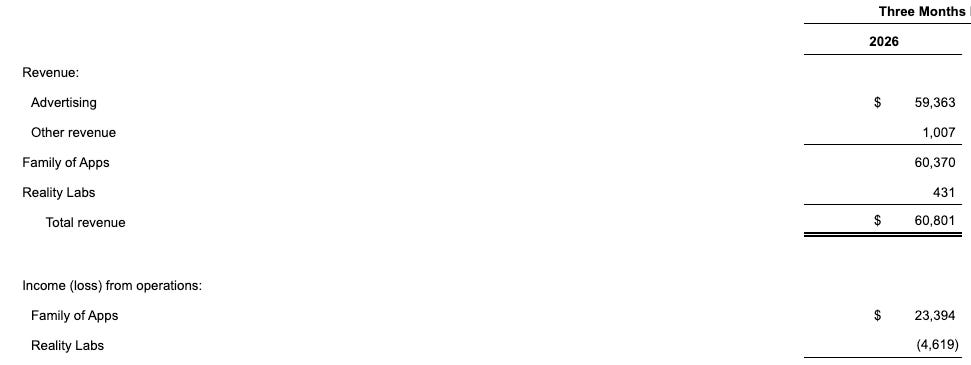
Reality Labs (in short): roughly $1 of revenue for every $10 of operating losses.
Time to move on, Zuck.
What this Q validated (and What it Didn’t)
In the spirit of keeping score:
The core ad business is exceptional. AI-driven improvements to targeting, content matching, and conversion are real, measurable, and driving pricing power. 27% revenue growth at $60 billion in quarterly revenue doesn’t happen by accident.
WhatsApp monetization is shaping up. The $1 billion “Other Revenue” milestone is a proof of concept for the B2B agent thesis. The Movida case study explained by Zuck seems to be the kind of ROI evidence that will accelerate enterprise adoption.
The CapEx cycle is the defining bet and the wildcard. Meta is making a generational capital allocation decision ($130–$145 billion on CapEx annually) on the premise that AI compute will be the true infrastructure advantage of the coming decade. If that’s right, this CapEx, Meta’s network and know-how will reinforce the moat. If it’s wrong, it’s a significant value destroyer. There’s no clean way to hedge that view.
Legal risk deserves closer monitoring. The quantum of potential liability from youth-related litigation is unknown, but tail risk of this kind should not be dismissed, especially as political and regulatory scrutiny of social media intensifies.
The B2B pivot is early but has potential. API access, compute sales, and enterprise AI agents are not today’s revenue story. But Meta’s distribution advantages (3+ billion daily actives across its apps) are not something that can be easily replicated by competitors trying to build into the same space.
The question worth asking, and the one that will define whether this is a great investment or an expensive mistake, is whether you trust Zuck.
Thanks for following along,
—Nikotes
Unlock Premium Content – For just $0.39/day ($12/month) or $0.27/day ($100/year)!
🔗 Portfolio Corner - 🗓️ Monthly Updates (Last Update: 28-Jul-2026)
