



Mercado Libre (Meli for those in the know) just posted the fastest revenue growth it’s put up in four years, and yet a good chunk of the initial commentary and market reactcion I’ve seen zeroes in on the fact that operating margin contracted 550 basis points YoY.
This is a pattern I’ve grown used to seeing across some companies I follow: the market finds a number to fixate on that, taken in isolation, sounds concerning, while ignoring the whole context that actually explains it.
In Meli’s case, that number is the EBIT margin, and once you realise where the compression is coming from, I don’t think it’s a red flag at all.
To give the bears some credit, I get it. Meli is a high-growth business operating across riskier emerging markets, while facing the ever-present threat of Chinese competition. Those are legitimate risks. But it’s not as if Meli hasn’t faced, and overcome, major challenges before.
The company has a (long) history of navigating harsh environments, adapting its business model, and coming out stronger on the other side. If you haven't read it yet, I'd recommend checking out my piece on 🔗 Mercado Libre’s Origin Story - Part I to better understand how this company was built, and what survival really means for the business and the people behind it.
Let’s start with what actually happened in Q2.
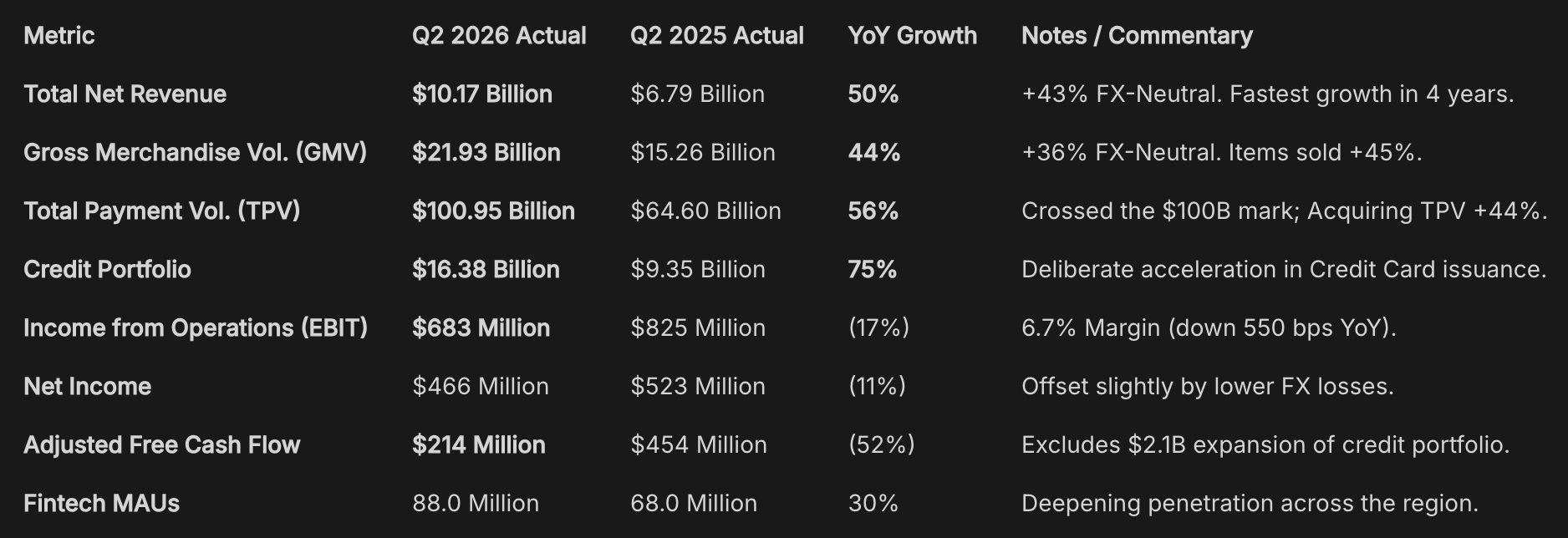
Net revenues surpassed $10 billion for the first time, up 50% YoY, the fastest pace of growth the company has delivered in four years.
FX-neutral GMV grew 36%, and Total Payment Volume crossed the $100 billion milestone, up 56%.
Income from operations came in at $683 million, a 6.7% margin, down 550 bps YoY but broadly stable sequentially (QoQ).
On this last point. Management didn’t hide from it and explained (once again) that the compression is a choice and that they are actively redeploying operating leverage into customer acquisition (credit card issuance in Brazil, lower take-rates for sellers, subsidized POS devices in Mexico) to entrench their market position (build the moat) while the opportunity is there.
The question for a long-term investor is whether the money is being spent on real, defensible growth or whether it’s just competitive discounting with no payback. Let’s dig into that.
Financials
The Margin Story: Good Costs vs. Bad Costs
Not all margin compression is created equal.
Let me elaborate: a company that’s losing pricing power to a competitor and cutting prices defensively is in a very different position from a company that’s found high-return reinvestment opportunities and is sacrificing near-term profitability to capture them.
Meli’s Q2 looks a lot more like the latter, and I think the three main drivers make that case clearly:
Brazil commerce investments.
Meli lowered seller take-rates in specific verticals and offered PIX payment discounts to buyers. Some argue this was mainly a defensive move to counter Shopee's rise in the region, as Meli was starting to lose pricing power. I get the concerns, these initiatives obviously compresses margins in the short-term. BUT the results from this so-called “defensive move” are difficult to argue with, and, in my view, tell a more interesting story: Active sellers grew 29% YoY and items per buyer grew 19% YoY.
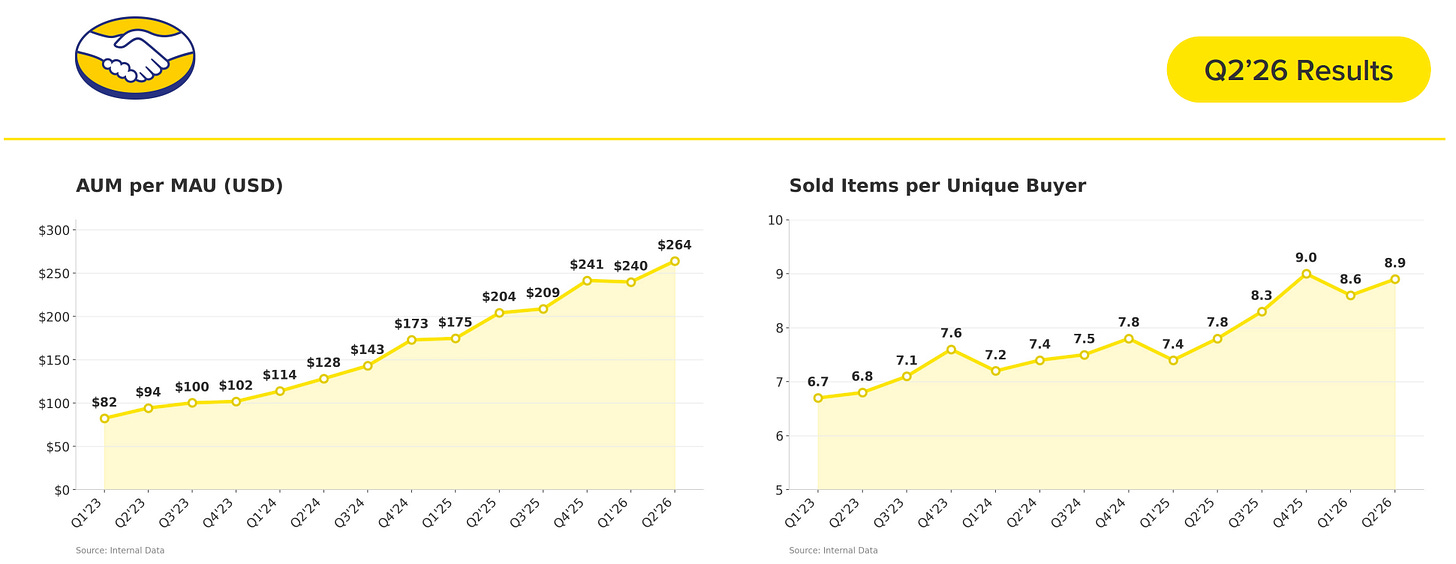
Extract from Meli’s Q2 Letter to Shareholders Management made sure to put this graphs at the avant garde of the Q2 shareholder letter. Not a coincidence. They want you to know they’re winning.
This does not look like a company buying growth with no return, but a company buying market share at a price that’s translating directly into higher engagement across the platform.
The credit card 🔗 J-curve.
Meli issued 2.6 million new credit cards in Brazil in Q2, up from 1.6 million a year ago. Credit card cohorts take 12 to 18 months to reach breakeven on a Net Interest Margin After Losses basis, so a period of accelerating issuance will suppress current profitability, even if every single cohort is behaving exactly as expected. Osvaldo Gimenez, President of Fintech, addressed this during the CC and also made an additional interesting point:
“It was nearly breakeven a year ago; at minus 2.5% [NIMAL] now. But that is driven mostly by the fact that we were able to accelerate the speed of issuance. A year ago, we issued 1.6 million cards in a quarter, and this quarter we issued 2.6 million cards in Brazil... And beyond the payback in the card itself... they are more likely to be ecosystemic users and to have higher engagement and higher profitability in the platform.”
This is a textbook J-curve. The faster you grow originations, the worse the blended NIMAL looks in any given quarter, purely as a function of mix (you have more young, unprofitable cohorts diluting the older, mature ones). What matters isn’t the current blended number, it’s whether each cohort is individually tracking toward profitability, and whether the card is doing its job beyond its own economics, which brings me to the next point.
Mexico POS subsidies and chip inflation.
Meli now has 1.4 million active POS devices in Mexico, more than all incumbent banks combined, and is subsidizing terminal sales to keep winning the offline cash-to-digital conversion. On top of that, global memory chip inflation pushed up the unit cost of these devices, adding an unplanned, immediate hit to Acquiring margins on top of the deliberate subsidy. This second piece is worth separating out because it’s a cost headwind and also a transitory one tied to a commodity input.
Put together, I think this tells a fairly coherent story: the bulk of the margin compression is Customer Acquisition Cost (CAC), not deterioration, and CAC that’s already showing up in the metrics that matter, i.e. active sellers, items per buyer, “ecosystemic” engagement.
The Ecosystemic Flywheel Builds the Moat
If there’s one number in this release that I think matters a lot for Meli’s long-term dominance, it’s this one: users who engage with both the marketplace and Mercado Pago, what management calls “ecosystemic users,” grew 37% YoY.
These users generate 70% more GMV and roughly double the TPV of single-platform users. Here’s how leadership framed the flywheel:
“When we see an ecosystemic user have 70% more GMV on the marketplace and 90% more TPV, double the assets under management, so very much engaged... that results in better profitability... The bigger and the more engaging our marketplace becomes, the better chances we have of building the largest digital bank in Latin America.” —Ariel Szarfsztejn, CEO
This is the crux of the whole thesis, in my view.
As I explained in a second piece I released earlier this year, 🔗 Mercado Libre’s Flywheel - Part II, Meli isn’t really running a marketplace business and a fintech business side by side; it’s running a single flywheel where commerce funds fintech acquisition and fintech, in turn, deepens commerce engagement. The credit card issuance discussed above isn’t just about lending product, it’s more about a customer acquisition tool for the entire ecosystem, since cardholders are 2 to 3x more likely to become highly profitable ecosystemic users.
Once you see it this way, the margin compression stops looking like a cost of doing business and starts looking like the moat building itself.
The AI dividend
Another positive note from this report was to see Meli starting to extract real efficiency out of AI on the cost side, and I think this part of the release deserves more attention than it’s getting.
Despite business volume roughly tripling over the last four years, customer service headcount actually shrank, from 10 000 reps to 7 000. CFO Martín de los Santos put it this way:
“Four years ago we used to have 10,000 reps on customer service. Today, we have 7,000 reps, even though the business grew by 3x in that period of time. And that’s because 90% of the interactions are done without a human participating... In product development, human-written code is an exception. All of the code, the majority of the code is done by AI.”
These last lines are worth sitting with. This has become a company where 20 000 developers are using AI tooling and where code submissions are up 110% YoY, to the point where human-written code is described as the exception rather than the rule. Jensen would be proud.
The result also shows up cleanly in the financials:
Product Development expenses fell from 8.4% to 7.2% of revenue YoY, despite an $80 million increase in AI investment itself.
Advertising is another beneficiary, with generative recommender-style models now embedded in Mercado Ads, which crossed 10% share of Latin America’s digital ad market for the first time and grew 62% YoY on an FX-neutral basis.
So while the P&L shows margin compression at the consolidated level, there are two different forces at work underneath it: deliberate, ROI-positive customer acquisition spend on one side, and structural efficiency gains from AI on the other. As you can see, netting the two together and reading only the headline number misses most of the story.
Regional Dynamics
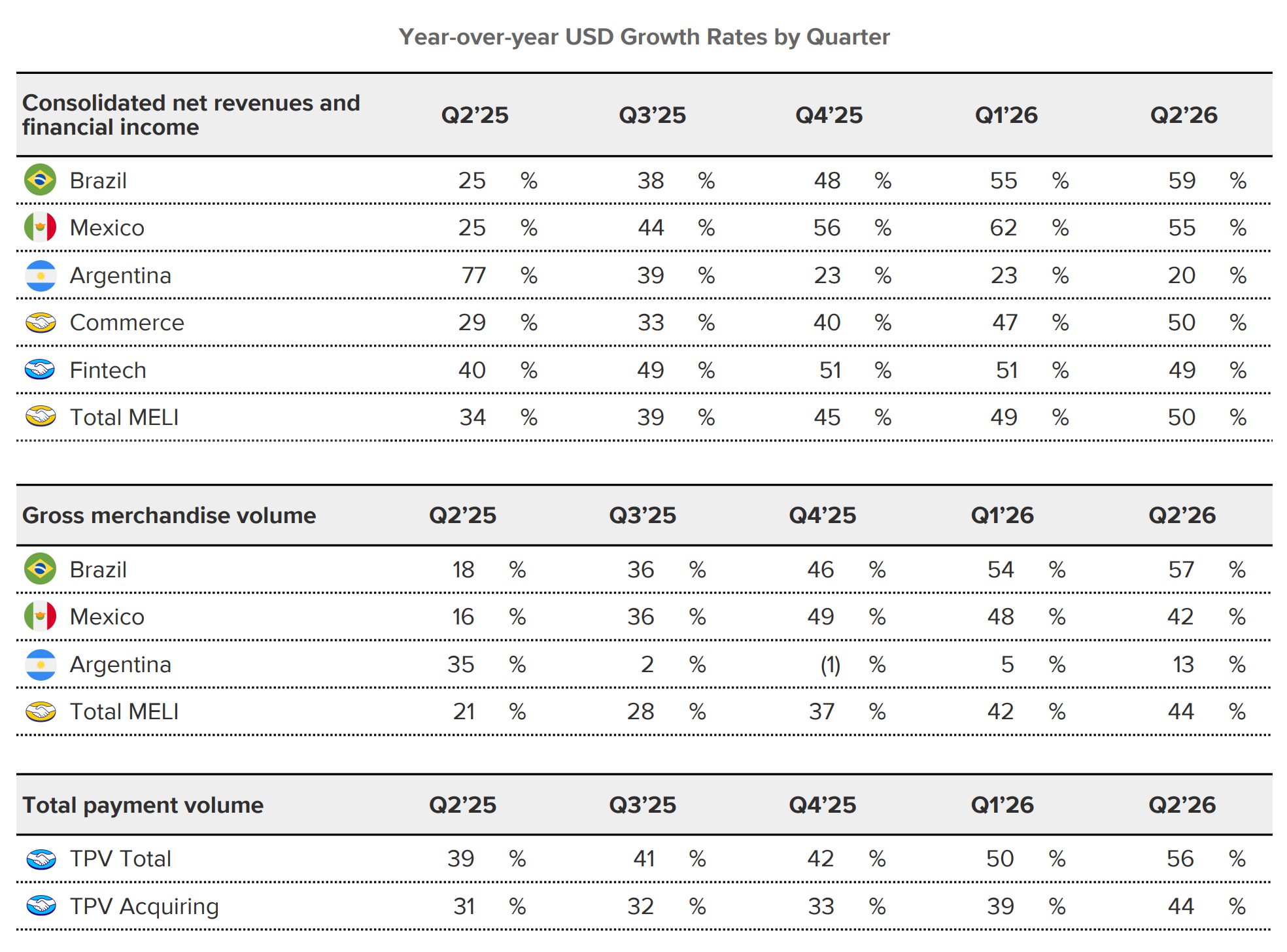
Brazil (54% of revenue) was, once again, the fast grower, with FX-neutral GMV growing 39% and revenue growing 59%. The free shipping threshold cut that management made a year ago appears to have been vindicated: conversion is up 1.1 percentage points YoY, and management described it as a permanent step-change rather than a temporary bump. This matters because it’s direct evidence that the “spend now, harvest later” playbook has already worked once in this exact market.
Mexico (23% of revenue) grew GMV 26% and revenue 38%, both FX-neutral, somewhat muted by a previously flagged tax reform and a softer consumption backdrop during the World Cup. I don’t think this changes the medium-term picture much. Meli continues to take share from both physical retail and incumbent banks, and the POS device lead over the entire domestic banking sector speaks for itself.
Argentina (18% of revenue) is a segment I find interesting precisely because of the macro backdrop it’s operating against. Despite ongoing consumption headwinds and inflation volatility, GMV grew 38% and revenue grew 48%, both FX-neutral, and credit book asset quality has remained pristine. A business that can grow this quickly through a genuinely difficult macro environment, without its credit quality deteriorating, tells you something about the resilience of the underlying demand.
Cross-border trade and the China lifeline round out the picture.
To counter the competitive threat from Asian platforms like Shopee and AliExpress, Meli leaned into its own Chinese fulfillment infrastructure, and volume out of that fulfillment center grew 170% QoQ. CBT GMV grew 60% YoY overall. CEO Ariel Szarfsztejn framed this as a self-reinforcing loop:
“The volume coming from our Chinese fulfillment center is growing 170% quarter-over-quarter... The more supply we get, the more demand we get, and with that demand, our platform becomes more attractive in order to get more supply. Simultaneously, the warehouse in China has enabled us to improve delivery speed [and] reduce cancellation.”
I think this is worth flagging because it’s the one area where Meli is playing defense as much as offense: rather than cede low-cost supply to Asian competitors, they’ve decided to become the on-ramp for it themselves, on their own platform, with their own logistics. That seems like a good way to neutralize a competitive threat rather than simply absorb it.
Risks & Flags
None of the above means this is a story without risk, and I want to be clear about the parts I’d keep an eye on.
Mexico tax and macro softness. The tax reform is a persistent headwind, and management acknowledged that consumption challenges “were a bit deeper in June and July” than earlier in the quarter. This is worth monitoring, though it’s a demand-side issue rather than anything specific to Meli’s execution.
Credit provisioning as an optical drag. The credit portfolio is growing 75% YoY, well ahead of the 50% consolidated revenue growth rate, which means provisions for bad debt will keep weighing on consolidated margins for as long as origination keeps accelerating. Credit quality is still strong today, with 15-90 day NPLs at just 7.0%, historically low levels, but a book growing this fast is also a book that hasn’t been tested by a real macro shock yet. Brazil is the market to watch here, given the size of the card program running through it.
Takeaway
Pulling this together, here’s how I’d summarize what this quarter validated:
The margin compression is a choice to build the moat. Strip out the credit card issuance and POS subsidies and margins would look better overnight, but at the cost of the market share gains that are compounding the ecosystemic flywheel. If Meli stopped spending tomorrow, the P&L would look cleaner and the long-term opportunity would look considerably smaller.
The ecosystemic thesis is playing out in the data, not just in management’s framing. A 37% YoY increase in ecosystemic users, generating 70% more GMV and roughly double the TPV of single-platform users, is the kind of number that’s hard to manufacture through marketing spend alone. It shows the flywheel is turning.
AI is doing real, measurable work on the cost side. AI-driven efficiency is showing up in the numbers. Product Development expenses as a percentage of revenue are already down, and customer service headcount has already shrunk by 30% against a 3x larger business. That’s leverage that shows up whether or not the growth investments above pan out exactly as planned.
The balance sheet gives them room to keep playing this game. A net cash position of $1.84 billion, excluding Fintech debt, on top of 50% revenue growth at this scale, means Meli is reinvesting because the returns on customer acquisition currently look better than the returns on sitting still.
I don’t think the 6.7% EBIT margin tells you much about the health of this business in isolation. What tells you more is watching whether active sellers, items per buyer, ecosystemic user growth, and cohort-level card economics keep moving in the right direction over the next few quarters. If they do, this margin compression will look, in hindsight, exactly like the free shipping threshold cut in Brazil a year ago: a deliberate short-term cost that bought a permanent structural advantage.
Thanks for following,
—Nikotes
Unlock Premium Content – For just $0.39/day ($12/month) or $0.27/day ($100/year)!
🔗 Portfolio Corner - 🗓️ Monthly Updates (Last Update: 28-Jul-2026)
