



Intuitive Surgical reported Q2 2026 earnings yesterday after-hours, and the results were, once again, about as clean as it gets.
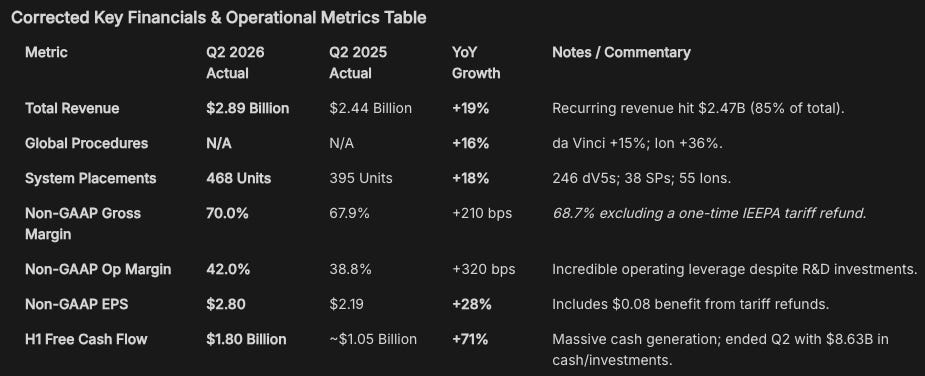
Revenue came in at $2.89 billion (+19% YoY), non-GAAP EPS reached $2.80 (+28% YoY), and procedure volume grew 16%.
The market will inevitably find something to nitpick, it almost always does with ISRG. And yes, there are a few headlines that bears will likely latch onto. If it's not Ion growth decelerating (which I'll address), it's the China commentary, or the negative free cash flow print, or the 2027 instrument revenue drag from the extended-use announcement.
But are they enough to undermine the long-term bull thesis?
Financial Results
The dV5 Upgrade Cycle Story
Of the 267 systems placed in the U.S. during Q2 (up 24% YoY), a substantial portion were trade-ins, i.e. existing customers voluntarily handing back older, functional Xi systems to upgrade to the Da Vinci 5. Intuitive’s CFO explained this on the call:
“If you look at the U.S. placements in Q2, 267 systems relative to the 216 in the year-ago period, almost the entirety of that increase is in trades, it shows the extent to which customers are interested in upgrading... Embedded in that, given how we designed da Vinci 5 structurally, it does give customers incremental capacity, and that’s reflected in how we’ve described the higher utilization of da Vinci 5 versus XI.” — Jamie Samath, CFO
The fact that hospitals are willing to retire functioning assets and absorb the capital expenditure of a new platform tells you something about the perceived clinical and economic value of the dV5.
They wouldn’t do this if the incremental benefits weren’t real. The compute architecture, the Force Feedback instruments, and the higher utilization rates the dV5 delivers are evidently clearing the bar for ROI in the eyes of hospital procurement committees. Management noted that U.S. utilization grew 3% in Q2, with the dV5 yielding meaningfully higher utilization than the Xi. The upgrade cycle is showing up in the capital deployment data now.
The Market Segmentation Strategy
One thing I believe doesn’t get enough credit is how Intuitive is pushing to segment the capital market. While premium health systems are buying the dV5, the company placed 64 refurbished Xi systems (XiR) in Q2, up from just 10 a year ago. And of the 27 placements in U.S. Ambulatory Surgery Centers (ASCs), 20 were XiR. Here’s how management framed their strategy:
“What’s exciting about XiR is it gives us the opportunity to access customers that have not yet invested in robotics, allows them to have their first program, start to get through the learning, see the benefits of it, and becomes then a customer that we can bring to more advanced technology over time.” — Jamie Samath, CFO
This is a classic land-and-expand playbook.
Get cost-conscious ASCs into the da Vinci ecosystem on a refurbished system, let them build procedural volume and clinical competency, and then upsell them to the dV5 over time. XiR is not really a margin-dilutive concession, instead it’s deliberately used as a customer acquisition tool for a segment that would otherwise be out of reach. I think this is underappreciated for the long-term story.
On the Extended-Use Instrument Announcement
Management announced that starting in H1 2027, they will introduce updated EndoWrist instruments with extended useful lives, effectively lowering the per-procedure cost for hospitals.
The stated goal is to drive penetration into high-volume, lower-acuity procedures (benign gynecology, hernia repair) in cost-sensitive markets like international geographies and U.S. ASCs.
CEO Dave Rosa framed it this way:
“By lowering customer cost per procedure, we expect to support broader adoption of da Vinci surgery, particularly in those procedures and geographies where cost constraints may be greater. Ultimately, these efforts help reinforce a virtuous cycle where lower costs support broader adoption, which drives utilization and scale, and in turn enables continued innovation.” — Dave Rosa, CEO
The obvious concern here is the revenue drag. If hospitals are replacing instruments less frequently, the Instrument & Accessory (I&A) revenue per procedure could compress.
I think this concern is legitimate and worth watching, but I would contextualize it. The bet Intuitive is making is that the elasticity of demand, i.e. more procedures per period because the economics are more attractive, will more than offset the lost revenue from slower instrument turnover. Whether that elasticity materializes in the numbers is something we’ll have to track starting in 2027.
This is a volume-over-unit-revenue trade-off, and I think it could be the right long-term move for a company trying to expand its TAM into more cost-constrained settings. Whether the math works out is a different conversation.
The Ion Maturity
Ion procedure growth came in at 36% YoY, which some investors are already framing as a deceleration story. It’s true that Ion procedures grew at triple-digit rates in 2023, but using that as a baseline to express concern about 36% growth is a somewhat misleading comparison. The installed base in the U.S. now exceeds 1000 systems, which means the denominator is simply much larger. The law of large numbers is working against the growth rate, not the underlying demand.
The more interesting story for Ion is what happens next. System placements were essentially flat YoY (55 vs. 54), which does suggest that U.S. capital placement growth for this platform is approaching its ceiling in high-volume centers.
But Intuitive appears to have anticipated this and is executing on two new growth vectors:
international expansion (now in 12 countries)
and deeper utilization of the existing U.S. installed base.
On that second point, U.S. Ion system utilization grew 11% YoY, which tells me that hospitals with the system are funneling more patients through it. Adding ROES (Rapid On-Site Evaluation) and EBUS (Endobronchial Ultrasound) programs to the Ion ecosystem is exactly the right move to further entrench the platform in the lung cancer diagnosis pathway and expand the number of cases that flow through the robot.
The GI Optionality
Perhaps the most underappreciated development this Q was Dave Rosa’s disclosure that Intuitive has submitted a 510k to the FDA for a “foundational non-commercial next-generation flexible robotic endoscope system for use in the gastrointestinal tract.”
“The way I would frame GI is basically a natural extension of our mission to bring better minimally invasive care to more patients... Ion has demonstrated we can develop and commercialize platforms beyond core soft tissue surgery. We’re in a good place to bring the learnings from da Vinci and the learnings from Ion, bring those together and inform our work in the GI tract.” — Dave Rosa, CEO
I am not here to claim that GI is a near-term catalyst, it doesn’t seem likely. This is still early-stage, non-commercial, and will require years of development and clinical validation before it moves the revenue needle. But what it does tell you is that Intuitive’s platform-building ambitions extend well beyond the current product portfolio, and that the company views Ion not just as a product but as a PoC for expanding into new anatomical territories. The GI market is enormous. The option value here is real, even if it’s difficult to quantify today.
Margins Hard to Argue With
A 70.0% non-GAAP gross margin is a geat number for a MedTech company launching a new hardware platform. The natural expectation when ramping a complex, capital-intensive new product like the dV5 is that margins take a hit because of more ramp costs, lower initial ASPs as the platform finds its footing, fixed overhead spread across more new units.
The fact that Intuitive expanded gross margin by over 200 basis points YoY while simultaneously scaling the dV5 speaks to the quality of their supply chain and manufacturing execution. Even stripping out the $36 million tariff refund that landed in Q2, core gross margin of 68.7% still represents a good improvement YoY.
What makes this more interesting is the guidance raise. Management now expects FY26 gross margin of 68.0% to 69.0%, up from the prior range of 67.5% to 68.5%. They’re absorbing known headwinds from freight costs and semiconductor memory pricing and still raising the bar. To me, that reflects ongoing product cost reductions and fixed overhead leverage as volumes scale.
What About the Bear Theses?
There are a few legitimate concerns worth discussing, and I’d rather address them directly.
Leasing now represents 54% of da Vinci placements, and the company deployed $1.95 billion to fund its own lease portfolio. Leasing is a sensible strategic choice for accelerating placements among capital-constrained customers, and it could generate attractive long-term returns, but it is capital-intensive upfront, and that capital intensity will be a recurring feature of the FCF profile as the dV5 ramps. This is worth keeping an eye on.
On China: management confirmed only 2 system placements in the quarter and described the market as “competitive and challenging from a pricing perspective.” The tender centralization the Chinese government is pursuing isn’t being compared to VBP (Value-Based Procurement) by management, they view it as an attempt to reduce duplicate purchasing across provinces, but the practical effect is the same in the near term: limited capital deployment. This is not a new headwind for ISRG, and I don’t think it changes the long-term thesis, but it’s not going away either.
The GLP-1 drag on bariatric procedures is real. U.S. bariatric cases declined in the “high single digits” again this quarter, but this is being offset by double-digit growth in general surgery. Cholecystectomy and hernia procedures are more than filling the gap. And on the ACA subsidy expiration, management flagged a “modest adverse impact” on benign procedure volumes from patients losing coverage as enhanced premium subsidies lapse. Worth acknowledging short-term, not sure what to make of it longer term though as anything can change given its political nature.
Guidance and What It Implies
Intuitive maintained its full-year procedure growth guidance of 13.5%–15.5%, but management noted they now expect to land closer to the midpoint of that range. If I'm being critical, that's a bit underwhelming for a company that trades at a premium and is expected to execute almost flawlessly.
The gross margin upgrade to 68.0%–69.0% is good news and the operating expense growth is expected between 11%–13%, which means operating leverage remains intact.
Put it all together and this quarter validated a number of things about the long-term thesis
The dV5 is generating real clinical and economic pull from existing customers, the trade-in data proves it
Gross margin keep expanding even during a major platform ramp, meaning the manufacturing and supply chain execution is exceptional
Ion’s U.S. capital placement cycle is maturing, but utilization growth and international expansion provide a credible next phase
The XiR strategy seems to be an intelligent way to expand the customer base in cost-sensitive segments without sacrificing the premium positioning of the dV5
The GI submission plants a flag on Intuitive’s next decade of TAM expansion
That said, the quarter wasn't without legitimate concerns:
The GLP-1 headwind on bariatric procedures is real.
Competition in China is becoming increasingly relevant, raising broader questions about how competitors could evolve in the US and other geographies over time.
The shift toward leasing is strategically sensible, particularly for capital-constrained hospitals, and could ultimately generate attractive lifetime economics. However, it is more capital-intensive upfront, meaning free cash flow conversion may remain under pressure as the da Vinci 5 rollout accelerates.
I’ve been following this company for long enough to know that the quarterly noise around procedure growth rates, tariff one-timers, and instrument revenue per procedure will always generate more headlines than the underlying business deserves.
Five years from now, very few investors will care about a single quarter’s guidance if the da Vinci 5 continues expanding the installed base, Ion establishes itself internationally, and margins remain anywhere near today’s levels.
This was another strong quarter from an exceptional business. The more difficult question is whether it’s an exceptional investment.
I understand why many prospective investors hesitate. The business quality is unquestionable, but with the stock forever trading at a premium, there are legitimate questions around future returns, the pace of value creation, and how much of the company’s long-term success is already reflected in the share price.
That’s ultimately where the debate lies, not in the quality of the business, but in the price you’re paying for it.
Thanks for following along,
—Nikotes
Unlock Premium Content – For just $0.39/day ($12/month) or $0.27/day ($100/year)!
🔗 Portfolio Corner - 🗓️ Monthly Updates (Last Update: 25-Jun-2026)
