



HEICO reported Q2 2026 results earlier this week, and once again, the company delivered numbers that should put the “peak aftermarket” crowd on the back foot.
Record net sales of $1.37 billion (+25% YoY),
Record operating income of $350 million (+41% YoY),
Consolidated organic growth of 18%.
Not too bad for a business that a growing cohort of skeptics has been arguing is “over-earning.”
I’ll admit my expectations going into this quarter were not high, perhaps the Iran conflict made me uncomfortable. What we got this Q was something closer to a full-throated validation of the long-term thesis, wrapped inside a beat on virtually every metric that matters.
I’ll spend the bulk of this piece discussing what I think are the most relevant developments, but let me start with what I believe was the most telling moment of the entire call: the 757 comment.
Eric Mendelson, co-president and one of the most candid executives you’ll find on an earnings call, had this to say when analysts raised the recurring “fleet transition risk” concern:
“I heard people say, ‘Oh, 757 is... very important to HEICO.’ Excuse me for saying this, but that is BS. That is just absolute nonsense. There is zero truth to that... The reason why I am more optimistic about the future is because I see all of these [new] products, and I see how expensive they are... We have customers literally begging us to do significantly more.”
I’ll delve into why this matters shortly.
For now, it should tell you something about the state of the bear thesis for HEICO when the loudest argument against the business is that one aging aircraft platform is aging out of service. But I suppose that’s what makes a market.
The quarterly numbers, and why I don’t love obsessing over them
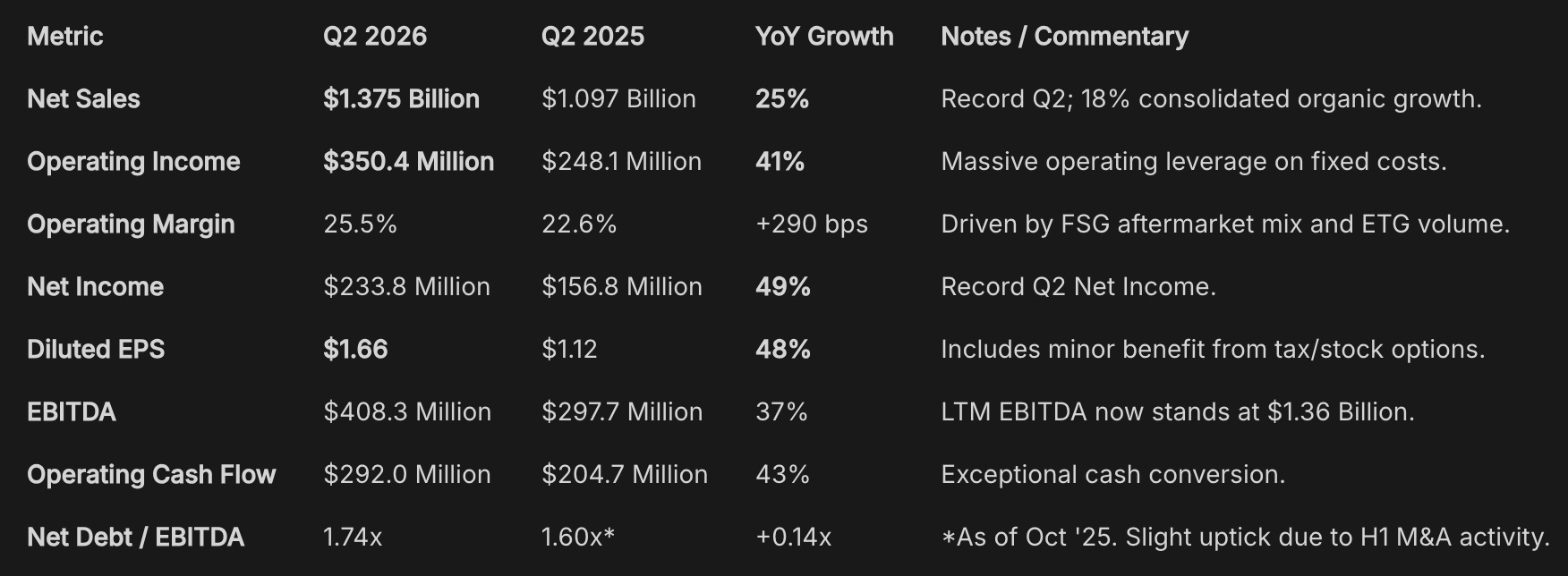
Let me also share the key segment numbers, because they are worth looking at:
Flight Support Group (FSG): Net sales of $929.4M (+21% YoY), organic growth of 19%, operating income of $243.1M (+31% YoY), and operating margins of 26.2%, up 210 basis points YoY.
Electronic Technologies Group (ETG): Net sales of $459.5M (+34% YoY), organic growth of 17%, operating income of $121.8M (+56% YoY), and operating margins of 26.5%, up 370 basis points YoY.
Amazing. 🤯
Now, the ETG number needs some context. Management acknowledged pulling forward approximately $15–20 million of defense sales from H2 at the customer’s request, which added roughly 60 basis points to the margin.
CFO Carlos Macau also reminded investors that ETG is an inherently lumpy business, shipping mix can swing margins in any given quarter, and that the better benchmark is the H1 average of 23.5%. For what it’s worth, even H1 average margins are tracking materially above where this business was operating two years ago, which I think is the more important point.
The reason I don’t love fixating on any given quarter’s numbers here is that HEICO’s value creation story is structural. When a company’s competitive advantage is tied to regulatory certification, engineering know-how, and a deep customer intimacy built over decades, one quarter’s revenue recognition timing tells you very little about where the business is going. What does tell you something is the direction of margins, the composition of revenue growth, and the discipline management applies to capital allocation. On all three, this quarter was excellent.
Why airlines are “clamoring” and what it means
Airlines are, structurally, in an extremely difficult position. Boeing and Airbus are years behind on new aircraft deliveries. Fuel remains expensive. Inflation has eaten into margins on the labor and services side. The practical consequence of all of this is that airlines are flying older aircraft for longer, and they need to maintain those aircraft as cheaply as possible without compromising airworthiness. HEICO’s PMA parts, i.e. reverse-engineered, FAA-approved, and sold at a significant discount to OEM list prices, are the most obvious solution to that problem.
Now, the bear thesis has long been that this dynamic is temporary. The argument goes: once Boeing and Airbus resolve their production backlogs, new aircraft (which come with OEM parts support and warranty coverage) will displace the aging fleet, and the urgent demand for aftermarket MRO solutions will fade. I’ve never found this argument particularly compelling for two reasons.
(1) Fleet transitions take a very long time. Even in an optimistic scenario where Boeing and Airbus normalize delivery rates in the next two to three years, the installed base of older aircraft doesn’t disappear overnight. Airlines order aircraft years in advance, and they don’t retire older planes until the economics clearly favor it. In the meantime, PMA adoption on legacy platforms continues to deepen.
(2) and this is the point Eric Mendelson was making with some visible frustration : new aircraft are not the enemy of PMA. They are the next opportunity. The 737 MAX, the A320neo, the 787: these platforms carry expensive, complex components. The pricing umbrella for HEICO to offer cost-competitive alternatives to airlines is, if anything, wider on next-generation aircraft than it was on the 757. This is not a melting ice cube. It’s a business with a decades-long runway ahead of it.
Management made this point:
“Whenever there’s angst or concern... with regard to commercial aviation, airlines realize they got to get more serious and cut costs. And that always helps us in the long term.”
I would even go as far as to say that the best environment for HEICO is precisely the one we’re in right now: cost-pressured airlines, supply chain stress, and an OEM ecosystem struggling to keep up with demand. Each of these forces independently drives PMA adoption, and right now all three are acting simultaneously.
The Wencor integration and what it means for FSG margins
One thing I think deserves more attention in the context of FSG’s margin trajectory is the Wencor acquisition and what it’s actually doing to the business mix.
Wencor, acquired in late 2023, was historically a distributor of aviation parts, a mix of OEM and PMA. The thesis at acquisition was that HEICO’s ownership would accelerate the conversion of Wencor’s repair volume toward proprietary PMA parts. That thesis is now playing out in the numbers.
When HEICO performs a component repair using its own PMA parts rather than sourcing OEM parts from a third party, two things happen: the cost of goods goes down and the margin goes up. This is not operating leverage in the traditional sense, but a structural mix shift that, as long as PMA penetration continues to deepen, should continue to push FSG margins upward regardless of revenue growth. The 210 basis point YoY margin improvement this Q in FSG reflects this improvement in the quality of the revenue mix.
I’ll note one minor caveat here: FSG’s component repair division grew “only” 10% organically this Q, below the ~20% growth in parts. Management was explicit that this shortfall isn’t a demand problem, it’s a supply chain problem. They have what they described as “massive backlogs” at repair stations but are waiting on third-party inputs to complete certain assemblies. This is worth monitoring. If broader supply chain conditions deteriorate, it could cap near-term revenue realization in the repair segment.
That said, pent-up backlog is not a structural problem. It’s a timing issue and HEICO has the customer relationships and regulatory certifications that mean that demand isn’t going anywhere.
ETG’s margin rebound and what to expect going forward
After a softer Q1, ETG’s operating margin snapped back to 26.5% in Q2. As I mentioned earlier, this included a timing benefit from pulled-forward defense sales. But the underlying story here is straightforward: defense demand is accelerating globally, and HEICO is well-positioned across both legacy programs and what Eric Mendelson called the “new defense tech space.”
Victor Mendelson (Eric’s brother) was also very positive about the multi-year defense tailwind:
“Our country and its allies have recognized the need to invest more in defense and to replace depleted stocks. We are now experiencing this in our defense sales, in our defense orders, and our defense backlog. We expect this to continue and to have a multiyear tail.”
I don’t think there’s much to add to that.
Defense spending cycles tend to be sticky once they begin. NATO allies are rebuilding. Legacy munitions stocks that were drawn down significantly over the past several years need to be replenished. And HEICO, with its exposure to both legacy exquisite programs (PAC-3, Standard Missile) and newer drone and unmanned systems platforms, is well-positioned across the spectrum.
CFO Carlos Macau guided investors to expect ETG GAAP margins to float between 24% and 26% going forward. This is an upward revision from the company’s previous internal conservatism. The rationale is : fixed costs are very low relative to incremental revenue, and volume leverage is powerful as demand grows. I’d take the H1 average as the baseline and model modestly upward from there.
Best-in-class capital allocation separates HEICO from the pack
HEICO completed four acquisitions in H1 2026 (two in FSG, two in ETG) and net leverage sits at a comfortable 1.74x Net Debt/EBITDA. Management described a robust pipeline of acquisition targets and more importantly, they are fully committed to their standards:
“As a rule of thumb, we don’t like to acquire businesses with less than a 20% operating or EBITDA margin... The likelihood of us just buying something that we think will remain sub-20% operating margin in perpetuity... is unlikely for us.”
Preach it, Eric. That’s music to my ears. M. Leonard would be proud.
One of the structural risks in any serial acquirer is that competitive pressure for deals eventually erodes return standards. Private equity’s participation in aerospace and defense MRO has been intense over the past several years, and HEICO faces situations where they are outbid (sounds familiar? 🧙🏻♂️).
Management’s response to this, which Victor Mendelson described as companies being “littered with private equity and other corporate deals where people overpaid and they are significantly underperforming” is to simply walk away.
The “buy and hold forever” philosophy is not just marketing language. It has strategic value when selling to founder-owned or family businesses where cultural continuity and long-term ownership matter to the seller. Many HEICO acquisition targets actively prefer HEICO over a higher PE bid precisely because they don’t want to be integrated, rationalized, and sold off five years later. That preferential deal flow is a competitive advantage, and it compounds over time as HEICO’s reputation grows.
With 1.74x leverage and a business generating substantial and growing free cash flow, HEICO has significant capacity to continue executing on this strategy. I don’t think the M&A engine is anywhere close to running out of fuel.
The Risks
I don’t want this to read as an entirely uncritical take, so let me discuss the things I’m watching.
ETG lumpiness. Management has been consistent about this caveat, and I think investors should take it seriously. Quarterly ETG margins can swing 300–400 basis points depending on shipping mix. The H1 average of 23.5% is the right number to anchor on, not the 26.5% Q2 print. This doesn’t change the long-term trajectory, but it will create periodic “disappointment” quarters that the market may react to.
Component repair supply chain. As noted above, FSG’s repair stations are running hot backlogs, but some completions are gated on third-party inputs. If the supply chain picture worsens, near-term revenue from this sub-segment could be deferred. Given how tight aerospace supply chains remain more broadly, this is a real risk, though one I’d characterize as timing-related rather than structural.
Middle East exposure. Management described this as “relatively small” and noted that the impact of ongoing regional conflict on sales to certain carriers has been offset by rerouting capacity to North American and European customers. Still, it’s worth monitoring. A broader escalation scenario could create incremental headwinds in commercial aviation demand from that region.
None of these risks, in my view, change the fundamental setup. But ignoring them entirely would be intellectually dishonest.
Putting it together
I’ve tried to stay away from the quarterly noise with this company as much as possible and focus on what I believe are the important signals from this earnings release. Let me summarize what I think this quarter validated:
The “peak aftermarket” thesis remains unsubstantiated. Organic growth of 18–19% across the largest segment of the business is not consistent with a demand environment that is topping out. Fleet transition risk is real in theory but misunderstood in practice. HEICO’s opportunity set grows with aircraft complexity, not against it.
The Wencor integration is delivering structurally better FSG margins. The mix shift toward proprietary PMA in the repair stations is not a one-quarter event. It’s a multi-year margin expansion catalyst that should continue as penetration deepens.
Defense is a multi-year tailwind, not a one-quarter bounce. ETG’s order book and backlog trajectory, coupled with management’s explicit commentary on defense spending cycles, suggests this segment will be an increasingly meaningful contributor to consolidated results over the next several years.
Capital allocation discipline is intact. The 20% EBITDA margin hurdle on acquisitions is being maintained in a competitive deal environment. That is not easy to do and speaks to management’s willingness to forgo growth rather than compromise quality.
The valuation is, and always has been, the hardest part of owning HEICO. This is not a cheap stock by any traditional metric. But then again, I’ve written before about how the relevance of the starting multiple diminishes the longer you hold a high-quality compounder and HEICO’s track record of compounding earnings over multi-decade periods is about as clean as it gets in the industrial sector. What the inverse DCF tells you is that the market is already pricing in meaningful continued growth. What this quarter tells you is that the business is growing fast enough to justify that expectation, and arguably doing so from a position of structural strength that is deepening, not weakening.
That’s a setup I’m comfortable with.
Thanks for following along,
—Nikotes
Unlock Premium Content – For just $0.39/day ($12/month) or $0.27/day ($100/year)!
🔗 Portfolio Corner - 🗓️ Monthly Updates (Last Update: 29-May-2026)
