



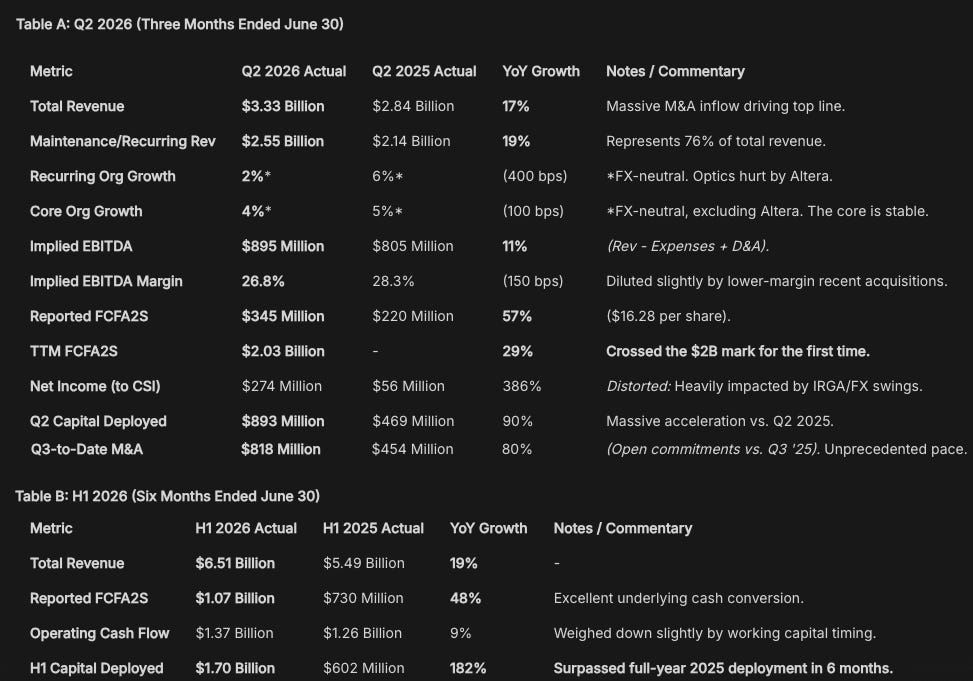
Constellation Software reported Q2 2026 earnings, and if you look at the headline organic growth number, you’d think something had broken. Consolidated FX-neutral recurring organic growth decelerated to 2%, and in a market that’s currently obsessed with whether AI is quietly eating away at the moats of VMS, that’s exactly the kind of number that gets seized on as evidence of “SaaSmageddon.”
I don’t think that’s what’s happening here, and the other side of the story, capital deployment, is entering a completely different gear.
CSU deployed $893 million in Q2 alone, and has already locked in another $818 million in commitments in Q3-to-date. Put together, the H1 2026 deployment of $1.7 billion + $818 millions in commitments already eclipsed the entirety of 2025 (and will likely surpass the 2023 record year).
So, with over $2.5 billion deployed or committed just past the halfway point of the year, the company is comfortably on track to deploy well over $3 billion in 2026. This more or less puts to rest the “Law of Large Numbers” bear thesis that gets trotted out on Constellation every couple of years, the idea that at some point the company simply becomes too large to keep compounding at the pace it always has. The numbers this year say otherwise.
The other headline figure worth sitting with is that TTM FCFA2S crossed $2.0 billion for the first time in the company’s history, up 29% YoY. Generating that kind of cash is one thing. What’s more impressive is that CSU is proving it can immediately redeploy essentially all of it back into the ecosystem at hurdle rates north of 20%. That reinvestment engine, cash generated, cash redeployed at high returns, is the entire Constellation thesis in a nutshell, and it’s running hotter than it ever has.
Financials
The Organic Growth Optics
So why did organic growth decelerate to 2%?
Part of it is simply a tough comp. Q2 2025 was an unusually strong quarter, with FX-neutral recurring growth of 6% vs a historical 2%-4% growth, which makes this year’s print look worse on a YoY basis than the underlying business actually is.
But I won’t be using this as an excuse, the more interesting explanation came from the MD&A first:
On the Altera Organic Growth Impact (Page 16):
Maintenance and other recurring organic growth for CSI excluding Altera was 4% in Q2 2026... For Altera, it was (19%). Consolidated was 2%
And directly from management on the call. Mark Miller and CFO Jamal Baksh walked through the specific culprits dragging the consolidated number down, and none of them have anything to do with AI-driven churn:
Altera is behaving as a “slow shrinker” against what was a tough Q2’25 comp, and I’ll come back to why this doesn’t bother me at all.
Dark Matter and several of Lumine’s recent mega-deals are heavy, unoptimized acquisitions that currently carry negative or flat organic growth profiles simply because they haven’t been restructured yet. Miller specifically flagged that Lumine’s own organic growth in the quarter was just 1%, a drag on the consolidated number, but one management expects to turn around over time.
A known South American customer attrition, a pre-acquisition issue entirely unrelated to AI or competitive pressure.
Miller was quite direct about the math:
"If you look at some recent acquisitions, Lumine is broken out... Their organic growth in the quarter was 1%. Again, a drag on CSI, but things that they're expecting to turn around... If you back out those three, four things [Altera, Dark Matter, Lumine, SA customer], you would normalize back down to that sort of 5% number that we have always trended at." — Mark Miller, President
That’s the number I’d anchor to, not the 2% headline.
So, when you strip out Altera specifically, the core CSI portfolio grew organically at 4% this quarter. That tells you that across hundreds of highly specialized software niches, CSU’s businesses remain sticky and are still compounding organically while requiring next to no incremental capital to do so.
That said, I’d actually push back a little on the framing that Altera should be stripped out of the conversation entirely. Altera isn’t a rounding error or a one-off anomaly to be excused, it’s become an integral part of how CSU thinks about capital deployment. Excluding it makes for a cleaner organic growth number, but it also obscures what’s arguably the more important story this quarter, which I’ll get into next.
On the AI question specifically, Miller’s comments were (refreshingly) boring, and I mean that as a compliment. Rather than positioning AI as a threat or an opportunity to be quantified, he was blunt about what CSU is and isn’t doing:
“What we are not doing is running an AI program out of head office. Our business unit managers understand their verticals far better than we do, and they are making those calls themselves at their own pace, funded out of their own P&Ls... We are not going to give you an AI target, an AI revenue line, or an AI timeline. If we start reporting numbers like that, we will start managing to it.”
CSU is treating AI as a decentralized developer productivity tool, funded locally, with no corporate mandate and no vanity metrics attached to it.
Miller did note that teams are “moving faster through backlogs” using AI tools internally, but he was careful to temper expectations of a near-term organic growth boost from AI-driven product add-ons, since (I believe) selling anything new into a VMS customer still requires that customer to go through its own rigid budgeting cycle.
Some won’t like this (yes... I’m looking at you, Mr. Market), but this is exactly the kind of pragmatism that brought me to CSU as an investor in the first place.
And it’s what I want to keep seeing from a company allocating capital across hundreds of decentralized business units:
No top-down AI narrative.
No urgency to manufacture a growth story.
Just quiet productivity gains where they naturally occur.
The Altera Masterclass
Before diving into the details, I want to give a special shoutout to Adrian on X (tweet below), who did an excellent job dissecting the Altera acquisition and showing how masterfully CSU is milking it.


If you want to understand why Constellation is perfectly comfortable absorbing a drag on its organic growth profile, you need to look at what the company has built around executing complex, Fortune 500-scale carve-outs, and Altera is the clearest example of that competency in action.
Adrian gave some quick deal details: Harris (a CSU operating group) acquired Altera, the Allscripts hospital carve-out, for $670 million back in May 2022. The deal was financed with $335 million in debt ring-fenced at the Altera level, meaning CSU’s actual equity check was only $335 million.
Now look at what that equity check has produced. Despite shrinking organically by 19% this quarter, Altera’s FCFA2S margins have remained remarkably stable, and over the last twelve months the asset generated $104 million in FCFA2S. Generating $104 million in cash on a $335 million equity base implies a 31% return on equity, for an asset that on paper looks like it’s in decline. Zoom out further and the picture gets even better: since the deal closed in May 2022, Altera has generated $400 million in FCFA2S. The asset has already paid for itself, twice over relative to the equity invested, and it keeps generating cash every quarter after that.
(Thanks again, Adrian, for this breakdown).
So, my point is this is precisely why I don’t think Altera should be excused from the organic growth conversation rather than folded into it as a feature of the strategy. CSU management could very easily boost the consolidated organic growth number by simply refusing to buy distressed, shrinking assets like Altera. But doing so would mean leaving big piles of cash on the table. Management is correctly choosing absolute cash generation as long as the hurdle rates are met and I’d argue that’s exactly the trade-off long-term shareholders should want them to make.
There’s also a second-order benefit here that I think gets underappreciated.
"I think that the fact that we've done it with Fortune 500 companies just underlines our ability to do carve-outs appropriately and maintain that customer base as expected... They're generally not very balance sheet driven, right? They're not thinking about their balance sheet... figuring out what that is and getting them to think about managing their working capital is harder than it would be for a standalone business." — Bernie Anzarouth (CIO) & Jamal Baksh (CFO)
CIO Bernie Anzarouth and CFO Jamal Baksh both spoke on the call about how managing these complex, messy carve-outs, ones that typically lack a standalone balance sheet or even basic working capital discipline, is a muscle CSU has spent the last five to ten years building. These carved-out businesses are “generally not very balance sheet driven... figuring out what that is and getting them to think about managing their working capital is harder than it would be for a standalone business.”
Precisely because CSU can now do these carve-outs without breaking the underlying business, it has unlocked an entire tier of capital deployment targets, Fortune 500 divestitures, that were previously harder to execute. That’s a structurally expanded TAM.
(Thank you, Lumine, you showed the way).
Margins: Operating Leverage vs. M&A Dilution
CSU doesn’t report a consolidated EBITDA figure, but we can back into an implied number: Revenue of $3.335 billion, less Operating Expenses of $2.496 billion, plus Depreciation of $56 million, gets you to an implied Q2 EBITDA of $895 million, a 26.8% margin, down about 150 basis points from 28.3% in Q2 2025.
But, as alway with the CSU family, the underlying drivers matter more than the headline compression. Staff expenses (the metric that matter the most) grew 16% YoY, slower than revenue growth of 17%, which on its own shows good operating leverage in the core business. The pressure came instead from Hardware expenses, which spiked 56% YoY, and 3rd-party License and Professional Services costs, which surged 24%. Put those together and the 150 basis point margin compression stops looking like structural deterioration and starts looking like exactly what it is: the mathematical consequence of digesting $1.7 billion worth of unoptimized acquisitions in six months.
As these newly acquired businesses get transitioned onto the CSU playbook, and Altera is a good template for how that plays out over a multi-year horizon, I’d expect margins to inflect back upward.
Unprecedented Capital Allocation
I’ve already touched on the headline deployment numbers, but it’s worth dwelling on the discipline behind them, because that’s usually where these growth-by-acquisition stories eventually break down.
Analysts on the call pushed management on whether the higher multiples paid for premium assets like DerbySoft (some say close to 4x revenues) signaled a loosening of underwriting standards.
The answer, from both Miller and Anzarouth, was an unambiguous no. “Hurdle rates aren’t changing,”
Miller said, and Anzarouth confirmed the IRR expectations on recent deals are in line with acquisitions of similar size historically. CFO Jamal Baksh added the mechanism behind how CSU is bridging any valuation gap on higher-quality assets without compromising returns: “we did use leverage as well, right? Remember that helps us pay a little bit more.”
In other words, CSU isn’t paying up by lowering its return bar, it’s paying up by using prudent leverage at the operating group level, the same structure that made the Altera economics work so well.
CIO Bernie Anzarouth also offered a useful read on the “SaaSmageddon” / Private Market Valuations:
“I think the competition is still very robust. No one is giving up on vertical software, whether it is large or small. We are seeing some weaknesses at the high end in pricing, but it is still very competitive. So it is not like we are increasing our win rates or anything like that. It is same old, try to get as much as we can.”
As mentioned in my Topicus earnings digest, private market software valuations have been softenening lately to a level where CSU’s hurdle rates are now being met across all of its operating groups, which explains a good chunk of the deployment acceleration.
He also noted that the wave of “copycat” PE roll-ups that emerged five to ten years ago to compete with CSU’s playbook are starting to bump up against fund-lifecycle limits, and CSU expects to eventually absorb some of those portfolios as sponsors are forced to exit.
On competitive intensity more broadly, Anzarouth was rather candid, “I think the competition is still very robust... it is not like we are increasing our win rates or anything like that. It is same old, try to get as much as we can.” That’s the language of a company that’s been doing this for two decades and knows exactly what game it’s playing.
What to Watch in H2 2026
A handful of threads from this call are worth tracking as the year progresses rather than drawing conclusions on today:
Verticalization. Miller described a subtle organizational shift toward grouping businesses into verticals rather than strict geographic or legacy operating group lines, putting similar businesses into the “same orbit” without formally integrating them. The stated goal is twofold: let businesses share AI best practices with each other, and position CSU as the “obvious permanent owner” for founders in a given niche who are eventually looking to sell. Worth watching whether this shift meaningfully changes sourcing dynamics over the next few quarters.
Debt utilization. Debt without recourse to CSI increased from $2.64 billion in December 2025 to $2.72 billion in June 2026, as operating groups lean on ring-fenced leverage to fund the $3 billion-plus deployment pace while protecting IRR. This is a similar structure that made Altera’s equity math work, but it’s worth monitoring subsidiary-level interest coverage ratios in H2 to make sure the leverage stays as prudent as management characterizes it.
AI token costs monitoring. CFO Jamal Baksh mentioned that CSU has created dedicated General Ledger accounts to track third-party AI token and compute costs across its decentralized business units. It’s a small operational detail, but it shows management wants to start getting some visibility into whether these costs stay margin-neutral productivity spend or start scaling into something that matters. Worth watching for commentary in H2.
Working capital normalization. H1 2026 operating cash flow was suppressed by an $18 million negative swing in non-cash working capital. Historically, CSU recovers these swings in the back half of the year, so I wouldn’t read much into this as a standalone data point.
Takeaways
Put all of this together and I think the market is set up to misprice this print, at least in the short term:
The 2% headline organic growth number is a function of a tough comp and three or four specific, identifiable drags, Altera, Dark Matter, Lumine’s unoptimized mega-deals, and one unrelated customer loss, not evidence of AI-driven erosion. Normalize for those and you’re back at the ~5% organic growth rate CSU has trended at historically.
Altera’s organic growth drag is not a problem to be solved, it’s the byproduct of a deliberate, extremely profitable strategy. A 31% cash return on equity, on an asset that’s already generated $400 million in FCFA2S against a $335 million equity check, is not something management should be apologizing for.
Crossing $2 billion in TTM FCFA2S for the first time, and immediately reinvesting essentially all of it at 20%-plus hurdle rates, is the entire compounding machine working exactly as intended, just at a larger scale than before.
The margin compression this quarter is a function of digesting acquisitions and should mean-revert as newly acquired businesses get integrated onto the CSU playbook.
2026 is shaping up to be a historic year for capital deployment at Constellation. Between an unrestrained M&A engine, a cash-conversion cycle that keeps getting more efficient, and a core software portfolio that continues to demonstrate real resilience against the AI disruption narrative currently haunting the software sector, I still think Constellation remains one of the premier compounding vehicles in global public markets (and I don't think you ever doubted that I would think this way).
I hope you enjoyed this new series of earnings digests from the CSU family. Topicus and Lumine’s are already published if you haven’t read them yet.
Thanks for following along,
—Nikotes
Unlock Premium Content – For just $0.39/day ($12/month) or $0.27/day ($100/year)!
🔗 Portfolio Corner - 🗓️ Monthly Updates (Last Update: 28-Jul-2026)

Thank you very much for writing this up! Great job.
Good write-up and breakdown!