



Every year, the Constellation Software AGM delivers more actionable insight than most earnings calls combined. This year, however, felt different.
For the first time, the 🧙🏻♂️ himself was missing from his annual appointment with shareholders. While there were only brief remarks about him at the beginning of the meeting, Mark Leonard will be deeply missed; not just as one of the greatest capital allocators and owner-operators of our time, but as a remarkable human being.
If I had to define Leonard after reading and listening to his shareholder letters (yes, there’s even a podcast dedicated to going through them 🎧 Constellation Software President Letters, I’d say he embodied the rare combination of relentless intellectual curiosity, humility, and disciplined leadership. A true scholar of every field he touched, and an inspiration for how to build and lead organizations.
Enough… 🥲
Because despite his absence, one thing didn’t change: in terms of depth, candor, and quality of insights, this AGM was every bit as rich as previous years.
While the broader market spends its time debating terminal value risk, AI disruption, and whether M&A hurdle rates are sustainable, the people running CSU’s portfolio companies were busy talking about something, I would argue, far more important: how you actually build a durable software business from the inside out.
The dominant narrative around CSU in 2026 goes something like this: AI will lower the barriers to writing vertical software, new entrants will flood niche markets that CSU has quietly dominated for decades, and the moat will slowly erode. I understand where this comes from. I also think it fundamentally misunderstands what the moat actually is. More on that later.
Let me walk through what I believe are the most important takeaways from this year’s AGM.
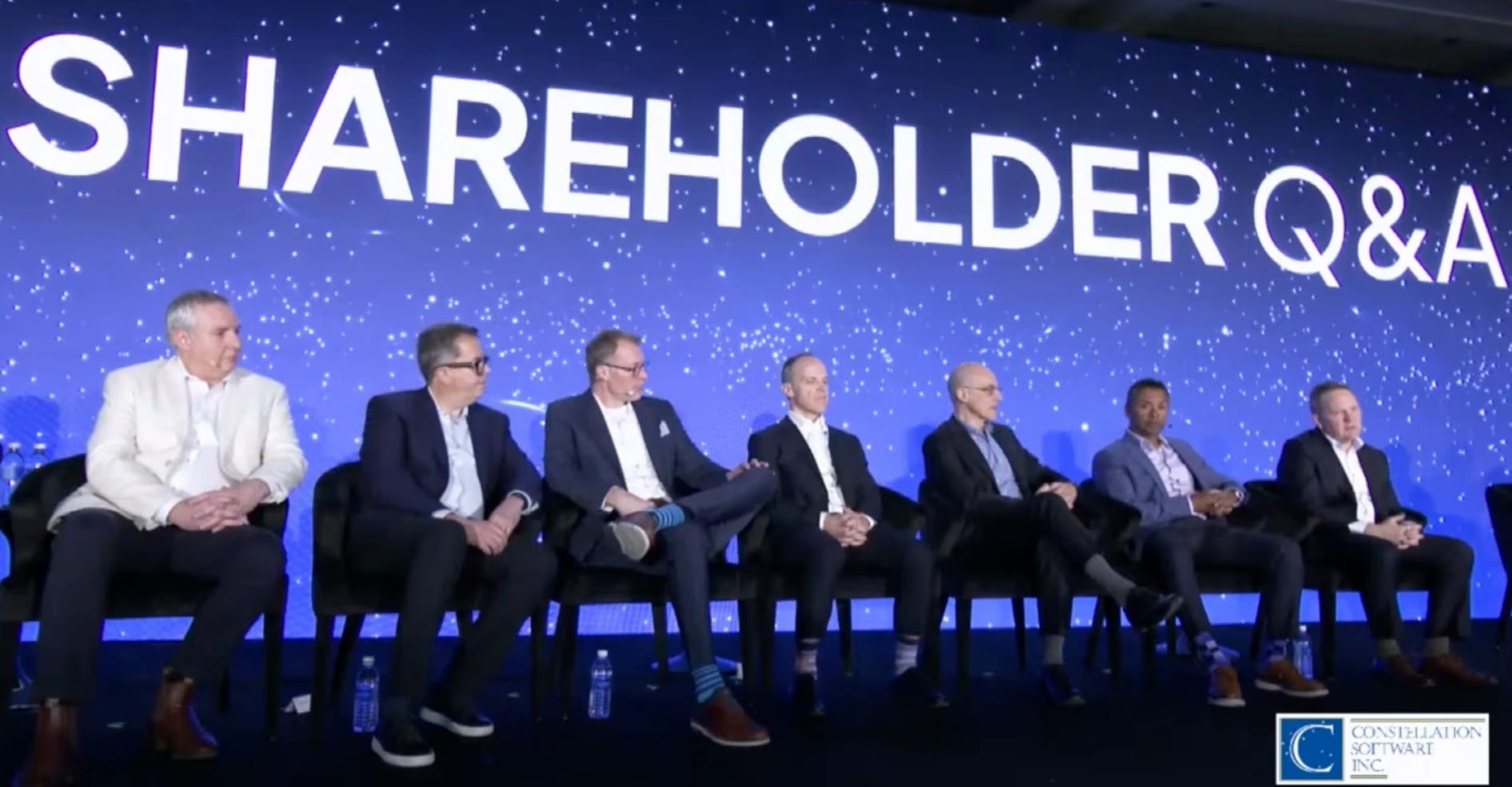
AI Is Doing Exactly What CSU Would Want It to Do
The biggest topic at this year’s AGM was inevitably AI, and I’ll admit my expectations going in were modest. So far, most companies - not named Google (or its big tech peers) or Nvidia - treat their AGM AI commentary as a PR exercise, vague commitments that tell you very little about what’s actually happening on the ground. CSU was, predictably, different.
One of the most concrete examples came from Andrew Jones, GM of ClickDimensions, who detailed what happened when they put a core team off their normal jobs for four days to build an AI support agent. By January 2026, the agent was live. The result: 82% of all Tier 1 support tickets resolved without human intervention. This was not a pilot, it was production.
The thing is the market tends to read “AI resolves support tickets” as a story about cost cuts and potential layoffs. That’s the wrong frame. What Jones described was the opposite: freeing up human engineers to focus on complex Tier 2 and Tier 3 issues, which is where customer intimacy is actually built.
When your best engineers stop spending their days answering the same question for the hundredth time, they start building deeper relationships with the customers whose problems genuinely require human judgment. That’s not cost-cutting. That’s a service quality upgrade with margin benefits as a byproduct. (Note: I was a tech support engineer working for a UK based industrial software company not long ago, so I can really relate to this).
What I found more interesting, and arguably more forward-looking, was the organizational design implication Jones raised. Rather than layering AI tools on top of existing human workflows, CSU business units are beginning to design their departments from an “agentic point of view”, asking how an AI agent would run the function, and then figuring out where humans add value inside that structure. Each AI agent gets a name, a Teams account, and a human manager to keep it on course. That last point sounds trivial, but I think it reflects something important about how CSU thinks: every system, human or otherwise, needs accountability and oversight. The instinct to give an agent a human manager is fundamentally a management philosophy expressed in software design.
David Nyland at Lumine and Bill Delaney at Modaxo echoed a related point on deployment: AI is compressing innovation cycles from months to weeks, and soon to days.
The bottleneck is no longer internal. Large enterprise customers (transit authorities, telecom companies, healthcare systems) still run procurement and security testing cycles that last years. This is not a new problem for CSU, but it does put an interesting spotlight on where the real friction lies. The software ships faster. The customer’s organization changes at the same pace it always has. Closing that gap is now the work.
There were some other interesting points made on AI.
(1) On AI Disruption vs. Customer Trust (The VMS Moat):
“The problem of pace of software development isn’t the challenge anymore... think about this week, we have 300 customers across the globe that use our software. We have a deep level of trust, a warm relationship... we don’t have to go and find them. We don’t have to persuade that we can go and have a meeting with them... from a go-to-market perspective, that’s the ultimate leverage that we have that our competitors don’t.” — David Nyland, CEO of Lumine Group
(2) On AI’s Impact on Jobs and “Cost Cutting”:
“This is about delivering innovation to our customers faster. We don’t have a profitability problem. We’re a profitable, successful company. This is not about cost cutting, but we’ve got to be able to innovate faster... Your job is not getting replaced by AI. But you may be replaced by somebody that uses AI better than you do.”
I’ll leave these here. More on this later.
The “Culture of Cultures” Is Not a Platitude
Mark Miller spent a meaningful portion of his address defending CSU’s decentralized model, and I think it’s worth pausing on why he felt the need to do so.
“I don’t believe in one corporate culture. We believe in a culture of cultures. Even the two companies in the same city in the same country can have two very different cultures. And that’s okay... one of the advantages of joining Constellation is, we’re not here to change your culture. We’ll measure you... but you should determine what your culture is.” — Mark Miller, President
“We’re not a company that [has] a strong central control over what’s done... There’s no CIO who decides what AI platform we use or what we should do... that’s done by our business leaders across the world.” — Mark Miller, President
Listening to this was music to my ears.
The pressure to centralize, to build one IT stack, one HR system, one sales function, is constant at any organization of CSU’s size. The theoretical efficiency gains are real. The problem is that they come with a hidden cost that most companies only discover after the fact: you destroy the customer intimacy that made the business worth scaling in the first place.
Miller’s argument is “we don’t believe in one corporate culture, we believe in a culture of cultures.” So, a decentralized model keeps the people building the product sitting directly across from the customers using it. The moment you separate those two groups, even by a single organizational layer, you introduce a translation problem that compounds over time.
Decentralization is where CSU’s competitive advantage is most durable, precisely because it’s the hardest thing for competitors to copy. A PE-backed roll-up can buy the same customer lists. It cannot replicate decades of domain-specific trust built by business unit leaders who have never been told to move on to the next deal.
This came through clearly in the M&A commentary. When CSU approaches acquisition targets, the pitch is not just financial. It’s a promise of continuity. Employees won’t cycle through three different business cards in the next ten years because a sponsor wants to exit. In highly regulated verticals like healthcare and transit, where customer relationships span decades and switching costs are embedded in institutional workflows, this matters enormously. The “buy and hold forever” philosophy is a sales pitch and a customer retention tool simultaneously.
“We don’t believe in fix or flip. When we talk to a business when it joins us, we believe in buying and holding forever... One of my favorite interview questions for some new person who’s looking for a job is what you do differently if you owned the business for 5 years versus forever. And you do a lot of things differently.” — Mark Miller, President
The mechanism for spreading best practices across a decentralized structure is also worth understanding. CSU doesn’t mandate. It convenes. The 330-person Modaxo summit and the internal AI Hackathons (done throughout this year) serve as peer learning environments where BU leaders absorb what’s working elsewhere and bring it back to their own operations voluntarily.
No corporate memo required. The knowledge compounds organically, which is a very CSU way to run things.
Talent Is the Bottleneck, and the Market Hasn’t Priced That In
“You just don’t scale unless you’ve got an ongoing active talent management process and you’re harvesting talent... That’s really a core competency of compounding this asset class, is just getting the talent where you need it to be, 1 year ahead of when you need it.” — David Nyland, CEO of Lumine Group
“The one thing I tell my people is the only thing that’s going to hold you back because we’ve got such strong growth is if you don’t have somebody ready to take over your role.”
Of all the things said at this AGM, the statement I keep coming back to is this one, and I’m paraphrasing: “The only thing that’s going to hold you back is if you don’t have somebody ready to take over your role.”
CSU is not capital-constrained. The company generates substantial free cash flow, holds a commanding position in its verticals, and has proven it can source and close acquisitions at scale. What CSU cannot manufacture on demand is the next generation of portfolio managers: people who understand the culture, who can operate independently within the decentralized model, and who are ready to lead when opportunity arises.
Every discussion about organic growth came back to this. The pipeline of M&A targets exists. The capital to fund them exists. The question is whether the leadership bench is deep enough to absorb and integrate new businesses without diluting the operational standards that make CSU worth owning. This is a different kind of quality problem than most companies face, and I think it’s actually reassuring in a counterintuitive way: it means the constraint on growth is not external or financial. It is purely internal and, more importantly, it is something management actively knows, tracks, and tries to solve.
The Real Threat Is Not What the Market Thinks It Is
Let me come back to the AI disruption thesis, because I think it deserves a direct rebuttal.
One of the noisier bear cases goes as follows: AI lowers the cost of writing vertical software to near zero, new entrants flood CSU’s niches, and pricing power erodes. This is a coherent argument if you believe that writing code is the hard part of vertical software. The problem is that writing code is not the hard part. Selling software to a risk-averse hospital or a municipal transit authority, passing their security and compliance reviews, integrating with their legacy systems, training their staff, and then earning enough trust that they never switch. That is the hard part. CSU owns the distribution channel and the customer relationship. A new entrant with a cleverly coded product still has to earn what CSU has built over 20+ years of operating in these verticals. AI does not compress that timeline.
“Obviously, the concern is that there are three kids in the garage, who are going to come disrupt our whole business. And my thought was, well, why don’t we go disrupt their whole business? So we got some people together and I say, hey, we’re going to buy all the tools... go forth and innovate.” — Greg Richards, Head of AssetWorks
If anything, the correct reading of the AI evidence from this AGM is the opposite of the bear thesis. CSU is using AI to lower its own internal costs, i.e. faster deployment cycles, automated support resolution, compressed testing timelines, … while simultaneously using the productivity gains to invest more deeply in customer intimacy rather than extracting them as margin.
Here are some useful insights in how CSU leadership defines “mission-critical.”
“If the software stops working, the business should pull out a piece of paper and hand write things down and keep going... If you think of it that way, that’s the ultimate mission criticality.”
“One of the key indicators is obviously attrition rates, right? So when you’re in this end of the spectrum [mission-critical], you tend to have very low attrition rates... I was talking at dinner last night to one of the Harris folks, and they have a couple of businesses with 0% attrition. I’ve never seen that. I’m just jealous.”
The test is simple: if the software stops working, does the customer go out of business? Attrition rates are the empirical answer to that question. High-attrition software gets priced accordingly or passed on entirely. What remains in the portfolio is software that the customer cannot afford to replace, regardless of what a new entrant is offering. The switching cost is not the product. The switching cost is institutional memory, regulatory compliance, and operational dependence built over decades.
Verticalization & Specialization: The Modaxo and Lumine “Umbrella” Is More Important Than It Looks
One detail that didn’t get enough attention in the notes: Bill Delaney’s explanation of why Modaxo (transportation and mobility division at CSU) exists as a named entity above its 41 constituent transit software businesses.
The answer is marketing leverage. By grouping under the Modaxo brand, portfolio companies that could never individually afford a platinum sponsorship at the UITP Expo in Hamburg (one of the most important global events in public transit) now get to show up as a platinum sponsor. The halo effect reaches 41 companies that would otherwise be invisible at industry level. This drives M&A lead generation in a business where finding proprietary deal flow is one of the primary determinants of return.
David Nyland made a similar point about Lumine’s reputation in corporate carve-outs. These deals are messy : “dysfunctional sellers”, complex transitions, regulatory entanglements. Because Lumine has proven it can execute (WideOrbit and Synchronoss being two cited examples), large telecom companies now bring deals directly to them, prioritizing execution certainty over squeezing the last dollar of valuation from the process. That is an earned competitive advantage in deal sourcing that cannot be replicated by throwing capital at the problem.
Verticalisation and specialisation are increasingly becoming key levers that CSU management is pulling to drive both deal flow and customer trust. And it’s no secret, Mark Miller has been quite vocal about this strategy, not only during this AGM but across previous conference calls as well.
The rationale is straightforward: deeper industry expertise improves acquisition sourcing, strengthens customer relationships, and enhances the value proposition for software businesses looking for a long-term home. As CSU grows larger, specialization may prove to be one of the most important tools for sustaining its acquisition engine and competitive advantage.
What the 2026 AGM Confirms About the Long-Term Thesis
To summarize what I believe this AGM validated:
AI, more a tailwind than a headwind. It lowers internal costs, compresses deployment cycles, and improves customer service quality. It does not erode the moat, because the moat was never the code, it was the customer relationship and institutional trust.
Decentralization is durable. The “culture of cultures” is not a feel-good principle. It is the mechanism by which CSU maintains customer intimacy at scale without the organizational rot that typically accompanies growth. This is genuinely hard to copy.
The talent constraint is the right constraint to have. Being capital-constrained is a problem. Being talent-constrained means you have more opportunity than people to pursue it. That is a very different kind of quality problem.
Verticalization and specialization (e.g. Modaxo, Lumine) creates durable sourcing advantages. The brand halo, conference sponsorship leverage, and earned reputation in complex carve-outs compound over time into proprietary deal flow. This remains an underappreciated aspect of the CSU playbook and is becoming an increasingly important lever for driving both deal flow and customer trust. As the company scales, deep vertical expertise may prove to be one of its most valuable competitive advantages.
The bear thesis misidentifies the moat. The risk to CSU is not that someone writes better code. The risk is that the company fails to develop the next generation of portfolio leaders fast enough to absorb the opportunity in front of it. That is a knowable, manageable risk and management is clearly aware of it.
I remain of the view that CSU is one of the more fundamentally unique assets available in public markets.
The decentralized structure, the ROIC discipline, and the pragmatic approach to AI confirm that the compounding engine is evolving in exactly the right direction.
Thanks for following along,
—Nikotes
Unlock Premium Content – For just $0.39/day ($12/month) or $0.27/day ($100/year)!
🔗 Portfolio Corner - 🗓️ Monthly Updates (Last Update: 3-May-2026)

Good article.
Thanks for sharing
Great summary. You’ll have to come to our CSU dinner next year!